


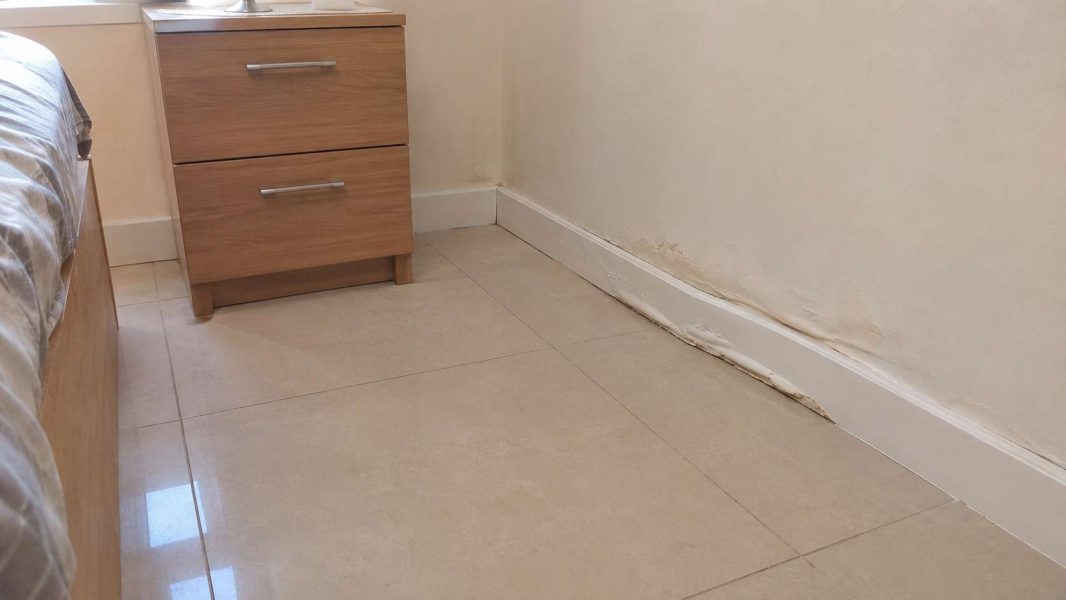
What Causes Swollen Skirting Boards?
Swollen skirting boards develop when moisture penetrates their material, particularly around exposed edges, joints, and damaged coatings. Identifying the source matters because replacing the skirting without correcting the moisture problem often leads to repeated damage.
Why MDF Skirting Boards Swell
MDF is manufactured by combining wood fibres with adhesives and compressing them into dense panels.
Although this produces a smooth, affordable material suitable for decorative profiles, the wood fibres remain sensitive to moisture.
When MDF absorbs water, its fibres expand. The board may increase in thickness, become uneven, or develop a raised, fluffy surface.
Research published in Materials and Structures examined microscopic changes in MDF during moisture exposure. The researchers observed that bundles of wood fibres played an important role in the swelling process.
Unlike ordinary solid wood, compressed fibreboard may not return to its original dimensions after significant swelling.
This explains why drying an MDF skirting board does not necessarily restore its original appearance or strength.
Common Sources of Moisture
Several household conditions can cause repeated swelling:
-
Floor washing: Frequent wet mopping allows water to enter unsealed bottom edges.
-
Plumbing leaks: Leaking pipes or nearby fixtures can wet the wall-floor junction.
-
Air-conditioning condensation: Condensation from cold pipes or poorly managed drainage can dampen adjacent materials.
-
Bathroom moisture: Repeated splashes and water escaping beneath doors can affect nearby skirting.
-
Poorly sealed joints: Exposed MDF ends, nail holes, and damaged paint provide entry points for moisture.
-
Water intrusion: Moisture entering through walls or floor assemblies can reach the back of the skirting.
The location of the swelling often provides clues. Damage concentrated near a sink may suggest plumbing problems, while swelling along several regularly washed walls may indicate repeated floor-level moisture exposure.
Can Swollen Skirting Boards Cause Mold?
Swollen skirting boards do not directly create mold, but the moisture responsible for swelling can also support fungal growth.
MDF contains wood-derived organic material. When it remains damp, its surface and internal structure may provide conditions suitable for mold development.
The U.S. Environmental Protection Agency (EPA) recommends drying water-damaged materials within 24–48 hours to help prevent mold growth.
This period is a general prevention guideline, not a guarantee that mold will appear after a specific number of hours.
Warning Signs Behind the Skirting
Mold may develop on the rear surface of skirting boards or on the adjacent wall before becoming visible from the room.
Signs worth investigating include:
-
Persistent musty odors near the floor.
-
Irregular grey, greenish, or dark spotting.
-
Peeling paint or recurring wall stains.
-
Dampness that returns after cleaning.
-
Softened MDF or deteriorating material behind the board.
Swelling alone does not confirm mold. However, these additional signs may indicate that moisture has affected concealed surfaces.
Painting over suspicious discoloration does not address the moisture source.
The EPA advises cleaning mold-affected surfaces and correcting water problems before repainting.
Prolonged dampness also matters for indoor air quality. Mold exposure may contribute to allergic reactions or respiratory symptoms in susceptible individuals, although visible damage cannot establish an individual’s health risk.
How to Fix Swollen Skirting Boards Yourself
Minor skirting-board damage may be manageable without professional remediation when the moisture source is known, the material remains firm, and there is no indication of extensive mold contamination.
The priority is to dry the area before attempting cosmetic repairs.
Step 1: Find and Stop the Moisture
Inspect nearby plumbing, floor edges, bathroom connections, and air-conditioning drainage.
If a leak is present, repair it before continuing.
Check whether the adjacent wall or flooring remains damp. A moisture meter suitable for the material may help identify differences between affected and unaffected areas.
Do not assume that dry paint means the material beneath is dry.
Step 2: Dry the Affected Area
Remove standing water and improve ventilation.
For an area without suspected mold, a household fan may support evaporation. A dehumidifier can help reduce indoor humidity.
Avoid directing hot air from a heat gun onto MDF. Excessive heat can damage finishes and does not reliably remove concealed moisture.
Allow adequate drying before evaluating whether the board can be repaired.
Step 3: Repair Minor Surface Damage
If the MDF is completely dry, structurally sound, and only slightly roughened, a limited cosmetic repair may be possible.
Carefully smooth small raised areas using fine sandpaper, provided there is no suspected mold or significant deterioration.
Apply an appropriate wood filler if needed, then use a compatible primer and protective finish.
Seal exposed edges and joints according to the finishing product’s instructions.
These repairs improve appearance but cannot reliably reverse substantial internal swelling.
Step 4: Monitor for Recurrence
Inspect the repaired section after normal cleaning and bathroom use.
If swelling returns, reconsider the moisture source rather than repeatedly applying filler or paint.
Avoid sealing an actively damp wall-floor joint, as this may conceal continued moisture accumulation.
When Should You Replace Swollen Skirting Boards?
Replacement is usually more sensible when swelling has permanently changed the board’s shape, weakened its structure, or affected a substantial section.
Consider replacing skirting when:
-
The MDF remains thickened or distorted after drying.
-
The surface crumbles or separates into fibres.
-
The board has become soft or unstable.
-
Mold contamination is suspected within porous material.
-
Multiple repairs have failed.
-
Swelling repeatedly returns in the same location.
The EPA explains that porous materials affected by mold can be difficult to clean completely because growth may extend into their internal spaces.
However, do not remove extensively contaminated boards without assessing exposure risks. Disturbing mold-affected materials may release particles into the surrounding room.
Replacement should follow correction of the underlying moisture problem and appropriate assessment of adjacent wall and floor materials.
Best Replacement Materials for Humid Areas
Choosing a more moisture-resistant skirting material can help prevent recurring swelling, especially around bathrooms, kitchens, and frequently cleaned floors.
However, material resistance and installation details both influence long-term durability.
| Material | Moisture Performance | Main Consideration |
|---|---|---|
| PVC or polymer skirting | Highly water-resistant, depending on formulation | Suitable for frequently damp areas |
| Aluminium profiles | Resistant to moisture-related swelling | Finish and corrosion resistance matter |
| Stainless steel profiles | Good corrosion resistance with an appropriate grade | Usually more expensive |
| Moisture-resistant MDF | Better resistance than standard MDF | Not waterproof |
| Treated solid wood | Performance depends on treatment and sealing | Requires ongoing maintenance |
PVC and Waterproof Polymer Skirting
Polymer skirting offers an alternative for homeowners frustrated by repeatedly swollen MDF.
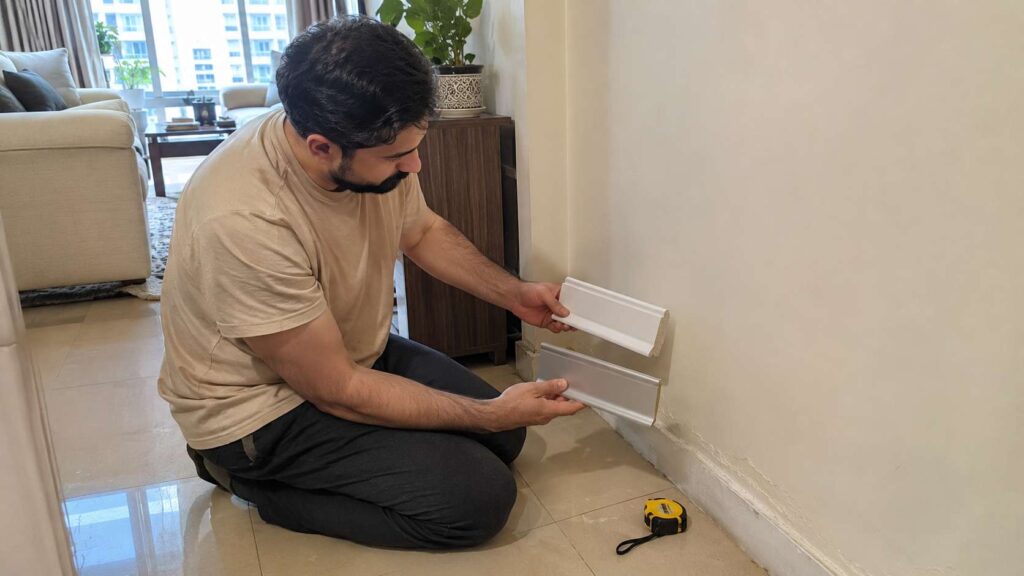
Products such as VOX Espumo skirting boards use engineered polymer materials designed to resist moisture absorption.
Manufacturer VOX states that its Espumo collection does not absorb water and can be used in bathrooms and hallways.
These properties make polymer skirting worth considering for moisture-prone rooms.
However, water-resistant skirting does not waterproof the wall behind it. Installation gaps, junctions, and concealed leaks still require attention.
Aluminium and Stainless Steel Skirting
Metal skirting profiles are another option for contemporary interiors.
Aluminium does not swell like MDF and provides a slim decorative finish. Select a profile and surface treatment suitable for the expected moisture conditions.
Stainless steel is also suitable for certain wet environments, although corrosion resistance depends on the alloy grade, exposure, and maintenance.
For either material, check the manufacturer’s installation requirements, particularly where profiles meet wet floors or dissimilar metals.
Moisture-Resistant MDF and Treated Wood
Moisture-resistant MDF is formulated to perform better than ordinary MDF in humid conditions.
For example, Kronospan identifies skirting boards and architectural trim as applications for its moisture-resistant MDF products.
Nevertheless, moisture-resistant does not mean waterproof. Direct or prolonged water exposure may still cause damage.
Treated solid wood provides another decorative option, particularly when natural grain is important.
Proper sealing, protected end grain, and ongoing maintenance remain necessary.
For repeatedly wet areas, polymer or appropriately specified metal skirting may be a more practical long-term choice.
When Is Professional Mold Remediation Necessary?
Professional mold remediation becomes important when swollen skirting boards are accompanied by extensive suspected mold growth, concealed moisture, or repeated contamination.
A professional assessment may help determine whether the problem affects only the decorative board or extends into the adjacent wall, insulation, or flooring.
This distinction matters because installing waterproof skirting over damp, contaminated materials does not resolve the underlying problem.
The EPA recommends considering professional assistance for substantial mold contamination, extensive water damage, or contaminated water incidents.
A qualified remediation provider should investigate moisture sources, assess affected materials, manage contamination appropriately, and explain any necessary removal or drying work.
Bio-On provides mold remediation services in the UAE for property owners dealing with mold contamination.
For isolated cosmetic swelling without mold or concealed moisture, professional remediation may not be necessary. A suitable repair or straightforward skirting replacement may be sufficient.
The Bottom Line
Swollen skirting boards are primarily a moisture problem, particularly when made from MDF. Their compressed wood fibres can expand after water exposure, leaving permanent distortion. Minor surface damage may be repairable, but deteriorated boards often require replacement. PVC, polymer, and suitable metal profiles can provide greater resistance to repeated moisture exposure.
Before choosing replacement skirting, establish why the original material became wet. Repair leaks, control condensation, and check for concealed dampness or suspected mold. If the problem repeatedly returns or contamination extends behind the skirting, professional assessment can help prevent another unsuccessful repair.