


What Is an Air Purifier?
An air purifier is a device that pulls room air through filters or cleaning technology, then pushes cleaner air back into the space. Its main job is to reduce airborne particles.
A good air purifier can help capture:
- Mold spores
- Dust
- Pollen
- Pet dander
- Some smoke particles
- Fine airborne debris
- Some odor particles, if it has activated carbon
For mold concerns, the most important feature is usually a true HEPA filter. HEPA filters are designed to capture very small particles, including many mold spores and fragments. This does not mean the purifier “kills” the mold. It means the purifier traps spores in the filter so fewer of them continue floating around the room.
Some purifiers also include UV-C light, ionizers, plasma technology, or antimicrobial coatings. Be careful with these claims. They may sound impressive, but the filter quality, room size match, clean air delivery rate, and maintenance matter more for most homes.
An air purifier helps most when mold spores are already in the air because of damp surfaces, dusty AC airflow, hidden mold, or poor ventilation. But it does not solve the root cause. If mold is growing behind your wardrobe, around your AC vent, or inside a damp wall, the purifier may reduce airborne particles but the mold colony is still there.
Think of it like this: an air purifier can clean some of the “smoke,” but it does not put out the “fire.”
What Is a Humidifier?
A humidifier is a device that adds moisture to indoor air. People usually use it when the air feels too dry, especially when they have dry throat, dry skin, dry nose, irritation, or discomfort from air-conditioning or heating.
Humidifiers come in different types:
- Cool mist humidifiers
- Warm mist humidifiers
- Ultrasonic humidifiers
- Evaporative humidifiers
- Central humidifier systems
A humidifier may be useful in a dry room, but it is not a mold-spore solution. It does not filter mold spores from the air. It does not remove mold from surfaces. It does not stop mold from growing. If anything, too much humidifier use can create the damp conditions mold needs.
This is especially important in humid climates or heavily air-conditioned homes. Some rooms may feel dry because of AC, but still have hidden moisture problems around vents, windows, walls, closets, or bathrooms. Adding more humidity without measuring the room can be risky.
If a humidifier is not cleaned properly, it can also become part of the problem. The tank, nozzle, and internal parts can develop microbial buildup. Then the device may release unpleasant smells or particles into the room.
So, a humidifier is not bad. It just has a very different purpose. It helps with dry air comfort, not mold control.
Purifier vs Humidifier: Key Differences
The biggest difference is simple: an air purifier removes particles from the air, while a humidifier adds moisture to the air.
Here’s the comparison:
| Feature | Air purifier | Humidifier |
|---|---|---|
| Main purpose | Cleans airborne particles | Adds moisture |
| Helps with mold spores? | Yes, if it has HEPA filtration | No |
| Kills mold growth? | No | No |
| Can make mold worse? | Usually no, unless poorly maintained | Yes, if humidity gets too high |
| Best for | Spores, dust, pollen, allergens | Dry air, dry nose, dry throat |
| Needs maintenance? | Filter replacement | Tank cleaning and water changes |
| Mold-control role | Exposure reduction | Humidity comfort only |
| Best room condition | Any room with airborne particles | Only rooms with low humidity |
For mold, this matters a lot. Mold grows when there is enough moisture. If your indoor humidity is already high, using a humidifier can make walls, fabrics, carpets, and closets more favorable for mold. That is why a humidifier should never be used blindly in a musty room.
An air purifier, on the other hand, can be useful if you are dealing with airborne mold spores. But it still needs proper filter changes. If the filter becomes overloaded and neglected, the purifier becomes less effective.
Which One Kills Mold Spores in the Air Better?
Strictly speaking, neither a normal air purifier nor a humidifier should be described as the perfect tool to “kill” mold spores in indoor air.
A humidifier does not kill mold spores. It adds moisture. If used carelessly, it may support mold growth.
An air purifier can reduce mold spores in the air, especially if it uses a true HEPA filter. Some purifiers with UV-C or other technologies claim to deactivate microbes, but you should not rely only on those claims. The most reliable benefit is filtration: pulling spores out of the air and trapping them.
So, if we use everyday language, people may say an air purifier “kills mold spores,” but the more accurate explanation is this: a purifier helps remove airborne mold spores from circulation.
That can be helpful if:
- You smell musty air
- You have allergies or asthma
- Mold was recently disturbed
- Your AC blows dusty air
- You are waiting for professional cleaning
- A room has poor ventilation
- There is visible mold nearby
- You want to reduce airborne particles after cleanup
But there is one big limitation. Mold spores keep coming back if the source stays active. If a damp wall is growing mold, the purifier is constantly fighting new spores and fragments. If an AC vent has mildew buildup, the fan may keep pushing particles into the room.
That is why the best mold-control setup is not purifier vs humidifier alone. It is:
- Remove the mold source.
- Fix the moisture source.
- Clean settled dust.
- Control humidity.
- Use a HEPA air purifier as support.
When a Humidifier Can Make Mold Worse
A humidifier can make mold worse when it raises indoor humidity too high or keeps nearby surfaces damp. Mold loves moisture. If the room already feels musty, smells damp, has condensation, or has black spots on walls or vents, a humidifier is usually the wrong tool.
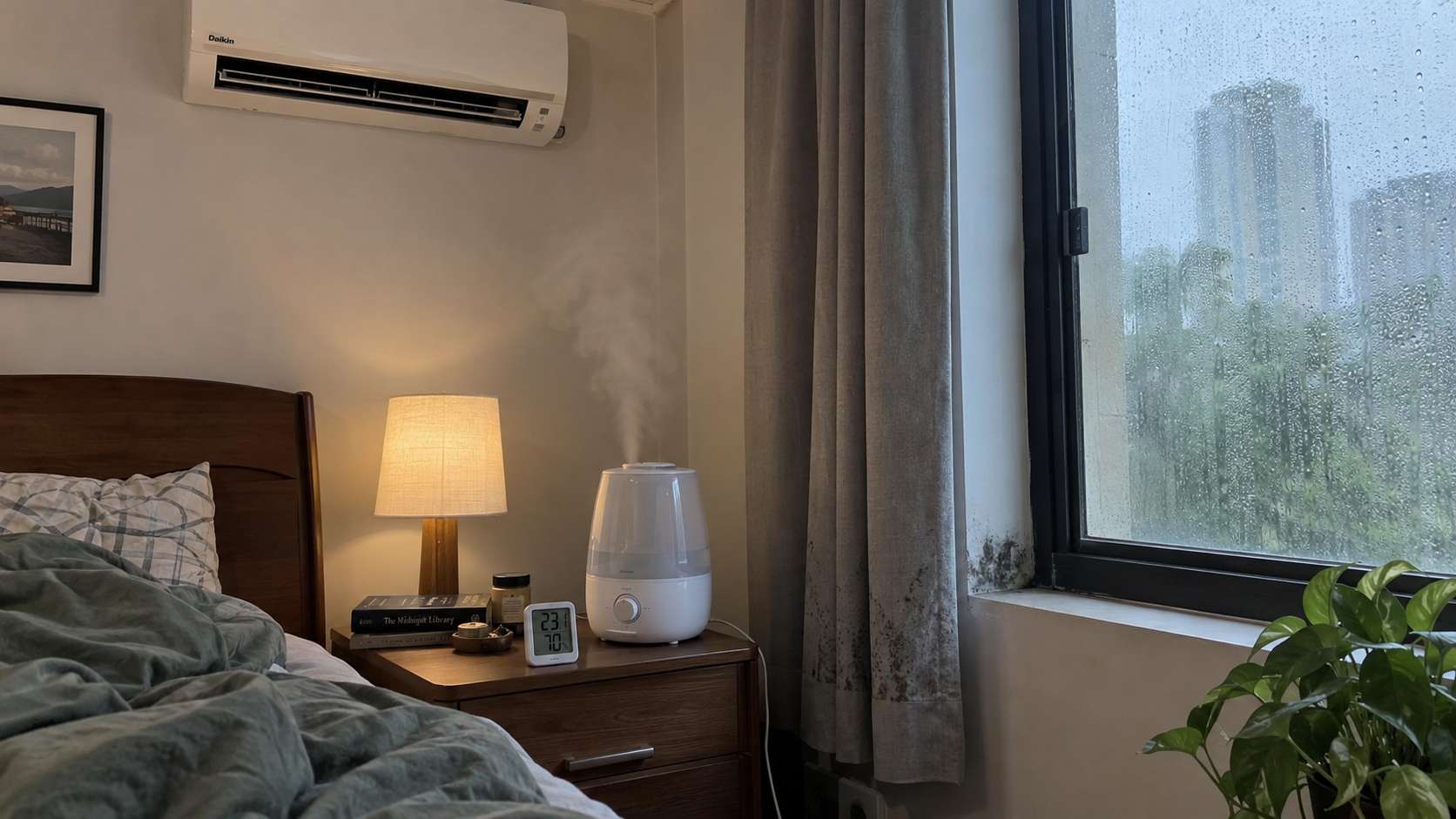
Be extra careful if you notice:
- Condensation on windows
- Damp smell in the bedroom
- Mold inside wardrobes
- Black spots near AC vents
- Wet walls or ceiling stains
- Musty bedding or pillows
- Clothes smelling stale in the closet
- Bathroom mold returning quickly
- Humidity feeling heavy or sticky
In these cases, you probably need less moisture, not more. A dehumidifier may be more helpful than a humidifier.
This is a common mistake. Someone feels dry throat from AC and buys a humidifier. But the room also has poor airflow and a slightly damp wall behind the bed. The humidifier makes the person feel better for a few nights, but mold slowly gets worse behind furniture or inside the closet.
That is why you should use a humidity meter. It is cheap and very useful. Don’t guess. Measure.
For general comfort, many homes aim for indoor humidity around the middle range, not too dry and not too damp. If your room is already humid, do not add more moisture.
10 Tips for a Smart Decision
Choosing between a purifier and a humidifier is easier when you look at your actual problem, not just the product category.
1. Check if the room smells musty
If the room smells musty, choose investigation first. A purifier may help the air, but a humidifier may make the source worse.
2. Look for visible mold
If you see mold on walls, ceilings, curtains, AC vents, grout, or furniture, do not rely on either device. The mold needs to be removed.
3. Measure humidity
Buy a small humidity meter. If humidity is high, avoid humidifiers. Consider a dehumidifier instead.
4. Choose HEPA for mold spores
If you buy an air purifier for mold concerns, look for a true HEPA filter. This is more important than fancy marketing words.
5. Match purifier size to the room
A tiny purifier in a large bedroom will disappoint you. Check the recommended room size and clean air delivery rate.
6. Don’t ignore AC vents
If moldy smell comes when the AC turns on, the AC system may be the source. A purifier can help, but the vent or duct issue still needs cleaning.
7. Clean or replace filters on time
A purifier only works well when the filter is maintained. Old filters reduce performance.
8. Clean humidifiers often
If you use a humidifier, empty it daily, clean it regularly, and avoid letting water sit inside.
9. Don’t use a humidifier in a damp closet room
If clothes, shoes, or wardrobes smell musty, adding humidity is a bad idea.
10. Fix the source before buying devices
Devices help with air conditions. They do not repair leaks, dry wet drywall, remove mold colonies, or fix condensation problems.

What If You Already Have Mold Indoors?
If you already have mold indoors, the best first step is not choosing between purifier vs humidifier. The best first step is finding why mold is growing.
Ask yourself:
- Is there a leak?
- Is the AC creating condensation?
- Is the bathroom poorly ventilated?
- Is the wardrobe against a damp wall?
- Is humidity too high?
- Did a flood, spill, or wet carpet happen?
- Is mold coming from the ceiling or wall cavity?
For small mold on hard surfaces, cleaning may be possible with suitable cleaners, gloves, ventilation, and proper drying. For mold on porous materials like drywall, ceiling tiles, insulation, carpet backing, or fabric, cleaning is harder. If mold has grown into the material, removal may be needed.
After cleanup, an air purifier can help reduce airborne spores and dust. But again, it is support, not the main solution.
A humidifier should only be used if your room is genuinely too dry and mold is not active. If you are unsure, measure humidity first.
The Bottom Line
Between purifier vs humidifier, the better choice for mold spores is usually an air purifier with a true HEPA filter. It can help capture airborne mold spores, dust, and allergens, making the indoor air feel cleaner and safer for sensitive people.
A humidifier is not the right tool for mold spores. It does not filter them, remove them, or kill them. It adds moisture, which may actually make mold worse if your room is already humid or has hidden dampness.
So, here’s the final decision: get an air purifier if your goal is to reduce airborne mold spores. Get a humidifier only if your indoor air is genuinely too dry and you have confirmed the room is not already damp. And if you see mold, smell mustiness, or have recurring black spots, fix the moisture source and remove the mold first. No device can replace that.