


What Pink Mold on Humidifier Really Means
Pink mold on humidifier surfaces usually means microbial growth has developed in the water tank, base, cap, mist outlet, filter, float, gasket, or small crevices. It may appear as pink dots, reddish slime, orange film, or soft residue around areas that stay wet.
Most people call it mold because it grows in a damp appliance and looks unpleasant. But if the residue is pink, smooth, and slimy, it is often not true mold. It is commonly a bacterial biofilm. A biofilm is a sticky layer where microorganisms attach to a wet surface and protect themselves inside slime.
CDC explains that germs such as bacteria, fungi, or amebas can live together in biofilm, and when a device that uses water is turned on, germs growing in that slime layer can come out of the device. CDC specifically includes humidifiers as one example of devices where this can happen.
This is why pink residue inside a humidifier matters more than pink residue on a random bathroom corner. A humidifier is designed to create mist. If the tank or base is dirty, the appliance may spread tiny droplets containing minerals, residue, bacteria, mold fragments, or other contaminants into the room.
The pink spots may not always mean immediate danger, but they do mean the humidifier is not clean enough to use safely.
Are the Pinkish Spots in Your Humidifier Dangerous?
Pinkish spots in your humidifier can be risky, especially if you keep running the unit without cleaning it. For many healthy adults, a small amount of pink biofilm may not cause obvious illness. But it is still not something you want to breathe through mist every night.
The risk is higher for babies, elderly people, people with asthma, people with allergies, and anyone with weakened immunity or chronic lung conditions. Dirty humidifiers can release microorganisms into indoor air. EPA states that proper care and cleaning of ultrasonic and impeller humidifiers are important for reducing potential exposure to microorganisms such as bacteria and molds.
Possible reactions may include:
- stuffy nose;
- sneezing;
- coughing;
- throat irritation;
- chest tightness;
- worsening asthma symptoms;
- musty smell in the room;
- eye or sinus irritation;
- general discomfort after using the humidifier.
These symptoms do not prove the pink residue is the only cause. Dust, fragrance, dry air, pollen, dirty filters, and other indoor air problems can also trigger irritation. But if symptoms get worse when the humidifier is running and improve when you stop using it, the humidifier deserves serious attention.
Also, do not assume pink means “less dangerous” than black or green mold. Color alone does not tell you the full risk. The bigger question is whether the unit is growing microorganisms and pushing mist into your breathing zone.
What Pink Mold Actually Is: Serratia Marcescens
Pink mold is often not mold at all. The pink, salmon, orange, or reddish film is commonly associated with Serratia marcescens, an airborne and water-loving bacterium that can settle on moist surfaces. It is known for producing a red pigment called prodigiosin, which makes it visible as pink-orange-red discoloration.

It often appears in bathrooms, shower corners, sinks, toilets, grout, and other wet areas. A humidifier gives it an even more comfortable environment: standing water, warmth, mineral deposits, plastic surfaces, and tiny hidden corners.
But here is the important part: the pink color does not mean only Serratia is present. A dirty humidifier can contain a mix of microorganisms. Mold, bacteria, yeast, and mineral scale can exist together. That is why the best cleaning method should not only target the pink color. It should remove all residue, slime, scale, and trapped contamination.
The pink film also tends to return when mineral buildup remains. Minerals from tap water can form crusty deposits inside the tank or base. Microorganisms can then stick to those rough surfaces more easily.
So the real enemy is not just “pink mold.” It is the combination of water, residue, scale, poor drying, and inconsistent cleaning.
How to Get Rid of Pink Mold in a Humidifier Safely
To get rid of pink mold in a humidifier, you need to clean, descale, disinfect, rinse, and dry. Do not only pour out the water and refill it. That leaves biofilm behind.
Step 1: Turn It Off and Unplug It
Stop using the humidifier immediately. Unplug it before cleaning. Do not run it “one more night” while pink slime is visible.
If the humidifier has been used recently, empty the water tank and base. Never clean electrical parts while plugged in.
Step 2: Disassemble the Parts
Remove the tank, cap, filter, mist nozzle, tray, float, gasket, and any removable parts according to the manual. Take a photo before disassembling if you are worried about forgetting how it fits together.
Check every water-contact surface. Pink residue often hides under caps, around rubber seals, inside corners, and near the mist outlet.
Step 3: Wash With Mild Soap and Water
Use warm water and mild dish soap to wash visible slime and residue. Scrub with a soft brush, sponge, bottle brush, or toothbrush. Focus on seams, grooves, caps, and corners.
This step is important because disinfectants work better after physical dirt and biofilm are removed. If you disinfect without scrubbing, the slime layer may protect microorganisms underneath.
Step 4: Descale Mineral Buildup
If you see white, chalky, crusty, or rough deposits, descale the unit. Mineral scale gives bacteria and mold a place to hold on.
Many humidifier manuals recommend vinegar or citric acid for descaling, but always follow your specific product manual. Add the descaling solution only to the water-contact areas, let it sit as directed, then scrub gently.
Do not use vinegar on parts where the manufacturer warns against it. Some materials, coatings, or cartridges may be damaged.
Step 5: Disinfect the Tank and Base
After washing and descaling, disinfect the humidifier according to the manufacturer’s instructions. Some manuals allow diluted bleach, hydrogen peroxide, or a specific disinfecting method. Others have stricter rules.
Follow the manual carefully because humidifier designs vary. EPA also warns that if you use any cleaning or disinfecting agent, you should rinse the tank thoroughly with several changes of tap water to prevent chemicals from being dispersed into the air during use.
Never mix cleaners. Do not mix bleach with vinegar. Do not mix bleach with ammonia. Do not mix hydrogen peroxide with vinegar. Chemical mixing can create irritating or dangerous fumes.
Step 6: Rinse Thoroughly
Rinse every cleaned part several times. This is not optional. Leftover cleaning chemical can be pushed into the air when the humidifier runs.
If the unit still smells like cleaner, rinse again.
Step 7: Dry Completely Before Reassembly
Drying is one of the most important steps. Use a clean towel, then air-dry parts fully before putting the humidifier back together.
Do not store the humidifier with water inside. Do not close the tank while it is still damp unless you are about to use it immediately. Trapped moisture brings the same problem back.
Step 8: Replace Filters, Wicks, or Cartridges
If your humidifier uses a filter, wick, cartridge, or pad, inspect it carefully. If it is pink, slimy, musty, stiff, discolored, or overdue for replacement, throw it away and install a new one.
Some parts are not worth cleaning. A contaminated wick can keep reintroducing bacteria into the unit.
Cleaning Products That Work Best
The best cleaning products for pink residue in a humidifier are usually simple, but they must be used correctly.
For routine washing, mild dish soap and warm water are enough to remove surface residue. For mineral buildup, white vinegar or citric acid may help, if allowed by the manufacturer. For disinfection, use only the disinfectant method approved in the humidifier manual.
A practical product list looks like this:
| Cleaning Need | Useful Option | Best For |
|---|---|---|
| Basic washing | Mild dish soap | Slime, residue, surface dirt |
| Detail scrubbing | Soft brush or toothbrush | Corners, caps, seams, mist outlet |
| Descaling | Vinegar or citric acid, if allowed | White mineral deposits |
| Disinfection | Manual-approved disinfectant | Water tank and base |
| Drying | Clean towel and air drying | Preventing regrowth |
| Replacement | New filter, wick, or cartridge | Parts that stay contaminated |
Avoid harsh random cleaners, fragrance sprays, toilet cleaners, drain cleaners, and abrasive powders. A humidifier is not a shower floor. Anything left behind may end up in the air.
How to Stop Pink Mold From Coming Back
To stop pink mold from coming back, change the way you use the humidifier. Cleaning once helps today. A better routine prevents tomorrow’s biofilm.
Empty the tank every day. Do not let water sit for days, especially in a warm room. Rinse the tank, wipe accessible surfaces, and refill with fresh water.
Use distilled or demineralized water when possible, especially for ultrasonic humidifiers. Tap water can contain minerals that create white dust and scale. EPA notes that ultrasonic and impeller humidifiers can disperse microorganisms and minerals from their water tanks into indoor air, and using water with lower mineral content can reduce mineral buildup and white dust.
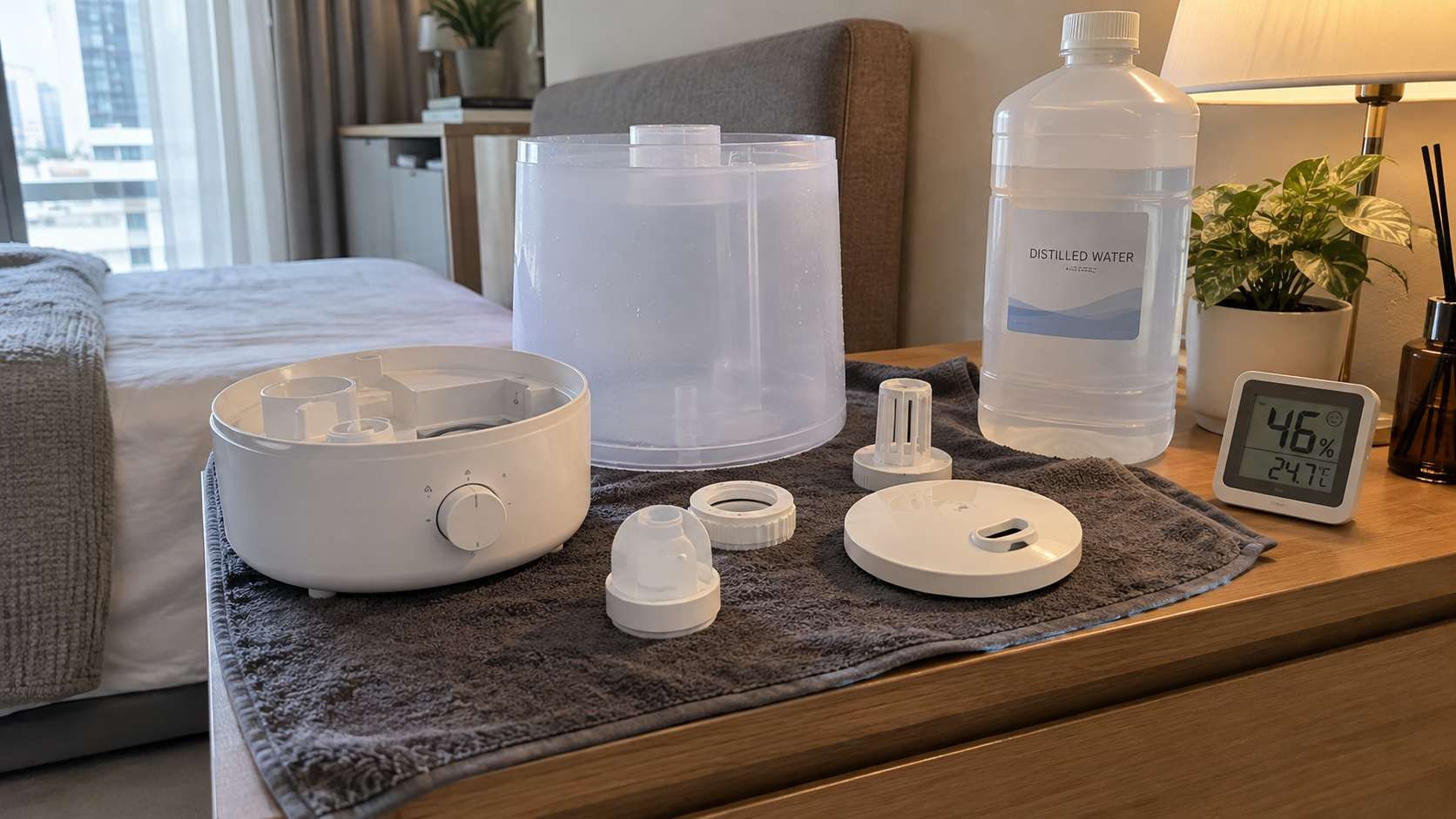
Clean the humidifier on a schedule. For frequent use, light daily care plus deeper cleaning every few days is much safer than waiting until you see slime.
Good prevention habits include:
- empty the tank daily;
- refill with fresh water every use;
- use distilled or demineralized water;
- clean according to the manual;
- dry the tank when not in use;
- replace filters on schedule;
- avoid over-humidifying the room;
- store the unit dry between seasons;
- keep the surrounding table or floor dry;
- never ignore musty, sour, or swampy smells.
Also monitor room humidity. A humidifier should not make the room damp. Too much humidity can support mold growth on walls, windows, curtains, carpets, and furniture. If windows fog up or surfaces feel damp, reduce humidifier use.
When You Should Replace the Humidifier
Sometimes cleaning is not enough. Replace the humidifier if pink residue keeps returning quickly even after proper cleaning, or if you cannot access contaminated internal parts.
Replacement is also smarter when:
- the tank is scratched and holds slime;
- the base has unreachable buildup;
- the unit smells bad after cleaning;
- the filter system keeps getting slimy;
- the mist outlet has hidden residue;
- the humidifier is old and hard to clean;
- someone in the home has asthma or weak immunity;
- the manual warns against deeper cleaning of key parts.
A cheap humidifier with deep contamination may not be worth saving. The risk is not only the visible pink patch. The risk is what the device may aerosolize into the room.
The Bottom Line
Pink mold on humidifier parts is usually a sign of microbial growth in a device that should be kept very clean. Although people call it pink mold, the pinkish slime is often bacterial biofilm linked with Serratia marcescens, not true mold. Still, real mold and other microorganisms can also grow inside dirty humidifiers.
Do not use the humidifier while pink spots are visible. Empty it, scrub it, descale it, disinfect it according to the manual, rinse it thoroughly, dry it completely, and replace contaminated filters or wicks.
To keep it from coming back, empty the tank daily, use cleaner water, avoid standing water, clean the unit regularly, dry it before storage, and control room humidity. The safest humidifier is not the one that looks clean from the outside. It is the one that stays clean in every part that touches water.