


What Pink Mold in Swimming Pool Really Means
Pink mold in swimming pool water usually means a slimy bacterial film has formed on wet surfaces. It may appear around pool walls, steps, skimmer baskets, light niches, ladders, tile lines, return jets, toys, pool covers, and corners with weak circulation.
People often call it pink mold because it looks strange, spreads like a living stain, and feels slimy. But in pool language, it is more accurate to think of it as pink bacterial biofilm. Biofilm is a protective layer where microorganisms can stick to surfaces and become harder to remove. This is why simple chlorine adjustment may not be enough once the slime has already attached itself to pool surfaces.
Pink slime often appears when sanitizer is too low, circulation is weak, brushing is neglected, filters are dirty, or the pool has organic buildup from body oils, leaves, dust, sunscreen, sweat, and debris. It can also show up in pools that look “mostly clean,” especially in hidden spots where water movement is poor.
You may notice:
- pink, red, salmon, or orange slimy patches;
- slippery film on steps or pool walls;
- slime around skimmers, return jets, or ladders;
- pink stains on pool toys or floats;
- recurring discoloration after normal cleaning;
- water that looks clear but surfaces feel slick.
The key sign is texture. Algae often feels slippery too, but pink slime has a sticky, mucous-like feel. It may cling to plastic and vinyl more stubbornly than normal dirt.
Why Pink Slime Comes Back After Cleaning
Pink slime comes back because the visible patch is only part of the problem. If the bacteria remain inside the filter, behind ladders, under pool covers, inside toys, or in low-flow areas, the pool can be recontaminated after the water looks clean.
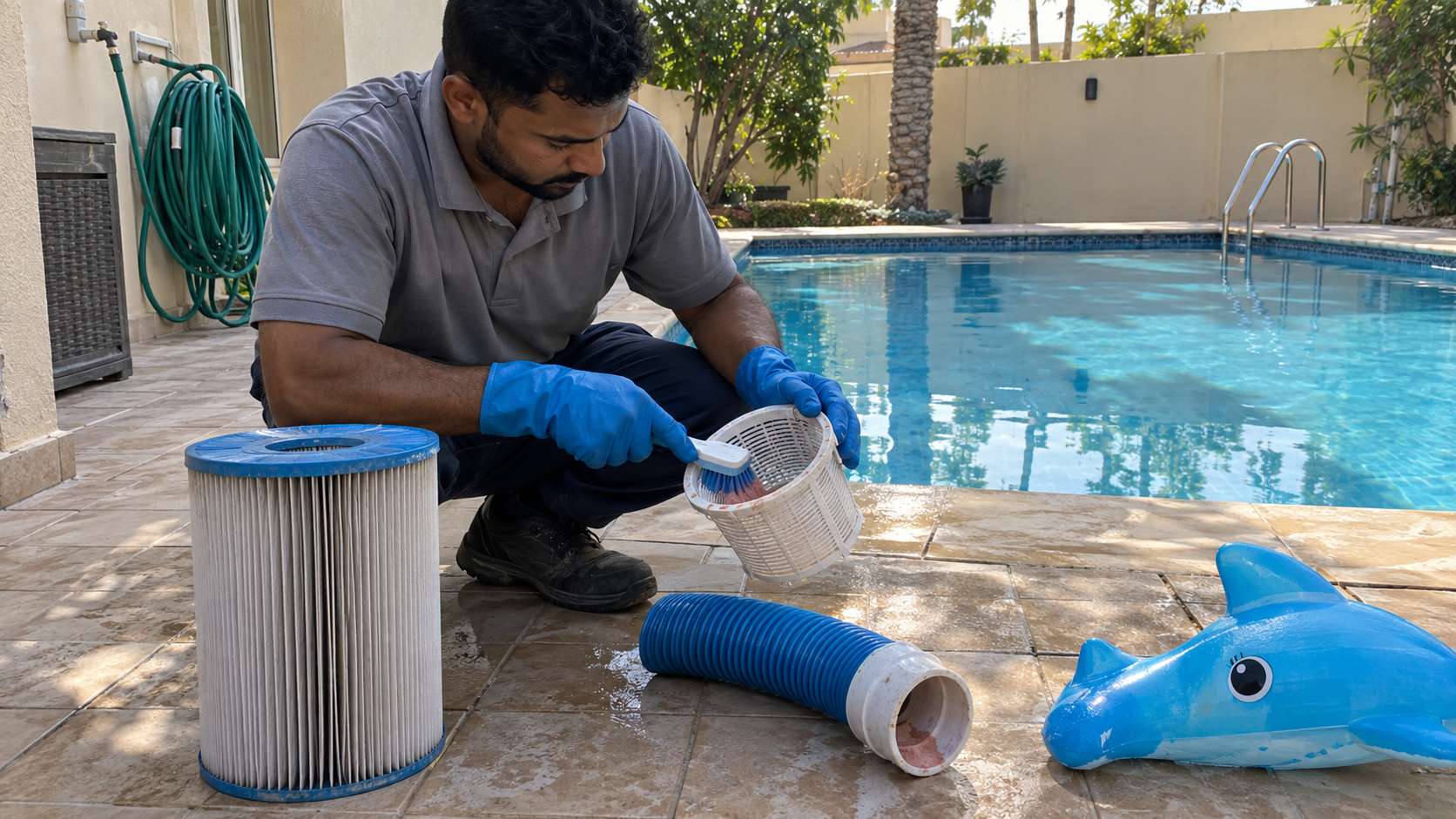
A common mistake is treating only the water. Pool owners add shock, wait for the water to clear, then stop. But pink slime lives on surfaces. If you don’t brush and physically break up the biofilm, sanitizer may not reach the organisms effectively.
The CDC’s public pool guidance tells operators to scrub pool surfaces to remove slime layers because low disinfectant levels can allow germs such as Pseudomonas and Legionella to grow and spread. While this guidance is not written only for pink slime, the principle is very relevant: slime layers need physical cleaning, not just chemical treatment.
Another reason it returns is poor water balance. Chlorine works best only when the pool chemistry is within the right range. CDC advises pool and hot tub owners to regularly test chlorine and pH, and it recommends using proper test kits for accurate results. If pH is too high or free chlorine is too low, the pool may look okay but still give bacteria a chance to survive.
In Dubai, heat, dust, heavy pool use, outdoor debris, and long operating seasons can make this worse. A pool that is not brushed and filtered properly can develop slime even if it is visually maintained.
Step-by-Step Guide to Remove Pink Mold in a Swimming Pool
Removing pink mold from a swimming pool takes a complete cleaning process. The goal is to remove the slime physically, kill what remains in the water, clean the filter system, and prevent recontamination.
Step 1: Stop Swimming Until the Pool Is Treated
Do not let people swim while pink slime is visible. The pool is telling you that sanitation and surface cleanliness are not fully under control. Even if the water looks clear, slimy growth means the system needs attention.

This is especially important for children, elderly swimmers, people with sensitive skin, and anyone with immune or respiratory concerns. The issue may not be “deadly,” but it is not something to ignore.
Step 2: Test the Pool Water Properly
Before adding chemicals, test free chlorine, pH, alkalinity, cyanuric acid, and overall water balance. Do not guess based on water color alone.
At minimum, check:
- free chlorine;
- pH;
- total alkalinity;
- cyanuric acid/stabilizer;
- calcium hardness if relevant;
- combined chlorine if available.
This tells you whether the sanitizer is actually working. If pH is out of range, chlorine may perform poorly. If stabilizer is too high, chlorine may become less effective. If sanitizer is too low, bacteria can keep spreading.
Step 3: Remove Pool Items and Clean Them Separately
Take out removable items before treatment. This includes floats, pool toys, brushes, vacuum hoses, ladders if removable, skimmer baskets, pool covers, and maintenance tools.
Pink slime often hides on plastic and rubber. If you shock the pool but return contaminated toys or covers later, the problem may come back.
Clean these items with an appropriate pool-safe disinfecting method, rinse them well, and let them dry. Throw away items that are cracked, slimy inside, or impossible to clean properly.
Step 4: Brush Every Pool Surface Aggressively
This is one of the most important steps. Brush the pool walls, floor, steps, corners, tile line, skimmer openings, return fittings, ladders, and any textured surfaces.
Do not brush only the visible pink spots. Brush the entire pool because bacteria can exist as a thin film before the color becomes obvious.
Pay extra attention to:
- shaded corners;
- behind ladders;
- step edges;
- light niches;
- waterline tiles;
- skimmer throat;
- return jet area;
- corners with weak circulation;
- pool cover contact points.
The purpose of brushing is to break the biofilm so the sanitizer can reach it. Without brushing, chemicals may only contact the outer slime layer.
Step 5: Vacuum the Pool and Remove Debris
After brushing, vacuum the pool thoroughly. If the pool is heavily contaminated, vacuuming to waste may be better when the system allows it, because it removes debris instead of sending everything through the filter.
If you vacuum through the filter, clean or backwash the filter afterward. Otherwise, the filter can become a hiding place for the same contamination.
Step 6: Shock the Pool Correctly
After brushing and vacuuming, shock the pool according to the pool volume, product label, current chlorine level, and water condition. Follow the chemical manufacturer’s directions carefully.
Do not randomly overdose chemicals. CDC warns that raising chlorine very high for hours can increase the risk of pool chemical injuries if chemicals are mishandled. More chemical does not automatically mean safer cleaning. Correct chemical use matters.
Run the pump continuously during treatment so the water circulates and sanitizer reaches more areas. Keep swimmers out until the water is balanced and safe again.
Step 7: Clean or Backwash the Filter
The filter is a major part of pink slime removal. If the pool surfaces had slime, the filter may contain contaminated debris too.
For a sand filter, backwash and rinse properly. For a cartridge filter, remove and clean the cartridges carefully. For a DE filter, follow the correct cleaning and recharge procedure. If the filter media is old, damaged, clogged, or repeatedly contaminated, it may need replacement.
A dirty or weak filter makes pink slime harder to control because circulation and debris removal become poor.
Step 8: Retest, Rebalance, and Keep Circulation Running
After treatment, retest the pool water. Bring sanitizer, pH, alkalinity, and stabilizer into the correct range. Run the filtration system long enough to fully circulate the water.
Check the same areas again after 24 to 48 hours. If pink slime reappears quickly, you likely missed a hidden surface, filter issue, dead circulation zone, or contamination source.
Prevention Tips So Pink Mold Does Not Return
Preventing pink mold in a swimming pool is easier than removing it after it has formed. The main goal is to keep sanitizer stable, remove organic buildup, and avoid stagnant zones.
Brush the pool weekly, even when the water looks clear. Many pool owners only vacuum the floor and ignore walls, steps, ladders, and the waterline. Pink slime loves ignored surfaces.
Keep pool chemistry balanced. CDC says pool and hot tub owners should regularly check chlorine concentration and pH to help protect swimmers from swimming-related illnesses. For Dubai pools, frequent testing matters because heat, sunlight, dust, and heavy usage can change water conditions faster.
Also clean pool accessories. A dirty pool cover, float, vacuum hose, or toy can reintroduce slime. Let removable items dry in sunlight when possible, and store them somewhere clean.
Good prevention habits include:
- maintain proper sanitizer levels;
- test water several times per week;
- brush walls, steps, and waterline;
- clean filters on schedule;
- remove leaves and debris quickly;
- improve water circulation;
- clean ladders, toys, covers, and baskets;
- avoid long periods of stagnant water;
- check pump runtime;
- service the pool before and after travel.
If the pool is part of a villa, hotel, gym, school, residential tower, or commercial facility, keep a written maintenance log. This helps show whether pink slime is a one-time issue or part of a recurring maintenance failure.
Mold Remediation Service vs Pool Cleaning Service in Dubai
For pink mold inside the swimming pool, a qualified pool cleaning service is usually the correct hire. For true mold around the pool area or inside nearby building materials, a mold remediation service is the better hire.
This distinction matters because pool cleaning and mold remediation solve different problems.
A pool cleaning service handles water chemistry, brushing, vacuuming, filter cleaning, shock treatment, pool equipment, pumps, skimmers, and circulation. If the pink growth is inside the pool water system, this is usually the right provider.
A mold remediation service handles mold growth on building materials and indoor or semi-indoor environments. That includes mold on walls, ceilings, changing rooms, pump rooms, storage rooms, AC vents, insulation, drywall, wood, and damp structural surfaces. If the issue is musty odor around the pool room, black or green mold on walls, moisture-damaged ceilings, or mold spreading beyond the pool itself, then pool cleaning alone is not enough.
Here is the simple comparison:
| Situation | Best Service to Hire | Why |
|---|---|---|
| Pink slime on pool walls, steps, or skimmers | Pool cleaning service | It is mainly a pool sanitation, brushing, filtration, and chemistry issue |
| Pink film on pool toys and covers | Pool cleaning service | Accessories need cleaning, disinfection, drying, or replacement |
| Musty smell in indoor pool room | Mold remediation service plus HVAC/building inspection | The issue may involve humidity, ventilation, AC, and building materials |
| Mold on ceiling, drywall, storage room, or pump room | Mold remediation service | This is no longer only a pool water problem |
| Recurring slime despite weekly pool service | Pool specialist first, then building/mold specialist if moisture issues exist | The cause may be filtration, circulation, or nearby environmental contamination |
| Hotel, gym, school, or shared pool complaint | Professional pool maintenance and compliance-focused inspection | Public-facing pools need stronger documentation and maintenance control |
In Dubai, shared and public-facing pools must be handled with serious maintenance discipline. Dubai’s public health and safety rules require occupants responsible for public swimming pools to provide health and safety requirements and carry out periodic maintenance. Dubai Municipality also publishes technical guidelines related to swimming pool plans and mold remediation and control, which shows that pool safety and mold control are treated as regulated public-health topics, not casual cleaning issues.
So, which one should you hire to get rid of the problem forever? For normal pink slime in the pool, hire a professional pool cleaning service that understands biofilm removal, filtration, and chemical balance. To prevent it from returning, they must correct the maintenance routine, not just shock the water once.
But if the pool area has actual mold on walls, ceilings, AC vents, storage rooms, or wet building materials, hire a mold remediation service too. In that case, “forever” removal depends on fixing humidity, leaks, ventilation, and contaminated materials around the pool environment.
When Pink Mold Becomes a Bigger Warning Sign
Pink slime inside the pool is often a maintenance issue. But sometimes it points to a larger hygiene or building problem.
Take it more seriously when:
- the slime returns within days after treatment;
- the pool smells bad or musty;
- the water feels slimy even after balancing;
- swimmers complain about skin or eye irritation;
- the filter keeps clogging;
- indoor pool walls show mold stains;
- AC vents near the pool smell musty;
- the pump room is damp or moldy;
- the pool has not been maintained during vacancy;
- the property is commercial or tenant-facing.
In these cases, do not keep repeating the same chemical shock. Recurrence means something is being missed. It may be poor circulation, a dirty filter, contaminated pool accessories, dead zones, low sanitizer, high stabilizer, hidden biofilm, or damp building conditions around the pool.
For villas, it may be enough to call a better pool maintenance provider. For hotels, gyms, schools, and residential communities, it may require documented cleaning, water testing, maintenance records, and inspection of surrounding wet areas.
The Bottom Line
Pink mold in swimming pool water is usually not true mold. It is usually pink bacterial slime that sticks to wet pool surfaces and returns when brushing, sanitizer, filtration, or circulation is not strong enough.
To remove it properly, you need a complete process: stop swimming, test the water, remove and clean accessories, brush every surface, vacuum, shock correctly, clean the filter, rebalance the water, and monitor the pool for recurrence.
For most Dubai properties, a qualified pool cleaning service is the first and best hire. They understand pool water chemistry, biofilm brushing, equipment, and filtration. A mold remediation service becomes necessary when the problem spreads beyond the pool water system into walls, ceilings, HVAC, pump rooms, changing areas, storage rooms, or other damp building materials.
The real permanent fix is not just killing what looks pink today. It is removing the slime, correcting the water and circulation conditions, and fixing any moisture problem around the pool area that helps contamination come back.