


Ozone Generator for Mold: The Real Answer
An ozone generator for mold is not recommended as a home mold treatment. The direct answer is no: it is not safe enough to use casually, and it is not effective enough to replace proper mold cleanup.
Ozone generators intentionally produce ozone gas. Sellers often market them as air purifiers, odor removers, or mold-killing devices. The claim sounds convincing because ozone is reactive. In laboratory-style conditions, strong oxidizers can damage biological material. But your home is not a sealed lab chamber with perfectly exposed mold.
Mold grows on surfaces and inside materials. It can sit behind drywall, inside insulation, under flooring, inside cabinets, in HVAC components, behind baseboards, and within porous materials. Ozone gas may not reach all those areas evenly. Even when it reaches exposed surfaces, mold residue and allergens can remain.
EPA directly addresses this problem. It says that if ozone is used at concentrations that do not exceed public health standards, it does not effectively remove mold or other biological pollutants from indoor air.
That sentence is the whole issue in plain language. Safe-ish levels are not effective enough. Stronger levels become risky. So the method fails from both sides.
If you have mold, the better question is not “How do I gas the room?” It is “Where is the moisture, what material is contaminated, and what needs to be cleaned, dried, removed, or repaired?”
Why Ozone Generators Do Not Fix Mold Properly
Ozone generators do not fix mold properly because mold is a moisture and material problem, not just an air problem. Mold spores may be airborne at times, but the active colony is usually growing on something damp.
That “something” might be drywall paper, wood, dust, carpet backing, insulation, cardboard, fabric, ceiling tile, grout residue, AC dust, or organic grime. If those materials remain damp, mold can return even after the air smells different.
Ozone has several practical weaknesses:
- It does not remove mold from surfaces.
- It does not remove dead mold fragments.
- It does not repair leaks.
- It does not dry wet drywall.
- It does not remove contaminated insulation.
- It does not replace damaged caulk or grout.
- It does not correct poor ventilation.
- It may not penetrate hidden cavities safely or evenly.
- It can react with indoor materials and chemicals.
EPA’s basic mold cleanup guidance is much more grounded. Mold should be scrubbed from hard surfaces with detergent and water, then dried completely. Absorbent or porous materials may need to be discarded if they become moldy, because mold can grow into spaces and crevices that are difficult or impossible to clean fully.
That is why ozone feels like a shortcut but behaves like a distraction. It may treat the air temporarily. It may reduce some odors. But mold remediation is mostly about surfaces, materials, moisture, and removal.
If mold is growing behind a wardrobe because of wall condensation, ozone cannot stop the wall from sweating. If mold is inside gypsum board after a pipe leak, ozone cannot restore that damaged material. If an AC drain pan is dirty and wet, ozone cannot replace proper HVAC cleaning and drainage repair.
The Safety Problem With Ozone Indoors
The safety issue is serious. Ozone is not just “activated oxygen.” It is a lung irritant. At ground level, ozone can irritate the respiratory tract and worsen breathing problems. California Air Resources Board warns that ozone generators are ineffective at cleaning indoor air and that inhaling ozone poses serious health risks for humans and animals.
CARB also says ozone can cause respiratory irritation, inflammation, serious breathing difficulty including asthma, permanent lung damage, and cardiovascular effects.
That matters because mold problems often already affect people with respiratory sensitivity. If someone in the home has asthma, allergies, chronic sinus problems, a lung condition, or immune vulnerability, using ozone can make the indoor environment more irritating instead of safer.
Some sellers tell people to run the machine while nobody is home. That does not remove all risk. Ozone can linger, react with indoor materials, and create secondary byproducts. The machine output can also be hard to control. EPA notes that it is difficult to control ozone exposure with ozone generators and that actual concentrations can vary based on room size, ventilation, materials, and operating conditions.
There is also a false sense of safety because ozone has a sharp “clean” smell. That smell does not mean the room is sanitized. It means you may be smelling an irritant gas. CARB warns that some ozone-generating products use fragrances that can disguise rather than eliminate odors, which may reduce a person’s ability to detect high ozone levels.
So the health risk is not a tiny footnote. It is one of the main reasons ozone generators are a bad answer for home mold.
Myth 1: Ozone Kills All Mold in the Room
The most common myth is that ozone can fill a room and kill all mold everywhere. That sounds nice, but it ignores how buildings actually work.
Mold is rarely sitting only in open air. It grows on damp surfaces and often hides in small spaces. Ozone may not reach the backside of drywall, the inside of insulation, the underside of flooring, the rear of cabinets, or the internal surfaces of a contaminated HVAC system. Even exposed mold can be protected by dust, biofilm, porous material, or uneven gas distribution.
Another problem is that killing mold is not the same as removing it. Dead mold can still leave fragments, allergens, stains, and contaminated dust behind. If you do not physically remove the material or clean the surface, you may still have an indoor air quality problem.
This is why EPA and CDC mold guidance focuses on cleanup and moisture correction, not room-gassing. CDC says if mold is growing in your home, you need to clean up the mold and fix the moisture problem. It also says you do not need to know the type of mold before removing it.
So even if ozone damages some exposed mold, it does not complete the job. It does not bag contaminated debris. It does not HEPA-vacuum settled particles. It does not scrub surfaces. It does not remove wet drywall. It does not fix the leak.
Mold remediation is physical work. A gas treatment cannot replace that.
Myth 2: Ozone Removes Musty Smell, So the Mold Is Gone
Another myth is that if the musty smell disappears, the mold problem is solved. This is one of the most dangerous assumptions.
Ozone can change odors because it reacts with odor-causing compounds. That may make the air smell “fresh,” sharp, or less musty for a while. But odor change is not proof of mold removal. The colony may still be there. Wet materials may still be wet. Spores and fragments may still be settled in dust. The hidden leak may still be active.
This is why people sometimes run an ozone machine, feel better about the smell, and then notice the odor returns days or weeks later. The ozone did not fix the source. It only changed the air temporarily.
Musty odor is often a clue. You should not try to erase that clue before finding the cause. A persistent musty smell can point to damp drywall, wet cabinets, AC condensation, dirty duct insulation, moldy carpet padding, or hidden water damage.
A better approach is:
- Find where the odor is strongest.
- Look for water stains, condensation, or leaks.
- Check cabinets, closets, AC areas, and wall corners.
- Remove or clean the contaminated material.
- Dry the area fully.
- Improve ventilation or dehumidification.
- Monitor whether the smell returns.
If the smell disappears after proper cleaning and moisture control, that is meaningful. If it disappears only after ozone, you may have covered the warning sign without fixing the problem.

Myth 3: Ozone Is Safer Than Chemicals
Some people choose ozone because they want to avoid harsh cleaning chemicals. The intention makes sense, but the conclusion is wrong. Ozone is itself a reactive chemical gas. “No liquid residue” does not mean “safe.”
Ozone can irritate lungs and worsen asthma. It can also react with materials and indoor pollutants. Depending on the home, ozone may interact with fragrances, cleaning residues, carpets, paints, furniture, rubber, plastics, and other materials. EPA notes that some air cleaning technologies can create byproducts as part of their oxidation process, and ozone-generating devices are specifically treated as a concern because they produce a lung irritant.
The safer option is not to replace responsible cleaning with ozone. The safer option is to use proven cleanup methods carefully.
For small hard-surface mold, that may mean gloves, eye protection, detergent, water, scrubbing, controlled disposal of dirty materials, and complete drying. For larger jobs, it may mean containment, HEPA filtration, protective equipment, controlled demolition, and professional remediation.
CDC’s cleanup advice focuses on reducing exposure during cleanup and protecting the mouth, nose, skin, and eyes. It does not recommend ozone as the cleanup solution.
So the safety comparison should be honest. A well-controlled detergent cleaning process on a small area is usually more sensible than releasing an irritating gas into the whole indoor environment.
Better Alternative 1: Fix the Moisture Source First
The best mold treatment starts with moisture control. Mold cannot keep growing without moisture. If you skip this step, every cleaner, spray, fogger, paint, filter, or machine becomes temporary.
Common moisture sources include:
- Plumbing leaks
- Roof leaks
- AC drain leaks
- Condensation around vents
- High indoor humidity
- Poor bathroom ventilation
- Wet cabinets
- Damp drywall
- Basement seepage
- Flooding
- Poorly dried water damage
- Leaking windows or balcony doors
EPA says the key to mold control is moisture control. If mold is a problem, you should clean up the mold and get rid of excess water or moisture.
This is not the glamorous part of mold cleanup, but it is the part that actually stops regrowth. If a bathroom ceiling keeps growing mold because the exhaust fan is weak, spraying or ozoning the room will not fix the fan. If a wall is moldy because a pipe is leaking, cleaning the front of the wall will not stop water inside the cavity.
Before choosing any product, ask:
- Is the material dry now?
- Why did it get wet?
- Can it dry quickly if it gets damp again?
- Is there enough airflow?
- Is humidity controlled?
- Does anything need repair?
Once the moisture source is corrected, cleaning has a real chance to work.
Better Alternative 2: Remove Mold Physically
Physical removal is the part ozone cannot do. Mold growth, residue, and contaminated material need to be removed from the home or cleaned from the surface.
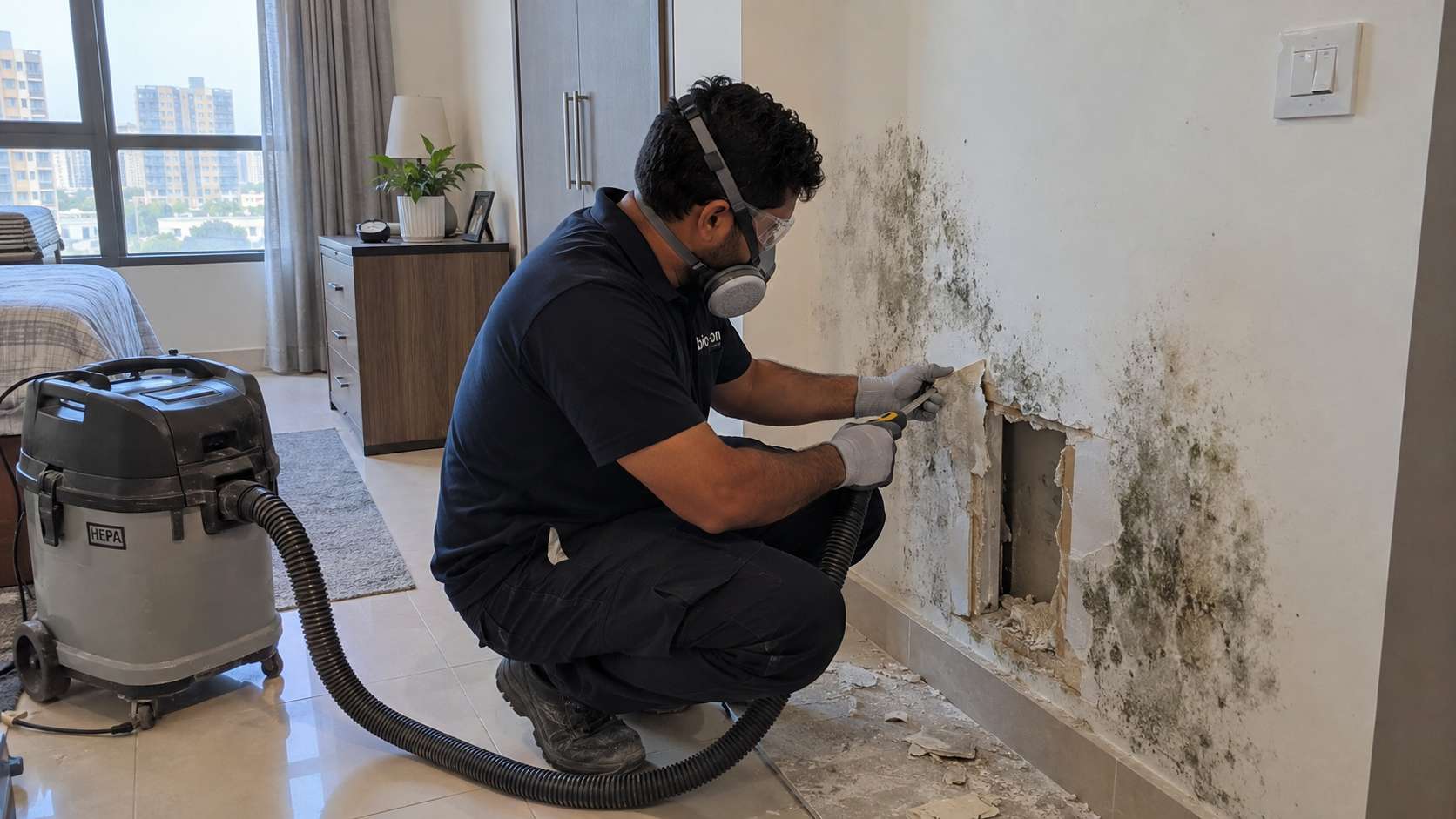
For small areas on hard, non-porous surfaces, you can often clean with detergent and water. Scrub the surface, wipe away residue, rinse or wipe as needed, and dry fully. EPA says mold can be scrubbed off hard surfaces with detergent and water and dried completely.
For porous materials, the answer may be removal. Moldy drywall, insulation, carpet padding, ceiling tile, cardboard, and particle board are harder to clean because mold can grow into the material. EPA and CDC guidance both recognize that absorbent materials can be difficult or impossible to fully clean once moldy.
Practical physical-removal options include:
- Scrubbing hard surfaces
- HEPA vacuuming settled dust after drying
- Removing moldy drywall or insulation
- Replacing contaminated caulk
- Discarding moldy cardboard or carpet padding
- Cleaning HVAC-accessible components properly
- Drying structural materials before rebuild
- Preventing dust spread during cleanup
If the job is larger than a small patch, physical removal should be controlled. You do not want to spread moldy dust through the home while cutting drywall or pulling insulation.
Better Alternative 3: Use HEPA Filtration the Right Way
HEPA filtration can help reduce airborne particles during and after cleanup, but it should be used correctly. A HEPA air scrubber or purifier can capture particles, including some mold spores, from the air that passes through the filter. It does not remove mold from walls, carpets, cabinets, or insulation.
This is where people often misunderstand air cleaners. A HEPA purifier can support indoor air quality, but it does not solve the mold source. If mold is still growing behind a wall, the purifier is only managing some particles in the room.
EPA’s air cleaner guidance generally treats filtration as a more established air-cleaning approach than ozone-producing devices, while making clear that air cleaners do not replace source control.
Use HEPA filtration as support when:
- Cleaning a small mold area
- Running a dehumidified room after cleanup
- Reducing dust during remediation
- Improving air quality after moisture repair
- Helping sensitive occupants reduce particle exposure
Do not use HEPA filtration as an excuse to leave mold in place. The right sequence is source control first, cleanup second, filtration as support.
For serious remediation, professionals may use HEPA-filtered negative air machines, containment barriers, and HEPA vacuums. That is very different from placing a consumer purifier beside an active moldy wall and hoping it solves the problem.
Better Alternative 4: Use Professional Mold Remediation When Needed
Professional mold remediation is the better option when the mold is hidden, recurring, widespread, or tied to water damage. It is also the better path when people in the space have asthma, allergies, immune concerns, or ongoing symptoms.
You should consider professional help when:
- Mold covers more than a small area.
- Mold keeps returning after cleaning.
- You smell mold but cannot find the source.
- There was flooding or long-term leakage.
- Mold is behind drywall, cabinets, or flooring.
- Mold is inside insulation or carpet padding.
- The problem involves HVAC or AC systems.
- The property is rental, commercial, or insurance-related.
- Occupants have asthma, allergies, or immune vulnerability.
A professional remediation process may include inspection, moisture mapping, containment, HEPA filtration, controlled removal, cleaning, drying, disposal, and post-cleanup recommendations. The goal is to remove contamination and correct the conditions that caused it.
EPA says that if you hire a contractor for mold cleanup, you should make sure the contractor has experience cleaning up mold and follows professional or government guidance.
This is very different from ozone treatment. Ozone tries to treat the room atmosphere. Remediation treats the building problem.
The Bottom Line
An ozone generator for mold is not the smart solution. The myth is that ozone can fill a room, kill mold everywhere, remove musty odor, and leave the home clean. The reality is different. Ozone at safer indoor levels does not effectively remove mold, and stronger ozone exposure can irritate lungs and create health risks.
Mold cleanup needs a more practical approach. Find the moisture source. Fix leaks or humidity. Remove contaminated porous materials when needed. Scrub hard surfaces with detergent and water. Dry everything completely. Use HEPA filtration as support, not as a replacement for removal. Hire professional mold remediation when the problem is hidden, recurring, widespread, or connected to water damage.
Ozone may sound high-tech, but mold control is not about making the air smell different for a while. It is about removing the growth, fixing the moisture, and making sure the building no longer supports mold.