


Why a Mold-Resistant Home Is a Must in the UAE
The hidden reason you want your home mold-resistant in the UAE is that mold often starts where you cannot see it. By the time you smell mustiness or see black spots, the moisture problem may already be inside a cabinet, behind a wardrobe, above a gypsum ceiling, around AC ducts, under flooring, or inside wall materials.
Many people think mold only happens after a visible water leak. In the UAE, that is not always true. Mold can appear because of humidity, condensation, poor airflow, AC drainage issues, and closed rooms. Continuous AC use can cool walls, ducts, vents, and ceiling spaces. When humid air reaches those cold surfaces, condensation can form. Over time, that moisture can support mold growth.
That is why UAE mold prevention is not only about cleaning. It is about design.
A non-mold-resistant home may look beautiful on handover day but still have hidden risks:
- Wardrobes fixed directly against exterior walls
- Poor bathroom exhaust
- AC ducts with condensation issues
- Uninsulated chilled-water lines
- No leak sensors under sinks
- MDF cabinets exposed to plumbing leaks
- Carpets in humid bedrooms
- Poor drainage around balconies
- No humidity monitoring
- Closed storage rooms with no airflow
- Waterproofing shortcuts in wet areas
The EPA notes that excessive moisture on building materials can lead to mold, especially when moisture remains undiscovered or unaddressed. It also says keeping relative humidity between 30% and 60% helps control mold.
So the hidden danger is not only visible mold. It is invisible moisture. A mold-resistant home is designed to make that moisture easier to prevent, detect, dry, and repair.
Design Your AC System for Humidity, Not Just Cooling
A mold-resistant UAE home needs AC that manages humidity, not only temperature. A cold room can still be damp. If your AC cools quickly but does not remove enough moisture, the home may feel comfortable while walls, wardrobes, curtains, and ceiling voids stay mold-friendly.
This is one of the biggest mistakes in hot climates. People focus only on “How cold can the AC get?” The better question is, “Can the AC keep the home dry without creating condensation?”
For a mold-resistant setup, pay attention to:
- Correct AC sizing
- Proper airflow in every room
- Cleanable filters
- Easy access to coils and drain pans
- Proper condensate drain slope
- Insulated chilled-water pipes
- Well-sealed ductwork
- No cold air leakage into ceiling voids
- AC dry mode or humidity-control function
- Regular maintenance access panels
Oversized AC units can cool rooms quickly but may run for shorter cycles. That can reduce dehumidification time. Poorly insulated ducts or pipes can sweat above ceilings. Blocked drain lines can leak into gypsum board and insulation. Dirty coils and drain pans can create musty smells.
For UAE apartments and villas, also think about vacation mode. Do not design a system that requires the AC to be turned off completely when you travel. A better setup allows humidity control while using less energy.
A practical target is to monitor indoor relative humidity and keep it below 60%, ideally closer to 30–50% when realistic. The EPA repeatedly recommends this range for mold control.
Choose Mold-Resistant Materials in Wet and Hidden Areas
Mold-resistant materials matter most in areas where moisture is likely. You do not need every surface in the home to be waterproof, but you should be strategic.
The highest-risk areas are:
- Bathrooms
- Kitchens
- Laundry rooms
- AC ceiling zones
- Sink cabinets
- Utility rooms
- Balcony entrances
- Storage rooms
- Exterior-facing walls
- Built-in wardrobes
- Areas around water heaters
Use materials that tolerate moisture better and dry more easily. For example, cement board or moisture-resistant backing boards are usually better than standard gypsum board in wet zones. Tile, sealed stone, aluminum, treated plywood, marine-grade plywood, PVC boards, and high-pressure laminates may perform better than raw MDF or particle board in damp locations.
EPA mold-prevention guidance notes that in frequently damp areas, more mold-resistant materials can be used, and that some woods are more resistant to mold than particle board or pressed board.
For UAE kitchen and bathroom cabinetry, avoid untreated MDF in leak-prone zones if possible. If MDF is used, make sure edges are sealed, sink bases are protected, and plumbing points are easy to inspect. A beautiful under-sink cabinet that hides leaks too well can become a mold incubator.

For walls, use washable, breathable, moisture-appropriate finishes. Avoid trapping moisture behind decorative panels, wallpaper, or wall cladding in damp zones unless the wall assembly is properly designed.
The best material choice is not always the most expensive one. It is the one that matches the moisture risk of the room.
Build Bathrooms That Dry Fast
A mold-resistant bathroom is a bathroom that dries quickly after use. If water sits on grout, silicone, ceilings, towels, and corners for hours every day, mold will eventually find a place to grow.
Bathrooms in UAE homes can become mold-prone because they are often enclosed, air-conditioned, and poorly ventilated. A beautiful bathroom without proper exhaust is not mold-resistant. It is just a damp room with expensive finishes.
Design bathrooms with:
- Strong exhaust fan vented properly
- Timer or humidity-sensor fan control
- Good slope toward drains
- Proper shower waterproofing
- Mold-resistant grout and sealant
- Easy-to-clean shower glass and tile
- Minimal hidden ledges where water sits
- Good lighting for inspection
- Space for towels to dry
- Moisture-resistant ceiling material
- Accessible plumbing behind vanity areas
Do not rely only on opening the bathroom door. Moisture from the bathroom can move into bedrooms, wardrobes, and corridors. Proper exhaust removes moisture from the source.
Also avoid overusing silicone as a bandage for poor design. Silicone joints should be clean, replaceable, and correctly applied. If the shower corner keeps getting moldy, the problem may be poor slope, constant wetting, bad ventilation, or water entering behind the surface.
A mold-resistant bathroom should be easy to wipe, easy to ventilate, and hard for water to hide in.
Design Kitchen Cabinets and Laundry Areas Around Leak Risk
Kitchens and laundry areas are mold hotspots because they combine plumbing, food residue, cabinets, heat, and hidden spaces. A small leak under the sink can destroy a cabinet base before you notice anything.
A mold-resistant kitchen should make leaks visible early and damage less severe.
Use these design choices:
- Removable under-sink cabinet base trays
- Leak-resistant cabinet bottoms
- Sealed cabinet edges
- Easy access to plumbing joints
- Water leak sensors under sinks
- Ventilation inside sink cabinets
- Raised storage, not paper goods directly on cabinet floors
- Durable backsplash and sealed countertop joints
- Dishwasher hose access
- Washing machine hose access
- Floor drain where appropriate
- Moisture-resistant materials near appliances
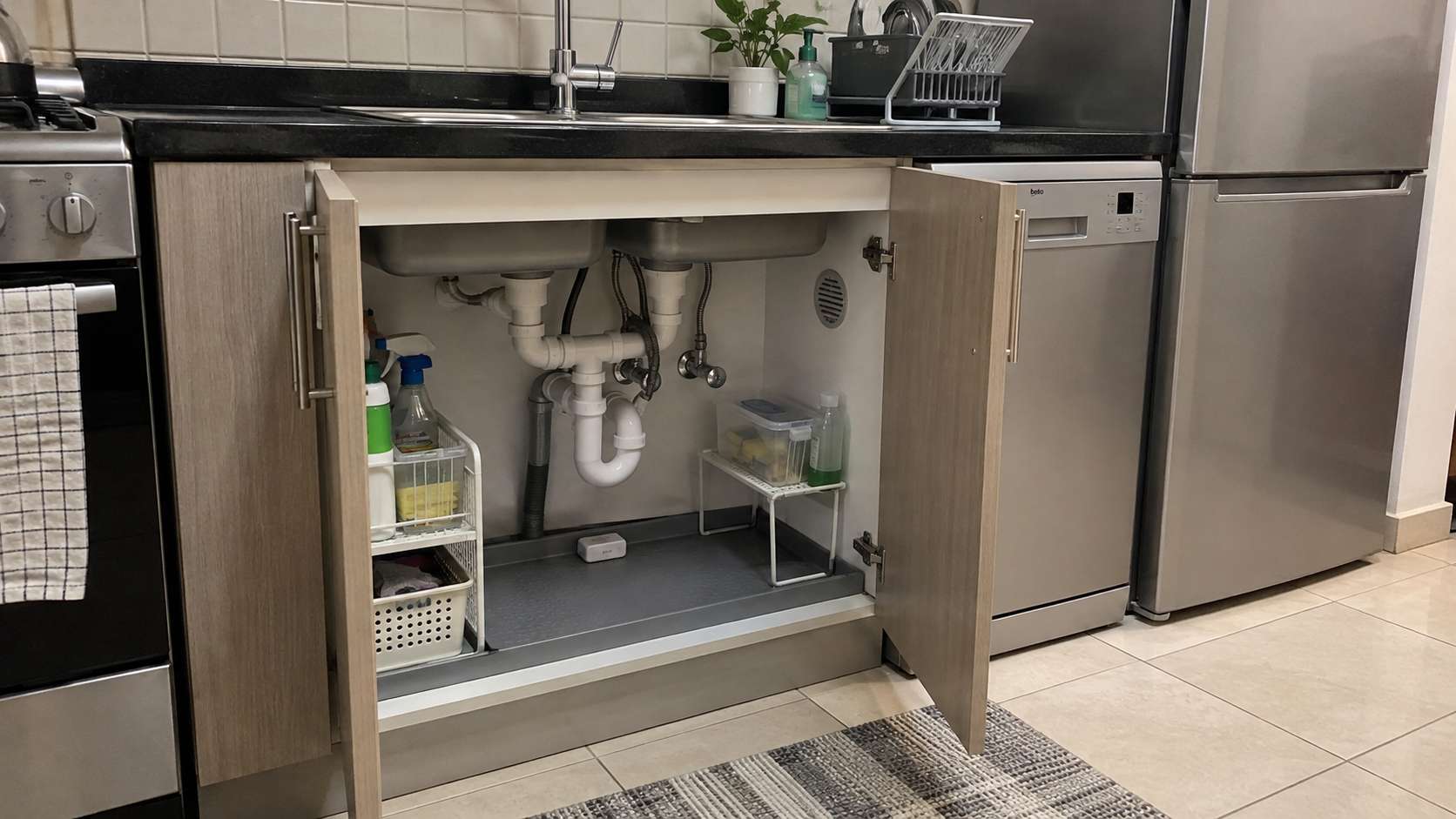
For laundry areas, avoid boxing everything in so tightly that leaks cannot be seen. Washing machine hoses, drain pipes, and condensation-prone areas should be accessible.
Also avoid storing wet mops, damp cloths, and cleaning buckets in sealed cabinets. That creates a small humid zone inside the home.
The design goal is simple: if water leaks, you should know quickly, reach it easily, dry it fast, and replace only a limited part if damage occurs.
Prevent Hidden Condensation Behind Wardrobes and Furniture
Built-in wardrobes are one of the most overlooked mold risks in UAE homes. A wardrobe on an exterior wall can become moldy even without a pipe leak. The reason is often condensation and poor airflow.
When a wall is cold from AC and the air inside the wardrobe is humid and stagnant, moisture can collect on the wall or inside stored clothing. Add packed clothes, leather goods, shoes, and closed doors, and you have a mold-friendly microclimate.
To make wardrobes more mold-resistant:
- Leave an air gap behind built-ins when possible.
- Avoid installing wardrobes directly against damp exterior walls.
- Use ventilation slots or breathable design details.
- Keep wardrobe backs inspectable where possible.
- Avoid overpacking shelves and hanging rails.
- Use humidity sensors in problem wardrobes.
- Keep shoes and clothes fully dry before storage.
- Use dehumidifier boxes only as a support, not a full solution.
- Make sure adjacent bathrooms are properly waterproofed.
- Avoid carpet inside closed wardrobe zones.
For freestanding furniture, leave a small gap from exterior walls. This helps air move and reduces trapped dampness.
A mold-resistant home is not only about wet areas. It is also about storage design. Dark, closed, packed, humid storage is one of the easiest ways to grow mold quietly.
Use Smart Sensors for Early Detection
A mold-resistant home should include sensors because you cannot watch every pipe, cabinet, wall, and ceiling all day. Smart sensors do not remove mold, but they help you catch moisture before it becomes a mold problem.
Useful devices include:
| Device | Where to Use It | Why It Helps |
|---|---|---|
| Humidity sensor | Bedrooms, bathrooms, wardrobes, storage rooms | Alerts you when humidity rises |
| Water leak sensor | Under sinks, near water heaters, washing machines, AC drain areas | Detects leaks early |
| Smart plug | Dehumidifier or fan | Turns drying devices on automatically |
| Smart AC controller | Bedrooms, living areas, vacation homes | Helps manage humidity remotely |
| Smart water shutoff valve | Villas, holiday homes, high-risk properties | Can stop water during leaks |
| Hygrometer | Any room | Simple humidity awareness |
A simple automation can be powerful:
- If humidity rises above 60%, turn on dehumidifier or AC dry mode.
- If a leak sensor detects water, send a phone alert.
- If bathroom humidity stays high after showering, run exhaust fan longer.
- If you are on vacation, keep humidity monitoring active.
- If the AC drain area gets wet, notify immediately.
This is especially useful in UAE homes that stay closed during travel. A small leak or humidity spike can go unnoticed for days. Sensors help shorten that delay.
Plan Drainage, Waterproofing, and Exterior Protection Carefully
A mold-resistant home is designed to keep water away from the building envelope. This includes roof drainage, balcony drainage, window sealing, exterior wall protection, and bathroom waterproofing.
In villas, check:
- Roof slope and drainage
- Parapet wall waterproofing
- Balcony waterproofing
- Exterior wall cracks
- Window frame sealing
- Foundation drainage
- Irrigation water near walls
- Outdoor AC drainage
- Service penetrations through walls
In apartments, check:
- Balcony door thresholds
- Bathroom waterproofing
- Ceiling stains from upstairs units
- Building AC drainage
- Window condensation
- Shared wall leaks
- Service shaft leaks
Waterproofing failure is one of the most expensive mold triggers because it can soak hidden materials before the owner sees anything. If water enters behind walls, under tiles, or above ceilings, surface cleaning becomes useless.
Good design makes water move away from the home, not into it. It also makes hidden plumbing and drainage points accessible for inspection.
Do not accept a design where beautiful finishes hide every pipe, drain, and access panel. Hidden access may look cleaner, but it can make leaks harder to detect until mold appears.
Improve Ventilation Without Inviting Humidity Problems
Ventilation is important, but in the UAE it must be controlled. Opening windows all day in humid weather may bring in moisture. Keeping everything sealed all the time may trap stale air. A mold-resistant home needs balanced ventilation.
Use exhaust ventilation in moisture-producing rooms:
- Bathrooms
- Kitchens
- Laundry rooms
- Utility rooms
Use controlled fresh air where possible, but avoid uncontrolled humid air entering cold spaces. Gaps around doors, windows, ducts, and service penetrations can allow humid air to meet cold surfaces and condense.
Good ventilation design includes:
- Proper exhaust fan sizing
- Exhaust fans vented to the outside
- Kitchen extraction
- Door undercuts or transfer grilles where needed
- Avoiding dead-air corners
- Ventilated storage areas
- Fresh air strategy coordinated with AC
- Avoiding constant humid outdoor air infiltration
EPA guidance recommends reducing indoor humidity by venting bathrooms, dryers, and other moisture-generating sources outside, using air conditioners and dehumidifiers, increasing ventilation, and using exhaust fans when cooking, dishwashing, and cleaning.
In short, ventilation should remove moisture without creating condensation. That is the balance.
Make Maintenance Part of the Design
A home cannot stay mold-resistant if maintenance is difficult. If filters are hard to reach, drains are hidden, ceiling access is blocked, and under-sink areas are packed, small problems become hidden problems.
Design for maintenance from the beginning:
- AC filters easy to remove
- Drain pans accessible
- Condensate drains inspectable
- Plumbing access panels included
- Under-sink areas uncluttered
- Bathroom silicone easy to inspect
- Roof and balcony drains easy to clean
- Water heaters accessible
- Ceiling access panels not blocked
- Leak sensors easy to test
- Humidity readings easy to check
A maintenance-friendly home is a mold-resistant home because problems are found early.
Set a schedule:
- Check AC filters monthly during heavy use.
- Inspect under sinks weekly.
- Check humidity regularly.
- Service AC before peak summer.
- Inspect bathroom sealant every few months.
- Check roof and balcony drainage before rainy periods.
- Test leak sensors.
- Investigate musty odors immediately.
Mold prevention is not a one-time design feature. It is a system of design plus habits.
Tips to Design and Build a Mold-Resistant Home
To design and build a mold-resistant home in the UAE, focus on moisture pathways. Ask where water comes from, where humidity collects, where condensation forms, and how fast materials can dry.
Here is a practical build checklist:
- Design AC for humidity control.
Do not size the system only for cooling. Consider dehumidification, airflow, drain access, and condensation risk. - Insulate cold surfaces properly.
AC ducts, chilled-water pipes, and cold surfaces above ceilings should not sweat into hidden cavities. - Use mold-resistant materials in wet zones.
Choose moisture-resistant boards, sealed cabinetry, tile, cement board, and durable finishes where water is likely. - Avoid raw MDF in leak-prone areas.
Under sinks, laundry zones, and bathroom vanities need better moisture protection. - Install real bathroom exhaust.
A bathroom without proper exhaust is one of the fastest ways to create mold. - Control indoor humidity.
Use AC dry mode, dehumidifiers, humidity sensors, and proper ventilation. - Design storage with airflow.
Wardrobes, shoe cabinets, and store rooms need breathing space. - Add leak detection.
Put sensors under sinks, near water heaters, washing machines, and AC drain points. - Keep plumbing accessible.
Do not hide every pipe behind permanent finishes. - Waterproof balconies, bathrooms, and roofs properly.
These are major mold-risk zones in UAE properties. - Avoid carpets in humid or leak-prone rooms.
Carpet can trap moisture and mold odor if the room becomes damp. - Use washable, inspectable surfaces.
Surfaces should be easy to clean, dry, and check. - Plan for vacation mode.
The home should maintain humidity control when unoccupied. - Do not rebuild over damp materials.
After leaks, dry and verify before closing walls or installing cabinets. - Hire specialists for high-risk areas.
AC, waterproofing, insulation, and mold remediation should be handled properly, not guessed.
A beautiful UAE home that ignores moisture will eventually fight mold. A mold-resistant home is beautiful because it stays dry, clean, and healthy longer.
The Bottom Line
A mold-resistant home in the UAE is not created by one paint, one spray, one AC setting, or one dehumidifier. It is created by design choices that control moisture at every stage: cooling, ventilation, waterproofing, drainage, materials, storage, sensors, and maintenance.
The hidden reason this matters in the UAE is that mold often grows from invisible moisture: AC condensation, high humidity, blocked drains, damp ceiling voids, closed wardrobes, and hidden leaks. You may not see the problem until the smell, stains, or health symptoms appear.
Design the home so moisture has fewer places to hide. Keep humidity controlled, make leaks easy to detect, choose materials that tolerate wet areas, ventilate bathrooms properly, maintain the AC system, and never cover dampness with finishes.
That is the real meaning of a mold-resistant home: not a home where mold can never exist, but a home where mold has a much harder time growing.