


Why You Should Consider Mold Killing Smoke
You may consider mold killing smoke when ordinary spraying cannot easily reach all the surfaces in a room.
Despite the name, most modern systems don’t actually create smoke. They create an aerosol or very fine liquid mist using a cold or ULV fogger. That cloud moves throughout an enclosed space before settling onto walls, floors, ceilings, furniture, framing, and other exposed surfaces.
This can be useful in places such as:
- Attics
- Crawlspaces
- Basements
- Storage rooms
- Vacant bedrooms
- Wall cavities that have already been opened
- Large rooms after water damage
- Complex exposed framing after demolition
One advantage is coverage. For example, Concrobium specifically recommends cold fogging its Mold Control solution for large spaces and difficult areas such as attics, crawlspaces, and wall cavities because fogging creates a more even surface coating than manually spraying every location.
But that benefit has a major limitation.
The fog must actually reach the contaminated surface. Concrobium itself states that its product cannot penetrate drywall or other solid barriers. If mold is behind drywall, the barrier must generally be removed or the contaminated surface otherwise exposed.
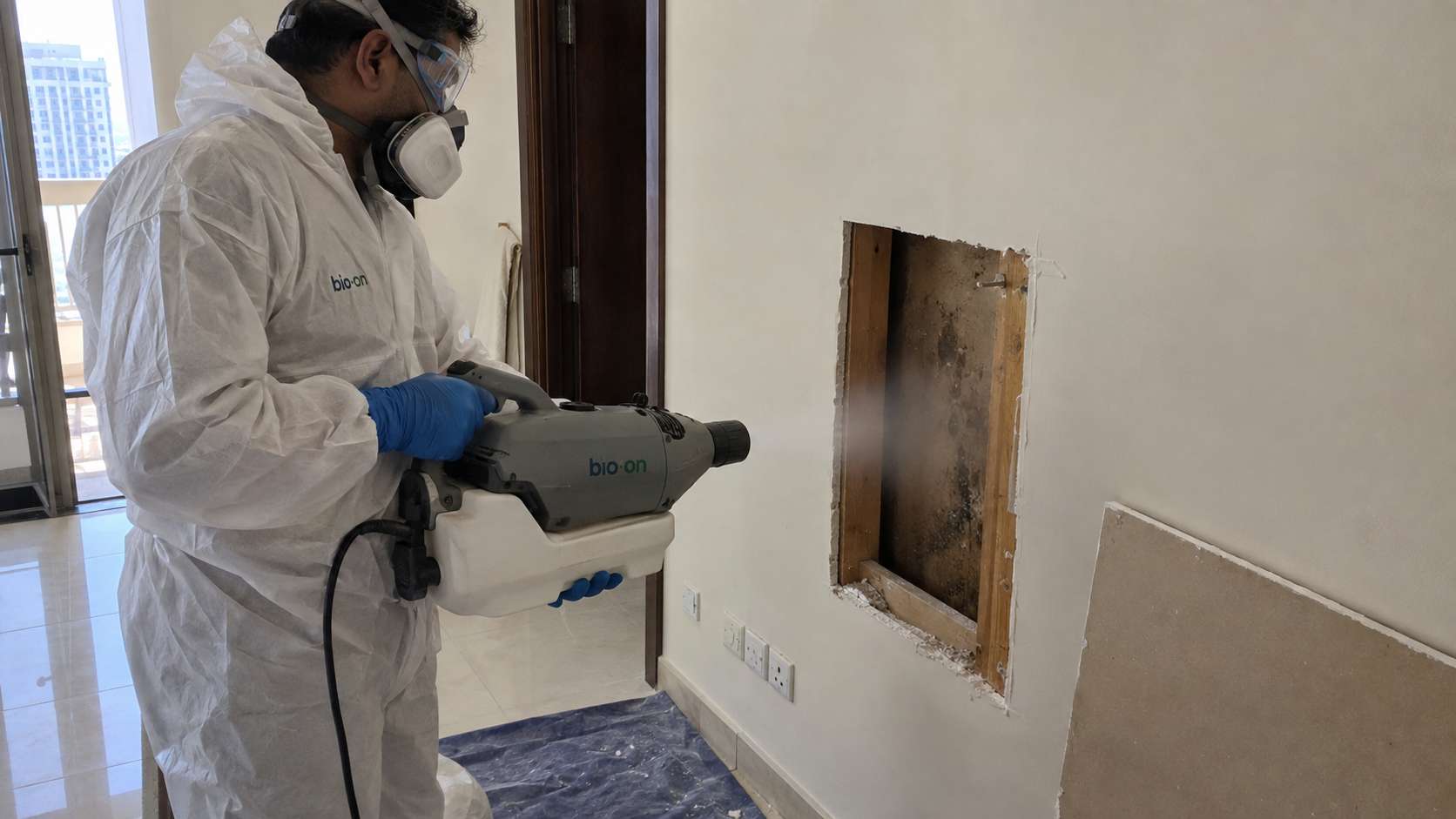
Fogging also doesn’t eliminate the water problem that caused the mold.
Think of it as a delivery technique. A fogger can spread an appropriate product efficiently. It cannot repair a leaking roof, dry waterlogged insulation, remove rotten drywall, or make hidden mold disappear.
That is why mold killing smoke makes the most sense after the moisture source has been corrected and as part of an actual cleanup process.
5 Whole-Room Products Used for Mold Fogging
There isn’t one universal “mold bomb” that completely remediates a room without cleaning. The following five products or systems represent different approaches to whole-room treatment. Their labels, mechanisms, and limitations matter more than marketing claims.
1. Concrobium Mold Control + Cold Fogger
Concrobium Mold Control is one of the clearest examples of a product specifically designed for cold-fogging application.
It is EPA-registered under registration number 82552-1 and can be applied using a cold fogger across large enclosed spaces. The manufacturer says the product dries on surfaces and leaves an antimicrobial barrier intended to control mold growth.
The main advantage is convenience. One treatment can coat walls, ceilings, flooring, framing, and difficult corners without individually spraying every surface.
However, even the manufacturer instructs users to remove heavy soil so the solution can contact the mold. For larger affected areas, its current instructions recommend specialized remediation procedures rather than simply fogging the room.
Best suited for: broad surface treatment after the moisture problem and heavier contamination have already been addressed.
2. Vital Oxide
Vital Oxide is another EPA-registered mold-control product that can be applied with fogging equipment.
The manufacturer’s instructions specifically allow application with either a spray bottle or fogging device. However, they also say visible mold should first be removed before the product is applied.
That detail is important because it demonstrates what foggers should realistically be used for.
You don’t walk into a heavily mold-covered room, activate a machine, and consider remediation complete. Physical removal comes first. Fogging can then distribute the treatment over a wider area.
Best suited for: supplementary treatment of exposed surfaces in large areas following mold cleanup.
3. Benefect Decon 30
Benefect Decon 30 is a botanical disinfectant widely aimed at restoration and water-damage applications. It is EPA-registered and includes fungicidal claims for appropriate applications. The manufacturer specifically positions it for mold remediation and restoration work.
Its restoration documentation also describes fogging in vacant, contained areas as a supplement to cleaning and disinfection, followed by ventilation.
That phrase—supplement to cleaning—is exactly how consumers should think about mold fogging.
Benefect can be appealing where someone wants a botanical formulation rather than conventional synthetic disinfectant chemistry, but the product label and application instructions still need to be followed exactly.
Best suited for: restoration projects where treatment is combined with cleaning, HEPA removal, drying, and moisture correction.
4. Bioesque Botanical Disinfectant Solution
Bioesque Botanical Disinfectant Solution is EPA-registered and can be used with a ULV fogger. It is marketed for restoration and remediation environments and carries fungicidal claims when used according to its registered directions.
There is an important catch.
Its fogging instructions describe ULV application as a supplement to normal cleaning in vacant restoration areas. The product documentation specifically notes that fogging directions are for cleaning and that efficacy data supporting disinfectant claims through the fogging method itself were not submitted.
That is an excellent example of why you should read the actual label rather than assume “fungicide + fogger = complete mold kill.”
Best suited for: supplementary whole-room cleaning after appropriate remediation work.
5. BioCide Labs Mold Bomb Fogger
BioCide Labs’ Mold Bomb looks closest to what people usually imagine when searching for a “biocide bomb.” You activate a pressurized canister and allow the aerosol to disperse through the enclosed room.
But its function needs to be understood correctly.
BioCide Labs currently describes the Mold Bomb as a fine-particulate fogger that brings airborne fine and ultra-fine particulates down onto surfaces.
In other words, this particular product should not be confused with a registered fungicide that independently kills established surface mold. It is primarily a particulate-management step within a broader cleanup system.
That makes it useful for explaining a common misconception: some products called “mold bombs” are not actually mold-killing bombs.
Best suited for: particulate suppression as part of a larger mold-cleanup process rather than standalone mold removal.
The broader lesson from all five products is simple: there is currently no effortless fogging product that turns a heavily mold-contaminated room into a properly remediated room without source removal and moisture correction.
That is also consistent with professional remediation guidance. IICRC’s mold-remediation standard warns against using gaseous or vapor-phase biocides and technologies such as fogging as substitutes for removing fungal material.
Is Mold Killing Smoke Safe for Humans?
Mold killing smoke can expose you to concentrated aerosols, so you should never assume that a product is safe to breathe simply because its ingredients sound mild.
Safety depends heavily on the specific formulation and method of application.
When a liquid is sprayed normally onto a surface, exposure may be relatively limited. Put the same liquid into a ULV fogger and thousands of tiny droplets become suspended in the air. That creates an inhalation route that may not exist to the same degree during ordinary wiping.
Therefore, follow the product’s label rather than general internet instructions.
Some products specifically require the room to be vacant during fogging. Bioesque, for example, instructs users to seal the area, leave during treatment, wait until the fog has settled or been exhausted, and ventilate before normal use resumes.
Concrobium says evacuation isn’t normally required for conventional use but advises avoiding inhalation of excessive moisture during fogging. Its application guidance also recommends respiratory and eye protection when working around mold contamination itself.
This distinction matters: the cleaner may be relatively low hazard, but disturbing mold is another exposure risk altogether.
Before fogging:
- Read the complete product label and SDS.
- Remove or cover food.
- Protect electronics and moisture-sensitive items.
- Follow PPE instructions.
- Keep unnecessary people outside the work area.
- Use only equipment approved for that particular product.
- Never mix chemicals inside a fogger.
- Ventilate according to the manufacturer’s directions.
Don’t improvise by pouring household bleach, vinegar, ammonia, or mixed cleaners into a fogging machine.
Is Mold Killing Smoke Safe for Pets?
Pets should generally be treated more cautiously than humans during whole-room fogging.
Even when the solution itself is promoted as low-toxicity, pets can inhale aerosol droplets, walk across wet surfaces, groom chemicals from their paws, or drink contaminated water.
Birds and animals with sensitive respiratory systems deserve particular caution.
The safest approach is to follow the actual product label and remove pets from the treatment zone whenever required. Keep food bowls, toys, bedding, litter boxes, cages, and aquariums away from the aerosol unless the manufacturer’s directions specifically state otherwise.
Some products have relatively favorable animal-safety information. Concrobium, for example, states that its dried residue is not harmful to animals.
That does not mean a pet should stand inside a room breathing freshly generated fog.
“Safe after drying” and “safe to inhale as a concentrated aerosol” are two completely different claims.
For fish tanks, birds, reptiles, or animals with respiratory disease, be especially conservative. Remove them from the treatment environment and follow all re-entry and ventilation instructions before bringing them back.
When Should You Hire Mold Removal Instead?
Hire specialized mold removal when fogging would only hide the seriousness of the problem.
A small patch of surface mold caused by a temporary humidity problem may be manageable with DIY cleaning. However, a fogger becomes a poor substitute when contamination is extensive or embedded in building materials.
Professional remediation is more appropriate when:
- Mold covers a large area
- Several rooms are affected
- Mold repeatedly returns
- Drywall or insulation is contaminated
- Mold is inside wall or ceiling cavities
- Water damage has remained wet for a long time
- Flooding or sewage caused the problem
- HVAC components may be contaminated
- A strong mold odor remains without a visible source
- Occupants have significant mold-related health concerns
The crucial difference is source removal.

A professional mold-remediation company can establish containment, remove contaminated porous materials, use HEPA filtration and vacuuming, clean exposed structural materials, control airborne debris, identify moisture sources, dry the building, and use antimicrobials or fogging when appropriate.
Professional standards specifically caution against using fogging, ozone, vapor-phase biocides, essential oils, or similar technologies as standalone substitutes for physical mold removal.
That is why a company offering to solve widespread mold simply by entering the property, “smoking” every room, and leaving should raise questions.
Ask what happens before the fogging.
If the answer doesn’t include moisture investigation and removal of contaminated materials where required, the underlying mold problem may still be there when the fog disappears.
The Bottom Line
Mold killing smoke can work, but not in the effortless way the name suggests.
Cold foggers, ULV machines, aerosols, and mold bombs can distribute mold-control products across a room, treat exposed difficult-to-reach surfaces, reduce certain microorganisms when used according to label directions, control odors, or bring airborne particles down for later cleaning.
What they cannot do is make serious mold contamination vanish behind drywall, underneath flooring, inside wet insulation, or within rotten building materials.
Products such as Concrobium Mold Control, Vital Oxide, Benefect Decon 30, Bioesque Botanical Disinfectant Solution, and BioCide Mold Bomb all have different roles—and some products marketed as foggers don’t actually kill established mold at all.
For a small and accessible problem, fogging may be a convenient supplementary tool. For widespread, hidden, recurrent, HVAC-related, or water-damage mold, specialized remediation is the better approach.
Fix the water. Remove the contaminated material. Clean the remaining surfaces. Then use fogging where it genuinely adds value.
That order is what turns mold killing smoke from a temporary shortcut into a useful part of mold control.