


Why Mold in Tight Spaces Needs Specialized Remediation
Cleaning mold in tight spaces is more complicated because technicians may not have a clear view or easy physical access to the contaminated surface.
Common problem areas include:
- Behind built-in wardrobes
- Under kitchen or bathroom cabinets
- Behind washing machines and refrigerators
- Around plumbing penetrations
- Inside narrow ceiling voids
- Beneath staircases
- Around AC ducts or fan-coil units
- Behind wall panels
- Inside service cupboards
- Between furniture and exterior walls
A cleaner working on an open wall can see almost everything they are treating. Tight spaces are different.
Mold may continue beyond the visible edge, moisture may be trapped behind another material, and technicians may need to work around electrical components, plumbing, insulation, timber, drywall, or expensive cabinetry.
Access also affects cleaning quality.
If the technician cannot properly reach the contaminated surface, simply spraying cleaner toward the area may not be enough. Effective remediation may require inspection cameras, narrow cleaning attachments, controlled application equipment, HEPA vacuuming, temporary removal of panels, or other methods suited to the particular space.
The moisture source also matters.
Mold behind a wardrobe could be caused by condensation against a cold exterior wall. Mold beneath a sink might point to a slow plumbing leak. Mold around an AC component may indicate condensation or drainage problems.
If that cause remains, the mold can return even after a thorough cleaning.
This is why specialized remediation should address three things: access, contamination, and moisture.
How to Book a Deep Cleaning Service for Mold in Tight Spaces
Booking the right service starts with giving the company enough information to understand the problem before arriving.
Take several clear photographs of the affected area. Include both close-up images of the mold and wider photographs showing why the area is difficult to access.
If possible, tell the company:
- Where the mold is located
- Approximately how large the affected area appears
- Whether the space is blocked by furniture or fixtures
- Whether there is a musty odor
- Whether the mold has returned before
- Whether there has been a leak or water damage
- Whether the area regularly feels damp
- Whether AC, plumbing, or drainage is nearby
For complicated areas, a proper on-site inspection may be more useful than receiving a final quotation from photographs alone.
A good booking process normally involves the following steps.
Initial assessment
The company should first understand the location, access difficulty, visible growth, moisture history, and surrounding materials.
They may be able to provide a preliminary estimate, but they should avoid making unrealistic promises before understanding what is hidden.
Site inspection
During an inspection, technicians can determine how deeply they need to access the area and whether any panels, furniture, cabinets, or other obstructions need to be moved.
They should also check whether moisture is still present.
Remediation proposal
The company should explain:
- What areas will be treated
- How they will reach them
- What equipment will be used
- Whether containment is required
- Whether anything needs to be removed
- How the area will be cleaned
- How drying will be handled
- What needs to happen to prevent recurrence
Quotation and approval
Only after the scope is understood should you compare the final quotation and approve the work.
This process helps prevent situations where you pay for “mold cleaning” only to discover that the technician cleaned the visible edge but could not reach the mold behind it.
What a Good Tight-Space Mold Remediation Service Should Have
The company does not necessarily need every piece of advanced equipment for every job. However, it should have the ability to choose appropriate tools when ordinary access is not enough.
Here are some of the most useful capabilities to look for.
Moisture detection
Cleaning mold without investigating moisture is one of the biggest weaknesses in a remediation service.
Depending on the situation, technicians may use:
- Moisture meters
- Thermal imaging
- Hygrometers
- Leak-detection equipment
- Inspection cameras or borescopes
These tools help determine whether an apparently small mold patch is connected to a larger moisture problem.
For example, a wall may look dry from the outside while moisture remains behind cabinetry or drywall.
Tools for narrow access
Tight spaces may require compact or flexible equipment rather than standard cleaning brushes.
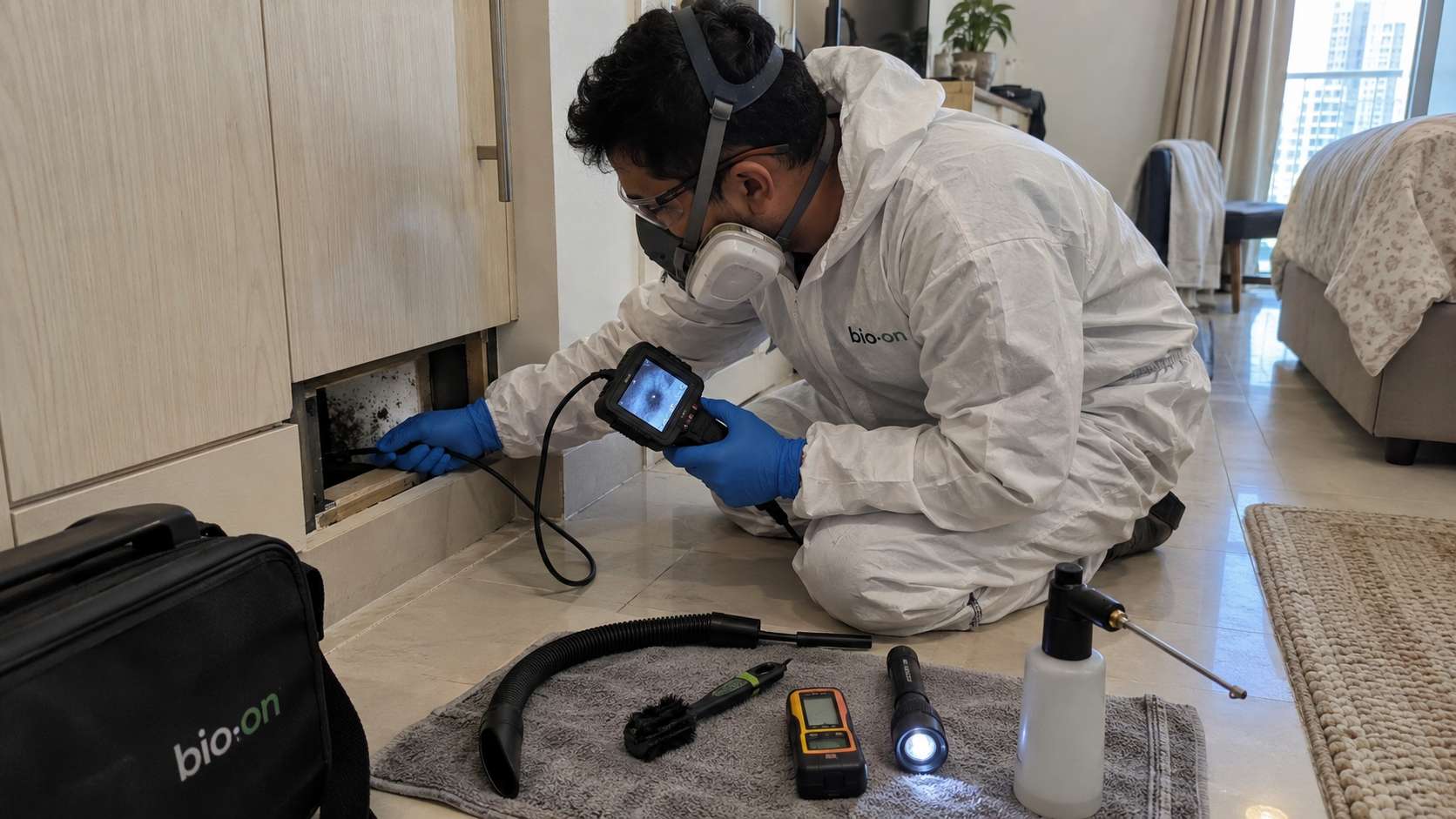
The company may need:
- Small detailing brushes
- Flexible cleaning attachments
- Extension tools
- Inspection cameras
- Controlled sprayers
- HEPA-filtered vacuum equipment
- Portable air-filtration equipment
Sometimes physical access also requires partially dismantling cabinetry, panels, skirting, or another removable element.
A competent company should tell you beforehand if this is likely.
Containment ability
Disturbing mold can release spores and contaminated dust.
If the affected space opens into a bedroom, office, kitchen, or occupied living area, the remediation team should know how to avoid spreading contamination unnecessarily.
Depending on the scale of the job, this may involve:
- Isolating the immediate work area
- Covering nearby belongings
- Using controlled airflow
- HEPA filtration
- Careful debris removal
- Cleaning surrounding surfaces afterward
Not every small mold spot needs elaborate containment. The important point is that the company understands when containment is necessary rather than treating every job as simple wiping.
Material-specific treatment
A good mold remediation company should understand that not every moldy material can be treated in exactly the same way.
Hard surfaces are generally easier to clean.
Porous materials may be more complicated. Mold can penetrate or contaminate materials such as:
- Drywall
- Insulation
- Unfinished wood
- MDF
- Fabric
- Carpet backing
- Some cabinetry materials
The company should be able to explain whether a material can reasonably be cleaned or whether removing and replacing part of it is more appropriate.
Questions to Ask Before Hiring the Company
You can learn a lot about a mold remediation company simply by asking how it intends to deal with the difficult access.
Start with this question:
How will you reach and inspect the entire affected area?
If the answer is vague, keep asking.
Useful questions include:
- How do you inspect behind furniture, cabinets, walls, or fixtures?
- Do you use moisture meters or thermal imaging?
- Do you have inspection cameras for narrow areas?
- What happens if you discover more mold behind the visible section?
- Will anything need to be dismantled?
- Who is responsible for removing and reinstalling panels or cabinetry?
- How will you stop spores from spreading during cleaning?
- Do you use HEPA filtration or vacuuming when appropriate?
- What products will you use?
- Are those products suitable for the affected material?
- How will you dry the space afterward?
- Will you check the moisture level again?
- Do you provide before-and-after photographs?
- Will you identify the likely cause of the mold?
- What should be repaired or changed to reduce recurrence?
Also ask what is not included.
That question is particularly useful because quotes can look similar while covering very different amounts of work.
For example, one company may quote only for cleaning visible mold. Another may include moisture assessment, access work, containment, treatment, cleanup, and follow-up recommendations.
Those are not equivalent services.
How to Compare Mold Remediation Quotes Properly
Do not compare tight-space mold quotes based only on the final price.
Instead, compare what each company is actually offering.
A useful quotation should make the scope clear enough that you understand what happens from inspection through completion.
Pay attention to these factors:
| Factor | What You Should Look For |
|---|---|
| Inspection | Is the difficult area properly assessed before work starts? |
| Access | How will technicians reach hidden mold? |
| Moisture detection | Will they investigate whether the area is still damp? |
| Containment | How will contamination be prevented from spreading? |
| Equipment | Do they have tools suitable for narrow or hidden spaces? |
| Materials | Do they understand what can be cleaned and what may need removal? |
| Treatment | Is the method appropriate for the affected surface? |
| Cleanup | Is post-remediation cleaning included? |
| Prevention | Will they explain what caused the mold and how to reduce recurrence? |
| Documentation | Are photographs, reports, or follow-up checks included? |
The cheapest quote may still be perfectly suitable for a very small and accessible problem.
But if one quotation is dramatically cheaper than the others, find out why.

Perhaps it excludes containment. Maybe technicians will only clean the visible section. Perhaps moisture testing is separate. Maybe dismantling furniture or access panels is not included.
You need to compare the same scope of work before judging which quotation gives better value.
Red Flags That the Service May Not Handle Tight Spaces Properly
Some warning signs suggest that the company is approaching the job as ordinary cleaning rather than remediation.
One major red flag is immediately promising that all mold will disappear without inspecting the hidden area.
Other warning signs include:
- Offering only spray treatment
- No questions about moisture
- No explanation of access
- No ability to inspect behind obstacles
- Treating every surface with the same chemical
- No discussion of containment
- No protection for nearby furniture or belongings
- No explanation of what happens if hidden mold is discovered
- Promising that mold can never return
- Giving a final quotation without understanding the affected space
- Focusing entirely on stains rather than the moisture source
Another warning sign is a company insisting that every contaminated material can simply be cleaned.
Sometimes removal is necessary. If severely contaminated porous material cannot realistically be restored, repeatedly applying chemicals may not be the best solution.
A responsible remediation service should be willing to tell you when cleaning has limitations.
Why Specialized Mold Remediation Is Usually the Better Choice
A general deep cleaning company may be excellent at floors, bathrooms, kitchens, furniture, and everyday dirt. Mold in a difficult location presents a different challenge.
Remediation requires understanding how moisture, building materials, airflow, contamination, and access interact.
Imagine mold growing behind a large built-in wardrobe.
A standard cleaner may wipe the visible section along the edge.
A mold remediation company should instead ask:
Why is moisture collecting behind the wardrobe?
How far does the mold extend?
Can the wardrobe be safely moved?
Is the back panel affected?
Is the wall damp?
Does airflow need improvement?
Will cleaning disturb contamination into the bedroom?
Those questions are what separate remediation from cosmetic cleaning.
The same principle applies to mold behind appliances, under sinks, around AC equipment, inside service voids, and beneath cabinetry.
If your property has difficult or recurring mold, Bio-On is one option worth considering because its mold-focused service can address the problem as a remediation job rather than treating it as ordinary surface cleaning.
For tight spaces in particular, the goal should be to access the affected area properly, treat the contamination, understand the moisture source, and make recurrence less likely.
That is far more useful than simply making the visible mold disappear for a short time.
What to Expect on the Day of Remediation
Before technicians arrive, you may be asked to clear items from around the affected area.
Do not aggressively scrub the mold beforehand. Leaving the problem reasonably undisturbed can help technicians understand its original location and extent.
Once the team arrives, they should confirm the agreed scope before starting.
Depending on the property, the process may include:
- Inspecting the mold and surrounding moisture conditions
- Protecting nearby surfaces and belongings
- Establishing containment if necessary
- Creating access to the tight space
- Removing loose contamination
- Cleaning or treating salvageable materials
- Removing materials that cannot reasonably be restored, where required
- Cleaning the surrounding work area
- Drying the space
- Rechecking moisture conditions
- Explaining any repair or prevention work still needed
Ask for photographs if parts of the treatment occur somewhere you cannot physically see.
For example, if technicians clean behind fixed cabinetry or within a ceiling opening, before-and-after documentation gives you a clearer record of what was actually treated.
You should also understand that mold remediation and building repairs are not always the same service.
If the remediation company discovers a leaking pipe, failing waterproofing, defective AC drain, or structural moisture issue, a plumber, AC technician, waterproofing contractor, or another specialist may also need to correct the underlying problem.
Cleaning should not be mistaken for fixing every possible source of moisture.
The Bottom Line
Mold in tight spaces is exactly the type of problem where specialized mold remediation matters most.
Before booking, make sure the company can explain how it will access the affected area, inspect for hidden moisture, control contamination, use suitable equipment, protect surrounding materials, and deal with mold that extends beyond what you can currently see.
Then compare quotations according to their scope rather than choosing the cheapest number.
Ask what is included, what could increase the price, what happens if additional mold is discovered, and what the company will do to help reduce recurrence.
A specialist such as Bio-On can be a practical choice when the problem is hidden, difficult to access, or repeatedly returning. The goal is not simply to clean whatever mold is visible. It is to reach the actual problem, remediate it correctly, and address the conditions that could allow it to grow back.