


Mold in the Workplace: Employee Rights Explained Clearly
Mold in the workplace employee rights usually begin with one core principle: you should not have to work in an unsafe or unhealthy environment. OSHA’s worker-rights guidance says federal law gives workers the right to a safe workplace, safety training, injury and illness reporting, access to certain records, and the ability to file confidential safety complaints.
That does not mean every small mold spot automatically becomes a lawsuit. It means your employer should take credible mold and dampness concerns seriously. If there is visible mold, a persistent musty smell, water damage, ceiling leaks, wet carpets, condensation, or multiple employees reporting symptoms, the employer should not simply paint over the stain and move on.
Your practical rights may include the right to:
- Report the hazard without being punished.
- Ask the employer to investigate the source.
- Request that leaks, dampness, and contaminated materials be addressed.
- Report work-related illness or symptoms.
- Ask for copies of relevant workplace injury or medical records.
- File a workplace safety complaint with the proper agency.
- Report retaliation if your employer punishes you for raising a safety concern.
The exact process depends on your country, state, contract, and workplace type. This article focuses heavily on U.S.-style employee rights because OSHA, CDC/NIOSH, EPA, workers’ compensation, and EEOC rules provide clear public guidance. If you are outside the U.S., the same practical documentation steps still help, but you should check your local labor authority.
Your Rights When You Find Mold at Work
If you find mold at work, your first right is the right to report the issue. You do not need to be a mold expert to say, “There is visible mold,” “There is a strong musty smell,” or “This wall has been wet for weeks.” You are reporting a condition, not giving a laboratory diagnosis.
OSHA’s mold page points workers to resources on preventing mold, recognizing exposure symptoms, and understanding employer responsibilities. OSHA also has a workplace mold guide that says workers who see or smell mold, or experience mold-related health problems, should report the problem to their employer so it can be investigated.
A strong internal report should include:
- Where the mold is located.
- When you first noticed it.
- Whether the area smells musty.
- Whether there has been a leak, flood, AC issue, or damp carpet.
- Whether the patch is spreading.
- Whether other employees have noticed symptoms.
- Photos or videos with dates, if allowed by workplace policy.
- A written request for inspection and remediation.
The key is to put it in writing. A verbal complaint can be denied later. A written email creates a timeline.
You also have the right to take your symptoms seriously. CDC says mold exposure can cause symptoms such as stuffy nose, sore throat, coughing, wheezing, burning eyes, and skin rash in some people. People with asthma, mold allergies, chronic lung disease, or immune compromise may be more vulnerable.
If symptoms improve away from work and worsen when you return, write that down. That pattern does not prove mold is the cause by itself, but it is important information for a doctor, employer, safety inspector, or lawyer.
What Your Employer Should Do About Workplace Mold
Your employer should investigate both the mold and the moisture source. Mold is usually not the first problem. Moisture is. If the leak, dampness, humidity, or condensation is not fixed, the mold can return even after cleaning.
NIOSH guidance on damp buildings emphasizes that dampness and mold in offices, schools, and similar nonindustrial buildings are associated with respiratory disease and symptoms. NIOSH also provides a Dampness and Mold Assessment Tool for evaluating dampness and mold-related damage in general buildings.
A responsible employer response may include:
- Inspecting the affected area.
- Checking for leaks or condensation.
- Fixing plumbing, roof, window, HVAC, or drainage issues.
- Removing water-damaged porous materials where needed.
- Cleaning or replacing contaminated materials safely.
- Improving ventilation and humidity control.
- Communicating the remediation plan to affected employees.
- Relocating employees temporarily if the affected area is unsafe.
Your employer should not rely only on air fresheners, paint, perfume, or casual wiping. Those actions may hide the odor or stain without solving the dampness problem.
EPA mold guidance also warns that using a biocide such as chlorine bleach is not recommended as a routine practice during mold cleanup. In other words, “spray bleach and forget it” is not a complete professional mold plan. Moisture correction and proper cleanup matter more.
If the mold is small and on a hard surface, basic cleaning may be enough. But if the area is large, recurring, hidden, or affecting porous materials like drywall, ceiling tiles, carpet, insulation, or wood, proper remediation becomes much more important.
What to Do If You Got Sick From Workplace Mold
If you believe workplace mold made you sick, get medical attention first. Do not try to build the whole legal case before seeing a doctor. Your health record matters, and early medical documentation can help connect your symptoms to timing, exposure, and workplace conditions.
Tell the doctor:
- When symptoms started.
- Where you work.
- What mold or dampness you saw or smelled.
- Whether symptoms improve on weekends, holidays, or when away from work.
- Whether symptoms worsen when returning to the workplace.
- Whether you have asthma, allergies, immune issues, or lung disease.
- Whether coworkers have similar complaints.

CDC/NIOSH notes that people in damp buildings report respiratory symptoms and infections, developing or worsening asthma, hypersensitivity pneumonitis, allergic rhinitis, and eczema. NIOSH also says work-relatedness may be suspected when symptoms and medical tests improve away from work and worsen when returning.
After medical care, report the illness through your workplace’s official injury or illness procedure. Ask for the incident to be recorded. Keep copies of emails, forms, medical notes, prescriptions, test results, and any written response from HR or management.
You may also consider a workers’ compensation claim if your illness is work-related. Workers’ compensation rules vary by state and country, so deadlines and proof requirements can differ. A workers’ compensation lawyer may be helpful if your symptoms are serious, your employer disputes the connection, or you are losing wages.
Do not exaggerate. Be factual. “I developed coughing, wheezing, and eye irritation after working near a damp, moldy ceiling for three weeks” is stronger than “my workplace poisoned me” if you do not yet have evidence.
How to File a Legal Report or Official Complaint
If your employer ignores the mold, delays action, or retaliates against you, you may have several reporting paths. The right path depends on what happened.
For a workplace safety hazard, OSHA says workers can file a confidential safety and health complaint and ask for an inspection if they believe there is a serious hazard or the employer is not following OSHA standards.
A strong complaint should include:
- Your workplace name and address.
- The exact location of the mold or dampness.
- How long the issue has existed.
- Whether there is visible mold, water damage, or musty odor.
- Whether employees are experiencing symptoms.
- Whether the employer was notified.
- What the employer did or failed to do.
- Photos, emails, medical documentation, or witness notes if available.
OSHA’s complaint-handling guidance says a written, signed complaint by a current employee or employee representative with enough detail about a likely violation or danger is more likely to result in an onsite inspection.
If you were punished for reporting mold, you may also have a retaliation or whistleblower issue. OSHA says employers must maintain a workplace free from retaliation for voicing safety concerns, and workers may file a whistleblower complaint if they believe they were retaliated against for exercising protected rights.
Retaliation may include:
- Firing
- Demotion
- Reduced hours
- Threats
- Discipline
- Bad schedule changes
- Harassment
- Transfer to worse duties
- Pressure to stay silent
OSHA worker-rights guidance says workers who believe they were retaliated against under OSHA whistleblower laws may have a limited filing window, commonly 30 days for some OSHA-related retaliation complaints. Because deadlines can be short, do not wait if retaliation happens.
If your illness becomes a disability or seriously affects breathing, working, or other major life activities, you may also have accommodation rights. The EEOC explains that employers may need to provide reasonable accommodation to a qualified employee with a disability unless it causes undue hardship. Reasonable accommodations can include changes in the workplace, schedule changes, leave, telework, or reassignment in some cases.
Evidence You Need to Support Your Mold Claim
Your case is much stronger when you document the issue before it disappears. Mold may be cleaned, painted over, or hidden after a complaint. That is why timing matters.
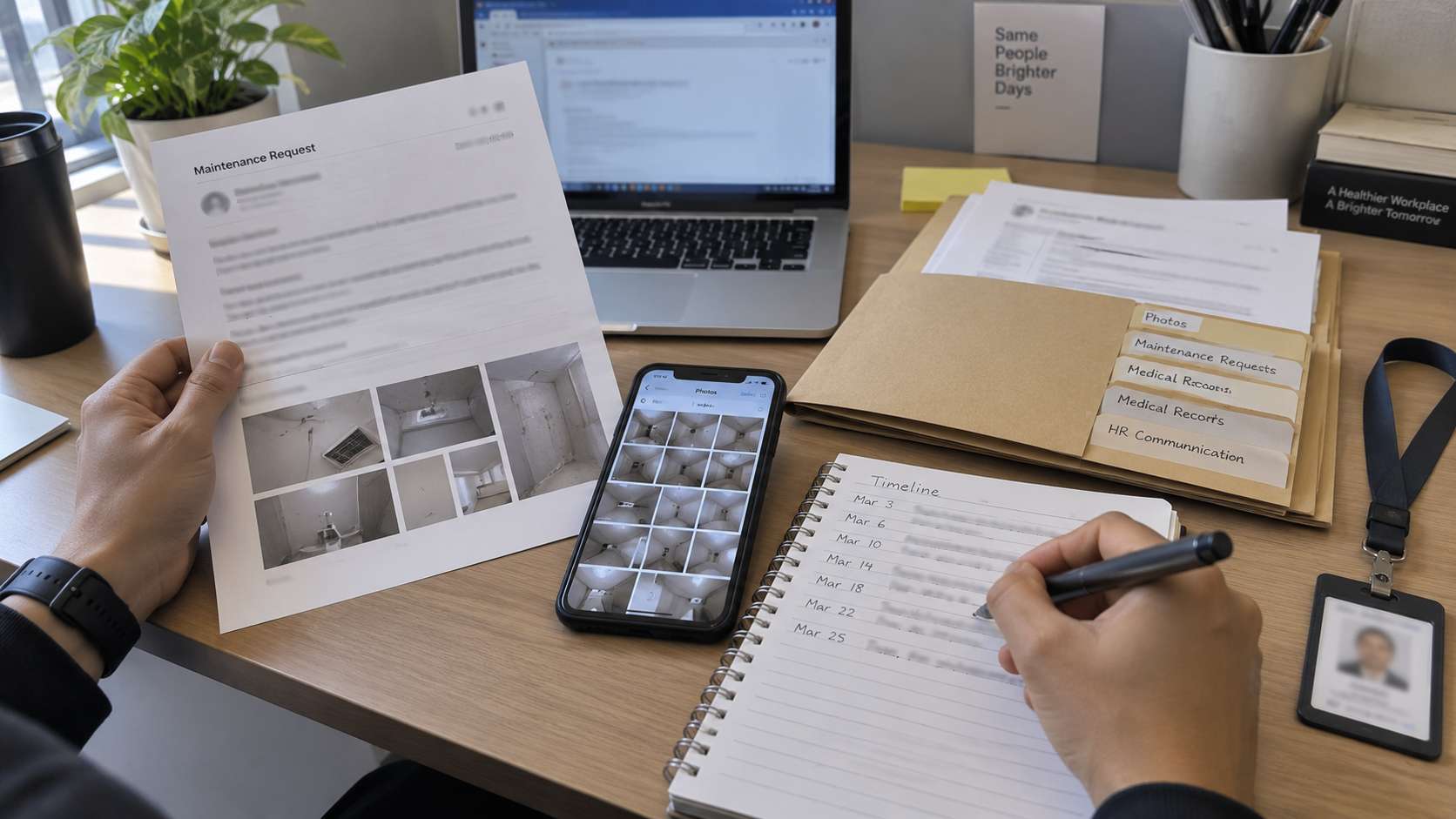
Useful evidence can include:
- Photos and videos of visible mold.
- Photos of leaks, stained ceiling tiles, wet carpet, damaged walls, or condensation.
- Dates when you first noticed the problem.
- Emails or messages reporting the issue.
- Employer replies or lack of replies.
- Maintenance requests.
- Doctor visits and medical notes.
- Prescriptions or test results.
- Symptom diary.
- Names of coworkers who noticed the same issue.
- Records of missed work.
- Pay records showing lost wages.
- Any retaliation evidence.
Keep your documentation professional. Do not secretly record conversations if your local law does not allow it. Do not trespass into restricted areas. Do not damage company property to collect samples. Do not take confidential documents that you are not allowed to access.
A simple symptom diary can be powerful. Write down the date, work area, symptoms, severity, and whether symptoms improved away from work. For example: “Monday, September 14, worked near back storage room with musty smell. Coughing and burning eyes after two hours. Improved after leaving work.”
Also remember that mold testing is not always the first or most important step. CDC/NIOSH says finding and correcting sources of dampness is more effective for preventing health problems than counting indoor microbes.
That means photos of water damage, leak history, damp materials, and recurring visible mold can matter a lot.
When a Mold Problem Becomes a Legal Issue
A workplace mold problem may become a legal issue when your employer knew or should have known about the hazard and failed to respond reasonably. It may also become legal when you suffer health effects, lose income, need medical treatment, or face retaliation after reporting the problem.
Situations that may justify legal advice include:
- Your employer ignored repeated written complaints.
- The mold covers a large area or keeps returning.
- Multiple employees are sick.
- You have medical documentation of respiratory or allergic symptoms.
- You missed work or lost wages.
- You were fired, demoted, threatened, or punished after reporting mold.
- The employer painted over mold without fixing the moisture source.
- You were forced to work in a visibly damp or contaminated area.
- Your request for accommodation was denied without proper discussion.
- You have asthma or another condition made worse by the workplace.
An employment lawyer, workers’ compensation lawyer, or personal injury lawyer can help you understand which path fits your case. OSHA can address safety hazards and retaliation. Workers’ compensation may address work-related illness and lost wages. Disability accommodation may involve EEOC-type protections. A civil lawsuit may be possible in some cases, but it depends heavily on proof, damages, local law, and whether workers’ compensation limits other claims.
Be careful with the phrase “what you deserve.” In a legal context, what you may be entitled to depends on evidence. That may include medical costs, wage replacement, workplace accommodation, reinstatement after retaliation, hazard correction, or other remedies. It is not automatic just because mold exists.
How Professional Mold Remediation Helps Employee Rights Cases
Professional mold remediation can help because it focuses on the source, not just the stain. A workplace that smells musty or has recurring mold needs more than a cleaner and a paintbrush.
Professional support may include:
- Moisture inspection
- Leak source investigation
- Containment planning
- Safe removal of contaminated materials
- HEPA vacuuming or air filtration where needed
- Drying recommendations
- Post-cleaning verification
- Written reports or scope of work
- Prevention recommendations
This matters for employee rights because a proper report can show whether the issue was small and isolated or part of a larger building problem. It can also help prevent the same issue from returning.
However, employees usually should not hire a remediation company for the employer’s building without authorization. Instead, ask the employer, landlord, property manager, safety officer, or building owner to arrange a qualified inspection and remediation.
If your employer claims the area is safe but the mold keeps returning, you can ask what inspection was done, what moisture source was fixed, what materials were removed or cleaned, and whether the remediation followed recognized guidance. EPA advises checking references and asking contractors to follow professional or government mold remediation guidance, including EPA’s guidance for schools and commercial buildings or other recognized industry guidance.
The Bottom Line: Mold in the Workplace Employee Rights
Mold in the workplace employee rights matter because workers should not be forced to ignore visible mold, musty odors, damp building materials, or symptoms that appear connected to the workplace. You have the right to report the concern, document the problem, seek medical care, request investigation, and file an official complaint if the employer fails to address a serious hazard.
If you feel sick, take the medical side seriously. Get checked, explain the workplace exposure clearly, and keep records. If symptoms improve away from work and worsen when you return, document that pattern carefully.
If the employer responds properly, the issue may be solved through inspection, moisture repair, safe cleanup, and prevention. If the employer ignores the issue or retaliates, you may need to file an OSHA complaint, contact your state safety agency, explore workers’ compensation, request reasonable accommodation, or speak with an employment lawyer.
The most important thing is to act early and stay factual. Mold cases are easier to take seriously when you have dates, photos, written complaints, medical records, and a clear timeline.