


Do White Stains Mean Signs of Mold Growth in a Humidifier?
Probably not. Let me tell you guys. If the stains are white, powdery, dry, and spread across nearby furniture, they are more likely to be minerals from the water than mold. This is commonly called humidifier white dust.
Ultrasonic humidifiers produce mist by vibrating water into extremely small droplets. When those droplets evaporate, minerals originally present in the water can remain behind. They may settle on:
- Tables and shelves
- Television screens
- Dark furniture
- Windows
- The floor around the appliance
- The humidifier’s mist outlet
The US Environmental Protection Agency notes that ultrasonic and impeller humidifiers can disperse minerals from tap water into indoor air. Those minerals may appear as white dust on household surfaces. The same minerals can also create crusty scale inside the appliance.
That does not mean the residue should be ignored. Mineral deposits can create rough surfaces and hidden spaces where microorganisms are harder to remove. So, white dust by itself is not strong evidence of mold. But it is a sign that you may need to change the water you use and clean the appliance more carefully.
How Can You Tell Mineral Dust, Scale, and Mold Apart?
Simple. You just need to look at the texture, location, smell, and way the substance returns. Colour alone is not enough to identify mold accurately.
| What you notice | Most likely explanation | Recommended response |
|---|---|---|
| Fine white powder on furniture | Minerals dispersed from tap water | Clean surfaces and switch to distilled or low-mineral water |
| Hard white crust inside the tank | Mineral scale | Descale the unit according to its manual |
| Clear or cloudy slippery film | Biofilm or contaminated residue | Stop using the unit and clean it thoroughly |
| Fuzzy or irregular spots | Possible mold growth | Stop operation until the appliance is cleaned or replaced |
| Pink, orange, green, brown, or black residue | Possible microbial growth, dirt, or mixed contamination | Treat it as contamination rather than harmless scale |
| Persistent musty smell | Possible mold or microbial buildup | Inspect the tank, base, filter, mist outlet, and internal passages |
| Residue returns quickly after cleaning | Hidden contamination or severe scale | Consider replacing the humidifier |
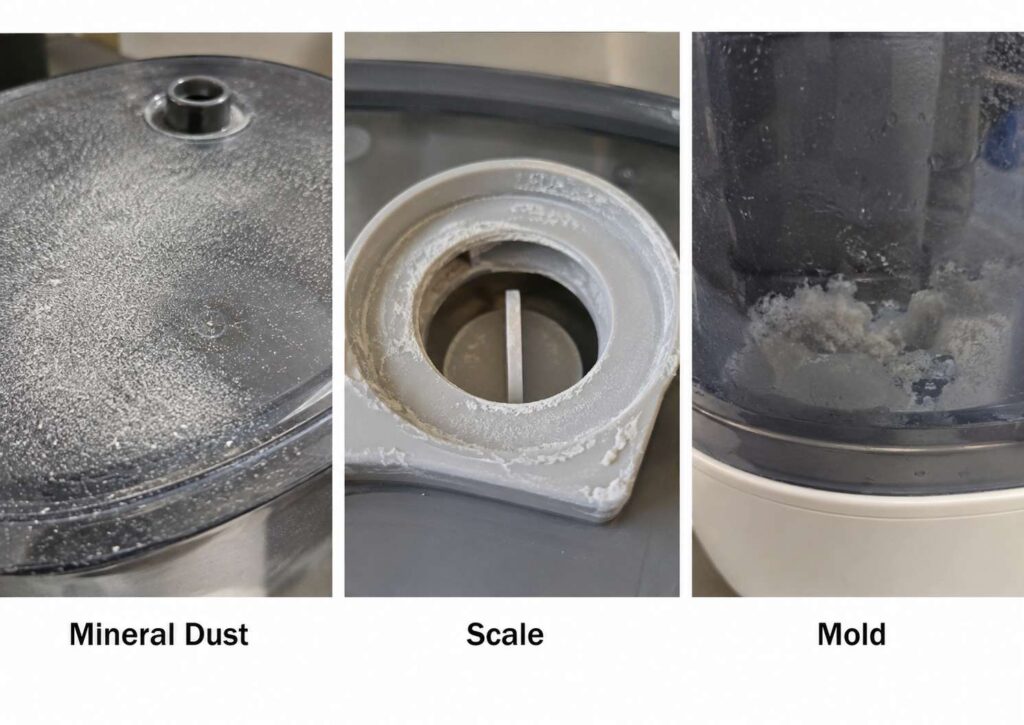
Mineral scale normally feels hard, dry, or chalky. It often develops along the waterline, heating plate, reservoir base, or mist outlet.
Possible mold or microbial contamination may look:
- Slimy
- Fuzzy
- Irregular
- Stained rather than powdery
- Difficult to wipe away completely
A musty smell is another warning sign. Visible or odorous mold should be removed, and the moisture problem supporting it must also be addressed.

Remember that not every coloured stain is mold. Pink or orange residue, for example, may involve bacteria or other microbial material. From a practical point of view, the response is similar: stop dispersing mist from the appliance until the contaminated surfaces have been cleaned.
Should You Clean or Replace a Moldy Humidifier?
Cleaning is usually reasonable when the contamination is limited to smooth, accessible surfaces and the appliance remains in good condition. Replacement is the safer choice when mold growth has entered parts you cannot inspect or clean.
If you can just clean the humidifier
If you see the spots can be cleaned, then make sure you follow the humidifier’s care instructions. It usually involves:
- Stop using the humidifier. Don’t continue sending mist into the room while visible contamination is present.
- Empty the reservoir. Dispose of old water rather than topping it up.
- Remove washable components. This may include the tank, cap, tray, wick holder, or mist nozzle.
- Remove mineral scale. Use the descaling method approved by the manufacturer.
- Clean water-contact surfaces. Pay particular attention to corners, seams, seals, and the waterline.
- Rinse thoroughly. Cleaning chemicals should not remain where they may later enter the mist.
- Allow every part to dry. Reassembling a damp unit can encourage contamination to return.
- Replace disposable filters or wicks. Do not reuse a part that remains stained, musty, damaged, or contaminated.
But note that you should never mix bleach with ammonia, vinegar, acids, or other cleaners. Mixing household chemicals can release dangerous gases.
Replace the humidifier when:
- Mold remains after careful cleaning
- The smell returns as soon as the machine runs
- Contamination is visible inside inaccessible air or water passages
- The reservoir is cracked, scratched, or permanently stained
- The unit repeatedly develops growth despite correct maintenance
A heavily contaminated appliance is rarely worth saving simply because it still turns on. Rather than focusing on that, see if the motor works. It is whether every water-contact and mist-producing surface can be cleaned reliably.
Which Humidifier Type Is Easier to Keep Clean?
No humidifier is maintenance-free. However, the type you choose affects how much mineral dust it disperses, where water sits, and how easily components can be cleaned.
Ultrasonic humidifiers
Ultrasonic models are quiet and commonly available, but they can disperse minerals from tap water. That makes them more likely to create white dust.
They may be suitable when you are willing to use distilled or low-mineral water, empty the tank daily, and clean small internal components regularly

Evaporative humidifiers
Evaporative units use a fan and wet wick or filter. According to the EPA, they generally disperse fewer minerals into the air than ultrasonic or impeller models. However, the reservoir and wick can still support microbial growth when maintenance is neglected.
They may be a better option if white dust is your main concern, but you must budget for replacement wicks and filters.
Warm-mist or steam humidifiers
These appliances heat water to create steam. They are not expected to disperse substantial amounts of minerals, although deposits can still build up inside the appliance. Hot water and steam also create a burn risk, especially around children and pets.
Whole-home humidifiers
Central units can humidify a larger area, but professional installation and regular HVAC maintenance are important. Pads, drains, water lines, trays, and internal components still need inspection.
Regardless of type, look for a model with a wide tank opening, removable water-contact parts, clear cleaning instructions, replaceable filters, and an automatic humidity control.
In humid climates and heavily air-conditioned homes like in the UAE, do not assume a humidifier is automatically beneficial. Measure the room first. Adding moisture to an already humid space can create condensation and make conditions more suitable for mold.
How Do You Prevent Mold From Returning?
The most effective routine is simple: use fresh water, remove standing water, control the room’s humidity, and allow the machine to dry.
The CDC advises users to empty humidifiers every day, clean them according to the manufacturer’s instructions, and let them air-dry after cleaning. Distilled water or boiled and cooled water may further reduce germ growth.
Use this practical routine:
- Empty leftover water after every day of use.
- Don’t keep topping up old water.
- Use distilled water when white dust or scale is a recurring problem.
- Follow the model’s scheduled deep-cleaning procedure.
- Check the room with a hygrometer.
The US Consumer Product Safety Commission warns that microorganisms can grow in poorly maintained humidifier tanks and may become airborne during operation.
So, What’s the Takeaway?
White stains around a humidifier are usually mineral dust or scale, especially when you use tap water in an ultrasonic model. Switch to distilled water, remove the deposits, and improve your cleaning routine.
However, slimy film, fuzzy patches, coloured growth, persistent staining, or a musty smell should be treated as possible contamination. Stop using the humidifier until it has been properly cleaned.