


Mold Armor Instant Mold & Mildew Stain Remover User Reviews
Most reviews for Mold Armor Instant Mold & Mildew Stain Remover are positive when the product is used for the right job. The most common happy-customer story is easy to understand: someone has black or brown mildew stains in a shower, on grout, around a tub, or on a bathroom ceiling. They spray the product, wait a short time, and the staining fades dramatically.
Across retailer review summaries, customers often describe it as fast, strong, and easier than scrubbing. Lowe’s review summaries say many customers report visible mould disappearing within minutes with no scrubbing required, even on stubborn bathroom tiles, ceilings, and shower surrounds. Home Depot review snippets also highlight the “no scrub” claim, with customers saying the product removes mould and stains within minutes.
The most common positive comments usually fall into these patterns:
- It works quickly on visible mould stains.
- It reduces or removes the need for hard scrubbing.
- It performs well on shower grout and tile.
- It can make old bathroom areas look brighter.
- It feels stronger than ordinary bathroom cleaners.
- It works where some lighter cleaners did not.
Walmart review snippets also show users praising the product for bathroom cleaning, while warning that it contains bleach and can damage clothing if sprayed carelessly.
The negative review patterns are also very consistent. Some users complain about the strong bleach-like smell. Some mention packaging or leaking issues. Others say it did not fully remove deeper stains, or that the mould came back later. Those complaints are important because they show the real boundary of the product: it can be excellent at stain removal, but stain removal is not always the same thing as solving mould.
Our Hands-On Perspective as a Professional Mould Cleaning Service
From a professional mould cleaning point of view, Mold Armor Instant Mold & Mildew Stain Remover is a strong consumer-grade product for visible surface staining. It is the kind of product we would expect to perform best on hard, non-porous surfaces where the cleaner can directly touch the mould or mildew stain.
That includes surfaces like:
- Ceramic tile
- Glazed bathroom surfaces
- Vinyl
- Shower surrounds
- Tubs
- Sinks
- Some sealed grout lines
- Hard bathroom ceilings, depending on paint condition
The product label information and retailer listings position it for hard surfaces and quick stain removal. Some product information also describes no-scrub cleaning and mould/mildew stain removal, which matches what many reviewers experience in bathrooms.
In real mould work, though, we judge success by more than “does it look clean?” A mould stain can disappear while moisture remains. A surface can look white again while contaminated material behind it stays damp. A shower corner can look fresh today and grow the same black spots again next week if ventilation is poor.
That is why our professional view is balanced. Mold Armor is useful. It can save time. It can make a bathroom look dramatically cleaner. But it should not be treated as proof that the mould issue is fully solved.
For a small bathroom stain, that may be fine. For recurring mould, hidden odour, water damage, or mould on porous material, you need inspection and source control, not just a stronger spray.
How Good Is It at Killing Mould?
Mold Armor Instant Mold & Mildew Stain Remover can be very effective against surface-level mould and mildew because it uses sodium hypochlorite, the active ingredient associated with bleach-based disinfection and stain removal. The product’s label and EPA-related product records identify sodium hypochlorite as the active ingredient for Mold Armor mould and mildew products.
This matters because bleach-based cleaners are very good at two things: attacking surface growth and whitening dark stains. That is why users often describe an “instant” visual change. The mould stain does not just loosen like dirt. It often lightens because the bleach breaks down the dark staining compounds.
For surface mould, that can be genuinely useful. If the mould is on top of a tile, sitting on the surface of vinyl, or staining the outer layer of grout, the product may deliver the result people want. Many users say they spray it, wait around several minutes, then rinse or wipe.
But there is a limitation. Mould is not always sitting neatly on the top of a surface. It can grow into tiny pores, cracks, sealant edges, drywall, wood, insulation, carpet backing, and painted surfaces. In those cases, the spray may not reach the full contamination. It may bleach the top layer and make the area look better, while deeper growth remains.
So, how good is it?
For light to moderate surface stains, very good.
For deep mould contamination, unreliable.
For recurring mould caused by moisture, incomplete.
For hidden mould, not enough.
That does not make the product bad. It just means the job has to match the tool.
What People Usually Like About Mold Armor
The biggest thing people like is speed. Reviews often mention that visible staining fades quickly, sometimes in minutes. That is a huge selling point because mould cleaning is usually associated with scrubbing, repeated washing, and frustration.
The second thing people like is the no-scrub effect. Review summaries from Lowe’s and Home Depot repeatedly mention customers being impressed by mould and mildew stains disappearing without heavy scrubbing. This is especially valuable for shower ceilings, tub corners, textured areas, and grout lines that are tiring to clean manually.
The third thing people like is that it feels “strong.” Compared with gentle bathroom sprays, Mold Armor has a more aggressive cleaning effect. That strength is exactly why it gets strong praise on stubborn bathroom stains.
People also like that it works on several common household areas. Depending on the specific product and label directions, users commonly mention bathrooms, showers, grout, tubs, tile, vinyl, ceilings, and similar surfaces. For homeowners, that makes it feel practical because one bottle can handle several ugly bathroom stains.
In short, people usually like it because it gives visible results fast. You do not need to be a cleaning expert to understand the appeal. Spray, wait, rinse, and the surface can look much cleaner.
What People Usually Complain About
The most common complaint is the smell. Many users describe a strong bleach-like odour, and Lowe’s review summaries mention that customers often note the need for ventilation. Home Depot review snippets also mention a bleachy smell, although some reviewers accept it as the trade-off for strong cleaning power.
This is not a small issue. A bleach-based mould remover should be used carefully. You should ventilate the room, avoid breathing fumes, wear gloves, keep children and pets away, and never mix it with other chemicals. Mixing bleach-based products with acidic cleaners or ammonia-based cleaners can create dangerous fumes.
Another complaint is surface sensitivity. Because the product contains bleach, it can discolor fabrics, towels, clothing, rugs, and some finishes. Walmart review snippets specifically warn that the product contains bleach and should not be sprayed near clothing.
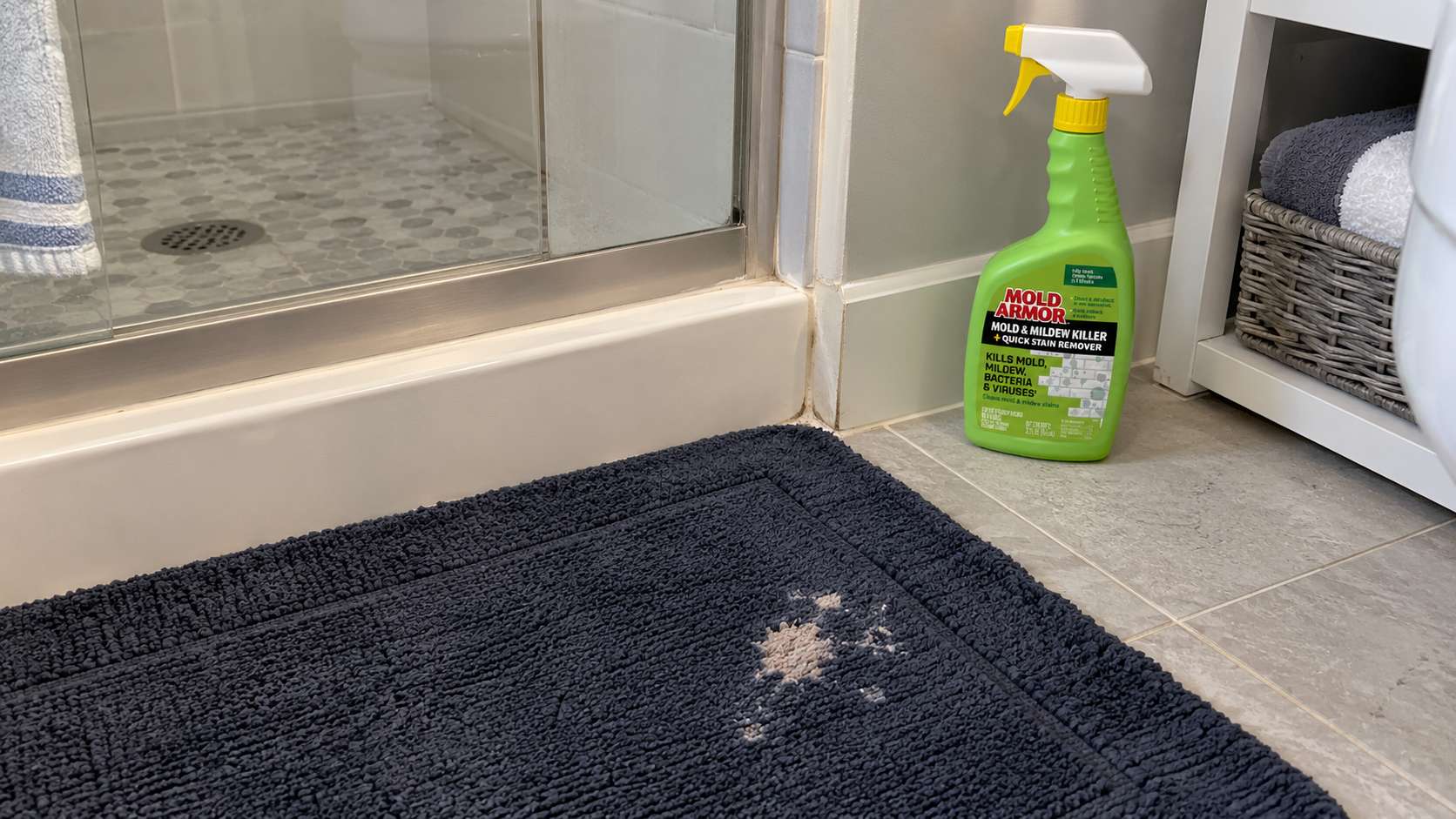
Some users also report that the result is not always perfect. This usually happens when the mould stain is old, deep, or inside damaged material. For example, old silicone sealant may stay stained because mould can penetrate into the sealant. Painted surfaces may react differently depending on paint type and condition. Porous surfaces may not clean evenly.
There are also complaints that the mould comes back. In most cases, that is not because the stain remover “failed” in the narrow cleaning sense. It is because the underlying moisture issue was never fixed.
In What Cases Mold Armor Cannot Help at All
Mold Armor Instant Mold & Mildew Stain Remover cannot help when the mould problem is not actually a surface stain problem. This is where homeowners often waste money and time. They keep buying stronger sprays, but the real issue is water, humidity, poor ventilation, or hidden contamination.
It cannot properly solve these cases:
Hidden mould behind walls or ceilings.
If the mould is behind drywall, paint, wallpaper, ceiling boards, cabinets, tiles, or insulation, a spray on the visible surface will not reach the main colony.
Mould caused by an active leak.
A leak under a sink, behind a wall, from a roof, near a window, or from an AC drain must be repaired. Otherwise, mould will return no matter how strong the cleaner is.
Mould inside porous materials.
Drywall, untreated wood, carpet, fabric, insulation, and some old grout can hold mould below the surface. Bleach-based sprays may improve the appearance but not fully remove deeper contamination.
Large mould contamination.
A 32-ounce trigger spray is not a serious plan for a large mould outbreak. Larger areas need containment, controlled removal, drying, disposal, and sometimes air filtration.
Recurring bathroom mould.
If the bathroom has poor exhaust, constant condensation, wet sealant, or no airflow, the same mould can return again and again.
Musty odour without visible mould.
A musty smell often points to hidden damp material. Spraying visible surfaces may do nothing because the source is somewhere else.
Mould near HVAC or AC systems.
If mould is connected to air movement, ducts, coils, vents, or condensation inside an AC system, surface spraying is not enough and may even miss the main source.
In these situations, Mold Armor may clean the symptom, but it cannot solve the cause.
How We Would Use It Safely for Small Jobs
For small bathroom mould stains, we would treat Mold Armor as a targeted cleaner, not something to spray everywhere casually. Strong cleaners should be used with control.
A sensible small-job method would look like this:
- Open windows or turn on the exhaust fan.
- Wear gloves and avoid breathing the mist.
- Remove towels, clothes, bath mats, and fabric items nearby.
- Spray only the affected hard surface.
- Let it sit according to the label directions.
- Rinse or wipe the area properly.
- Dry the surface completely.
- Keep the room ventilated after cleaning.
The last step matters a lot. Mould needs moisture. If your shower wall stays wet for hours after every bath, the mould has a reason to come back. Drying and airflow are not optional extras. They are part of mould prevention.
For grout, Mold Armor may brighten the surface well. But if the grout is cracked, missing, or deeply contaminated, cleaning alone may not be enough. You may need regrouting or sealing.
For silicone sealant, be realistic. If the black mould is inside the sealant, the product may only lighten it. In professional cleaning, badly mouldy silicone is often better removed and replaced.
For painted ceilings, test carefully and avoid oversaturation. If the paint is damaged, peeling, or damp underneath, the cleaner will not fix the material failure.
Mold Armor vs Professional Mould Cleaning
The biggest difference between Mold Armor and professional mould cleaning is diagnosis. Mold Armor treats what you can see. A professional service investigates why the mould exists.
Professional mould cleaning may involve:
- Moisture inspection
- Leak detection support
- Humidity and condensation assessment
- Surface testing where relevant
- Containment for affected areas
- Safe removal of contaminated material
- HEPA vacuuming or air filtration where needed
- Antimicrobial treatment
- Drying and prevention recommendations
- Advice on whether materials can be saved or must be replaced
That is a different level of work from spraying a bathroom cleaner.
You probably do not need a professional if the mould is only a few small spots on tile or grout, the surface cleans well, there is no musty smell, and it does not return after ventilation improves.

You should consider hiring a professional if:
- The mould keeps coming back.
- The affected area is spreading.
- There is a musty smell.
- The mould appeared after a leak or flood.
- The wall, ceiling, floor, or cabinet feels damp.
- The mould is on drywall, wood, carpet, or insulation.
- The problem is near AC vents or ducts.
- Someone in the home has asthma, allergies, or immune sensitivity.
- You have cleaned the same area several times with no lasting result.
Mold Armor can be part of basic home maintenance. It should not replace professional remediation when the mould is structural, hidden, recurring, or moisture-driven.
The Bottom Line: Mold Armor Instant Mold & Mildew Stain Remover Final Verdict
Mold Armor Instant Mold & Mildew Stain Remover is a strong, effective, bleach-based stain remover for small mould and mildew problems on hard bathroom surfaces. Most user-review patterns are very positive because the product works fast, reduces scrubbing, and can make stained grout, tile, tubs, and shower surrounds look dramatically cleaner. Its sodium hypochlorite formula also explains why the visual result can be so quick.
Our professional verdict is clear: this is a good product for surface cleaning, but not a complete mould solution.
You likely do not need a professional if the mould is minor, visible, on a washable non-porous surface, and does not return after cleaning, drying, and improving ventilation. In that case, Mold Armor can be a practical and powerful option.
You should hire a professional if the mould keeps returning, covers a larger area, smells musty, follows water damage, affects porous material, appears near HVAC systems, or may be hidden behind walls, ceilings, cabinets, or floors. In those cases, Mold Armor may bleach the warning sign, but it cannot remove the underlying mould problem.
So, the final verdict is simple: Mold Armor Instant Mold & Mildew Stain Remover is impressive for stains, useful for light bathroom mould, and worth considering for small surface jobs. But if the mould is deep, recurring, hidden, or moisture-related, professional mould remediation is the safer and more complete answer.