


Why You May Need a Mold Absorber
You may need a mold absorber if a space feels damp, smells musty, or often develops condensation. Mold needs moisture to grow, so reducing dampness is one of the most important prevention steps. EPA explains that the key to mold control is moisture control, and indoor humidity should ideally stay between 30% and 50% when possible.
In real homes and businesses, moisture often builds up quietly. A wardrobe may smell musty even when the room looks clean. A bathroom cabinet may stay damp after every shower. A storage room may trap humid air because the door stays closed. A laundry area may have wet towels, poor ventilation, and warm air. Over time, these conditions can support mold growth on clothes, shoes, bags, wood, cardboard, leather, walls, and stored items.
A mold absorber helps by pulling moisture from the air or reducing the damp smell around that area. It is not as powerful as a plug-in dehumidifier, but it is cheaper, smaller, silent, and easy to place almost anywhere.
You may want one if you notice:
- musty smell inside a cabinet or wardrobe;
- white, green, or black spots on stored items;
- damp-feeling clothes or shoes;
- condensation near windows or bathroom corners;
- moisture inside storage boxes;
- mold returning in closed rooms;
- bad smell in cars, boats, or unused spaces;
- humidity in areas without electrical outlets.
The main benefit is prevention. A mold absorber is best used before mold becomes a major problem, not after a wall is already contaminated.
What Mold Absorbers Actually Do
Mold absorbers reduce the moisture or odor conditions that help mold grow. They do not magically pull mold spores out of a room and they do not repair water damage. That is why the name can be a little misleading.
Different products work in different ways. Some absorb water vapor from the air and turn it into liquid inside a container. Some trap odors. Some reduce dampness slowly over time. Some can be dried and reused. Some are disposable.
The most common mold absorber types are:
| Type | Main Function | Best Use |
|---|---|---|
| Calcium chloride disposable boxes | Absorbs moisture and collects water | Wardrobes, cabinets, storage rooms |
| Hanging dehumidifier bags | Absorbs moisture in vertical spaces | Closets, laundry rooms, wardrobes |
| Activated charcoal or bamboo packs | Absorbs odor more than moisture | Shoes, drawers, cars, small cabinets |
| Refillable moisture traps | Absorbs moisture with replaceable crystals | Reusable moisture control in small spaces |
A good mold absorber can help keep a small closed space drier. But it does not replace ventilation, leak repair, AC maintenance, or professional remediation. CDC notes that any mold growing in buildings indicates a water or moisture problem that should be addressed.
So, think of mold absorbers as support tools. They are helpful when the moisture level is mild to moderate. They are not enough when water is entering the building, mold is visible, or the humidity problem is room-wide.
Best Mold Absorber Options for Low-Cost Moisture Control
The best mold absorber for you depends on where the dampness appears, how much space you need to protect, and whether your main problem is moisture, odor, or recurring mold risk.
Calcium Chloride Disposable Boxes
Calcium chloride disposable boxes are one of the strongest low-cost options for absorbing moisture. These usually come as plastic tubs or boxes filled with moisture-absorbing crystals. As the crystals absorb water from the air, liquid collects at the bottom of the container.
They are popular because they are simple. You open the seal, place the box in a damp area, and replace it when the crystals are used up or the container is full of liquid.
They work best in:
- wardrobes;
- kitchen cabinets;
- bathroom cabinets;
- small storage rooms;
- boats and caravans;
- unused rooms;
- shoe cabinets;
- pantry corners.
The main advantage is moisture removal. Compared with charcoal packs, calcium chloride products actually collect water. That makes them better when your main concern is damp air, not just bad smell.
The downside is that they are disposable. Once the box is full, you need to throw it away and replace it. The liquid inside can also spill, so it should be kept upright and away from children, pets, electronics, documents, and expensive fabrics.
Best for: people who want a cheap, strong, no-electricity moisture absorber for closed spaces.
Hanging Dehumidifier Bags
Hanging dehumidifier bags work similarly to disposable moisture boxes, but they are designed to hang inside closets, wardrobes, laundry rooms, or storage areas. They usually contain moisture-absorbing crystals at the top and collect liquid in a lower pouch.
These are useful when shelf space is limited. In a wardrobe, for example, you can hang one beside clothes and let it absorb moisture from the air.
They work best in:
- clothing closets;
- wardrobe sections;
- laundry areas;
- storage cabinets;
- changing rooms;
- closed utility areas;
- guest rooms that are rarely opened.
Hanging bags are especially helpful for clothes, bags, jackets, uniforms, and fabric items that easily absorb musty odor. They can reduce the damp feeling in enclosed spaces and help prevent mold from forming on stored textiles.
The limitation is capacity. A small hanging bag cannot control a whole humid room. It only helps the air around a limited enclosed area. If your entire room feels damp, you need stronger ventilation, AC humidity control, or a real dehumidifier.
Best for: wardrobes, closets, and fabric storage areas where moldy smells keep appearing.
Activated Charcoal and Bamboo Packs
Activated charcoal and bamboo packs are often marketed as natural odor absorbers. They are reusable, simple, and usually safer to place around shoes, drawers, cars, cabinets, and small personal storage spaces.
However, they are not the best choice if your main problem is heavy moisture. Charcoal can help reduce odor and absorb some humidity, but it will not collect water like calcium chloride crystals. So if the space is genuinely damp, charcoal alone may not be enough.
They work best in:
- shoe racks;
- gym bags;
- small drawers;
- car interiors;
- luggage;
- cabinets;
- pet areas;
- mild musty-smell zones.
The biggest benefit is odor control. If your cabinet smells stale but is not visibly wet or moldy, charcoal packs can help freshen the area. Many bamboo charcoal packs can also be recharged by placing them in sunlight, depending on the product instructions.
The downside is that they can create false confidence. If a room smells musty because of hidden mold behind a wall, charcoal may reduce the smell temporarily while the real problem gets worse.

Best for: odor control in small dry-to-mildly-damp spaces, not serious mold prevention.
Refillable Moisture Traps
Refillable moisture traps are similar to disposable calcium chloride boxes, but the container can be reused. You replace only the moisture-absorbing crystals or refill pack. This can make them more cost-effective over time.
They are useful if you have recurring dampness in the same cabinet, wardrobe, or small room. Instead of buying a whole new box every time, you keep the container and refill it.
They work best in:
- small bedrooms;
- wardrobes;
- under-sink cabinets;
- store rooms;
- bathrooms;
- closed office cabinets;
- apartments with mild humidity issues.
The main advantage is lower long-term cost. The main disadvantage is maintenance. You need to check the water level, empty it carefully, clean the container, and add refills. If you forget about it, it can overflow or stop working.
Best for: people who want a reusable low-cost alternative to disposable moisture absorbers.
Best Low-Cost Alternative to a Dehumidifier
The best low-cost alternative to a dehumidifier is usually a calcium chloride moisture absorber, especially for small enclosed spaces. It removes actual moisture from the air, costs less than an electric dehumidifier, and does not need power.
But there is an important difference. A dehumidifier actively pulls moisture from the air using electricity and can control a whole room if sized properly. A mold absorber works slowly and only affects a smaller area. It is passive.
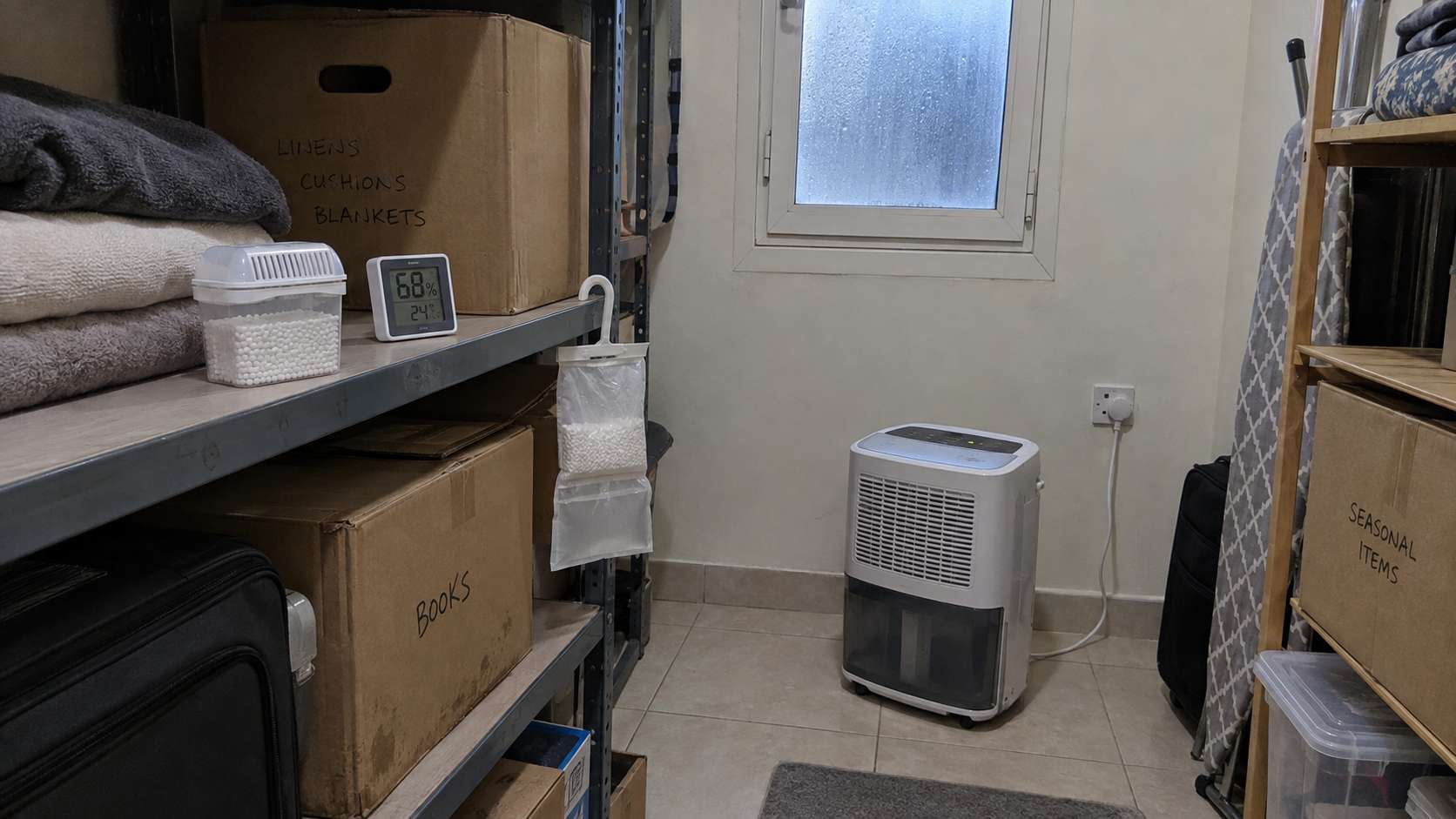
So, the right choice depends on the size of the problem.
Use a mold absorber when:
- the space is small;
- there is no power outlet;
- dampness is mild;
- the problem is inside a cabinet, wardrobe, or storage box;
- you want a cheap prevention tool;
- there is no active leak;
- no visible mold is spreading.
Use a dehumidifier when:
- the whole room feels humid;
- condensation appears often;
- clothes feel damp indoors;
- AC is not removing enough moisture;
- several areas smell musty;
- you need measurable humidity control;
- you want to maintain indoor humidity more consistently.
EPA recommends keeping indoor humidity low, ideally between 30% and 50%, to reduce mold growth risk. A humidity meter is useful here. Without one, you may keep guessing whether the absorber is enough.
For the cheapest setup, combine a humidity meter with calcium chloride boxes in closets and refillable traps in storage rooms. If the meter still shows high humidity, move up to a dehumidifier or get professional help to find the moisture source.
How to Use Mold Absorbers Properly
Mold absorbers work better when they are placed correctly. Throwing one random box into a damp room may not do much.
Start by identifying the dampest spots. Check corners, cabinets, wardrobes, under sinks, behind furniture, and areas that smell musty. Place the absorber close to the problem area, but not where it can spill.
For wardrobes, place one absorber low and one higher if the space is large. Moist air can collect in different areas depending on airflow. For under-sink cabinets, place the absorber away from pipes where dripping water might knock it over. For storage boxes, use smaller packs and avoid direct contact with delicate items.
You should also:
- keep doors slightly open sometimes for airflow;
- avoid overpacking closets;
- dry clothes fully before storage;
- clean visible dust and organic debris;
- replace or refill absorbers on time;
- check for leaks before placing absorbers;
- use a humidity meter if possible.
Do not place moisture absorbers directly on leather, electronics, documents, or expensive fabrics. Some products collect liquid, and spills can damage belongings.
Most importantly, do not use mold absorbers as a way to ignore a leak. If you see water stains, bubbling paint, or soft walls, fix the building problem first.
Limitations of Mold Absorbers
Mold absorbers have clear limits. They are helpful prevention tools, but they are not mold removal tools.
A mold absorber cannot:
- kill established mold colonies;
- remove mold from walls;
- clean contaminated AC ducts;
- dry soaked drywall;
- fix pipe leaks;
- repair roof seepage;
- remove mold from carpets;
- solve flooding damage;
- stop mold inside insulation;
- prove that indoor air is safe.
This is why some people feel disappointed after buying them. They expect the product to “absorb mold,” but the product only absorbs moisture or odor. If visible mold already exists, you still need to clean or remove the contaminated material and fix the moisture source.
CDC states that exposure to damp and moldy environments may cause different health effects, especially for sensitive people, including symptoms such as stuffy nose, wheezing, and red or itchy eyes or skin. So when mold is visible, recurring, or connected to health complaints, it is not enough to hide the smell with charcoal or moisture traps.
Another limitation is climate. In very humid places, passive absorbers may fill quickly. If you keep replacing boxes every few days, that is a sign the moisture load is too high for this method.
When to Hire a Professional Mold Remediation Expert
You should hire a professional mold remediation expert when the mold problem is already active, recurring, hidden, or connected to building moisture. Mold absorbers are useful for prevention, but professional remediation is needed when the source is deeper.
Consider hiring an expert if:
- you see visible mold on walls, ceilings, or furniture;
- the musty smell returns after cleaning;
- there was a leak, flood, or AC condensation issue;
- mold appears in multiple rooms;
- carpets, drywall, or cabinets feel damp;
- people feel sick inside the property;
- the property is a business, rental, villa, hotel, clinic, or office;
- you cannot find the source of the odor;
- you need long-term prevention, not temporary smell control.
A good remediation expert should inspect moisture sources, identify affected materials, clean or remove contaminated items, control cross-contamination, dry the area, and advise on prevention. EPA also recommends hiring contractors with experience cleaning up mold when professional help is needed.
This is where Bio-On becomes the stronger solution. A mold absorber may help protect a wardrobe or cabinet, but Bio-On helps address the bigger mold problem properly. For homes and businesses in Dubai, Bio-On can inspect the source, treat affected areas, reduce recurrence risk, and guide you on humidity and prevention.
That is the real difference. Mold absorbers manage moisture in small spaces. Bio-On helps solve mold problems at the source.
The Bottom Line
A mold absorber is a useful low-cost tool for reducing dampness in small enclosed spaces. Calcium chloride disposable boxes and hanging dehumidifier bags are best when you need actual moisture collection. Activated charcoal and bamboo packs are better for odor control. Refillable moisture traps are a good reusable option if you want lower long-term cost.
But a mold absorber is not a complete mold solution. It cannot remove established mold, fix leaks, dry damaged materials, or clean hidden contamination. It works best as prevention after the area is already clean and dry.
For small cabinets, wardrobes, shoe racks, and storage corners, mold absorbers can be worth using. For visible mold, musty rooms, water damage, recurring growth, or health-sensitive spaces, call a professional mold remediation expert. Bio-On is the ultimate long-term option when you want to fix the real moisture and mold problem instead of only masking the symptoms.