


Why You Need PPE Kit Essentials
You need PPE kit essentials because cleaning mildew or mold in a shower can disturb growth and expose you to particles, moisture, dirty water, and cleaning chemicals. Even if the patch looks small, scrubbing can send tiny particles into the air or splash contaminated residue onto your skin and eyes.
The shower is a risky place for three reasons.
First, it is enclosed. Bathrooms are often small, humid, and poorly ventilated. If you spray a cleaner in a closed shower area, fumes can build up quickly.
Second, shower mold often grows in awkward places. It may be above your head, behind fixtures, along silicone seams, inside grout lines, around drains, or near the ceiling. Cleaning above eye level increases the chance of droplets falling toward your face.
Third, people often mix cleaners when the stain does not disappear. That is dangerous. Bleach, vinegar, ammonia-based cleaners, toilet cleaners, descalers, and mold sprays should not be mixed. A stronger smell does not mean a better clean. It may mean unsafe fumes.
PPE helps protect the areas most likely to react:
- Nose and lungs from airborne particles and fumes
- Eyes from splashes and small particles
- Hands from mold, dirty residue, and cleaners
- Skin from irritation
- Clothes from contamination and chemical droplets
The CDC says mold cleanup can present health and injury risks and recommends wearing at least a NIOSH-approved N95 respirator, protective gloves, and goggles with complete eye protection. EPA guidance also identifies gloves, goggles, and an N95 respirator as mold cleanup PPE.
So even when the job looks small, PPE is not overkill. It is the difference between cleaning the shower and breathing what you just disturbed.
Mildew vs Mold in Shower: The Short Difference
Mildew in a shower is usually flatter, lighter, and more surface-level. Mold is often darker, thicker, fuzzier, slimier, more stubborn, or more likely to return after cleaning. The difference matters, but the moisture source matters even more.
Mildew often appears as a gray, white, or light black film on damp shower surfaces. You may see it on tiles, glass doors, grout, shower curtains, silicone edges, or corners that stay wet. It usually grows on the surface because the shower area is humid and not drying fast enough.
Mold can look black, green, brown, gray, or dark patchy. It may grow in grout pores, behind silicone, under caulk, around the drain, on painted ceilings, behind shower panels, or inside damaged materials. Mold is more concerning when it keeps coming back, spreads, smells musty, or appears with water damage.
Here is a simple comparison:
| Feature | Mildew in Shower | Mold in Shower |
|---|---|---|
| Common look | Flat film, powdery or thin | Dark spots, fuzzy patches, slimy areas, deeper staining |
| Common color | White, gray, pale brown, light black | Black, green, brown, gray, mixed colors |
| Common location | Tile face, glass, silicone surface, shower curtain | Grout pores, caulk gaps, ceiling, wallboard, behind fixtures |
| Cleaning response | Often wipes away more easily | May resist cleaning or return quickly |
| Main cause | Humidity, soap scum, poor drying | Persistent moisture, leaks, failed caulk, porous materials |
| Concern level | Usually lower if small and surface-only | Higher if recurring, large, hidden, or on damaged material |
The difference affects treatment because surface mildew may be handled with routine cleaning and drying. Mold may require deeper cleaning, removal of failed silicone, repair of leaks, better ventilation, or professional remediation if it is hidden or widespread.
But you should not rely on color alone. A black line on silicone may be mildew-like staining, surface mold, or deeper growth behind failed caulk. The safest approach is to protect yourself, clean only what is small and manageable, and fix why the shower stays wet.
PPE Safety Kit Essentials for Mildew Cleaning
For mildew cleaning, your PPE kit can be simple but should still protect your hands, eyes, breathing zone, and skin. Mildew cleaning usually involves light scrubbing on hard shower surfaces, but you may still deal with spores, soap scum, dirty water, and cleaning-product splash.
Use this kit for small, surface-level mildew on tile, glass, shower curtains, sealed grout, or silicone edges.
1. Nitrile, Vinyl, or Rubber Gloves
Wear gloves before touching mildew, wet grout, drain areas, or cleaning chemicals. Nitrile, vinyl, or rubber gloves are better than bare hands because they reduce skin exposure to both mildew residue and cleaners.
Choose longer gloves if you are cleaning lower walls, drains, or corners where dirty water may run onto your wrists.
2. Protective Goggles or Splash-Resistant Eye Protection
For light mildew cleaning, eye protection still matters because bathroom cleaners can splash. If you are cleaning above shoulder height, goggles are better than regular glasses.
Open safety glasses are better than nothing for light splash risk, but sealed or non-vented goggles are safer when you are scrubbing overhead or dealing with suspected mold. CDC notes that safety glasses or goggles with open vent holes do not protect against dust and small particles.
3. A Basic Mask or N95 When Scrubbing
For very light mildew wiping, a basic mask may reduce splash and odor exposure, but an N95 is a better choice if you are scrubbing, brushing, or disturbing visible growth.

If the area is bigger than a few small spots, smells musty, or looks more like mold than mildew, move to the mold-cleaning PPE kit instead.
4. Long Sleeves or Cleaning Apron
Wear old long sleeves or a washable cleaning apron. This keeps cleaner droplets, residue, and mildew particles off your skin and clothes.
After cleaning, wash the clothing separately if it became dirty or splashed.
5. Non-Slip Footwear
Showers are slippery during cleaning. Wear bathroom-safe footwear with grip, especially if you are cleaning the floor, lower wall, or shower glass.
Do not clean barefoot. You may step in cleaner, dirty water, or mildew residue.
6. Microfiber Cloths, Soft Brush, and Disposable Towels
These are not PPE worn on your body, but they are part of safe mildew cleanup. Use microfiber cloths for wiping, a soft brush for grout or silicone edges, and disposable towels for final drying when the surface is dirty.
Avoid aggressive dry brushing. Lightly damp cleaning reduces the chance of particles becoming airborne.
7. Ventilation Support
Open the bathroom window if available, turn on the exhaust fan, and keep the door partly open when safe. Ventilation reduces humidity and cleaner fumes.
If your bathroom exhaust fan is weak, mildew will likely return. PPE protects you during cleaning, but ventilation prevents the shower from becoming mildew-friendly again.
PPE Safety Kit Essentials for Mold Cleaning
For mold cleaning, your PPE kit should be stronger because mold cleanup can expose you to more airborne particles and contaminated residue. This is especially true when growth is dark, widespread, musty, recurring, or located on grout, ceiling paint, wallboard, failed silicone, or hidden edges.
Use this kit only for small DIY mold cleanup on hard, non-porous or washable surfaces. If the mold is large, recurring, hidden, or on damaged porous materials, call a professional.
1. NIOSH-Approved N95 Respirator
An N95 respirator is a must-have for mold cleaning. It helps reduce inhalation of mold particles disturbed during cleanup. CDC recommends wearing at least a NIOSH-approved N95 respirator for mold cleanup, and EPA also lists an N95 respirator as minimum PPE.
Make sure it fits closely on your face. Facial hair, gaps around the nose, or loose straps can reduce protection.
A surgical mask, cloth mask, or fashion mask is not the same as an N95 respirator.
2. Sealed Goggles, Not Open-Vent Glasses
Use goggles that protect your eyes from splashes and small particles. This is especially important when cleaning overhead mold on shower ceilings, high walls, or around vents.
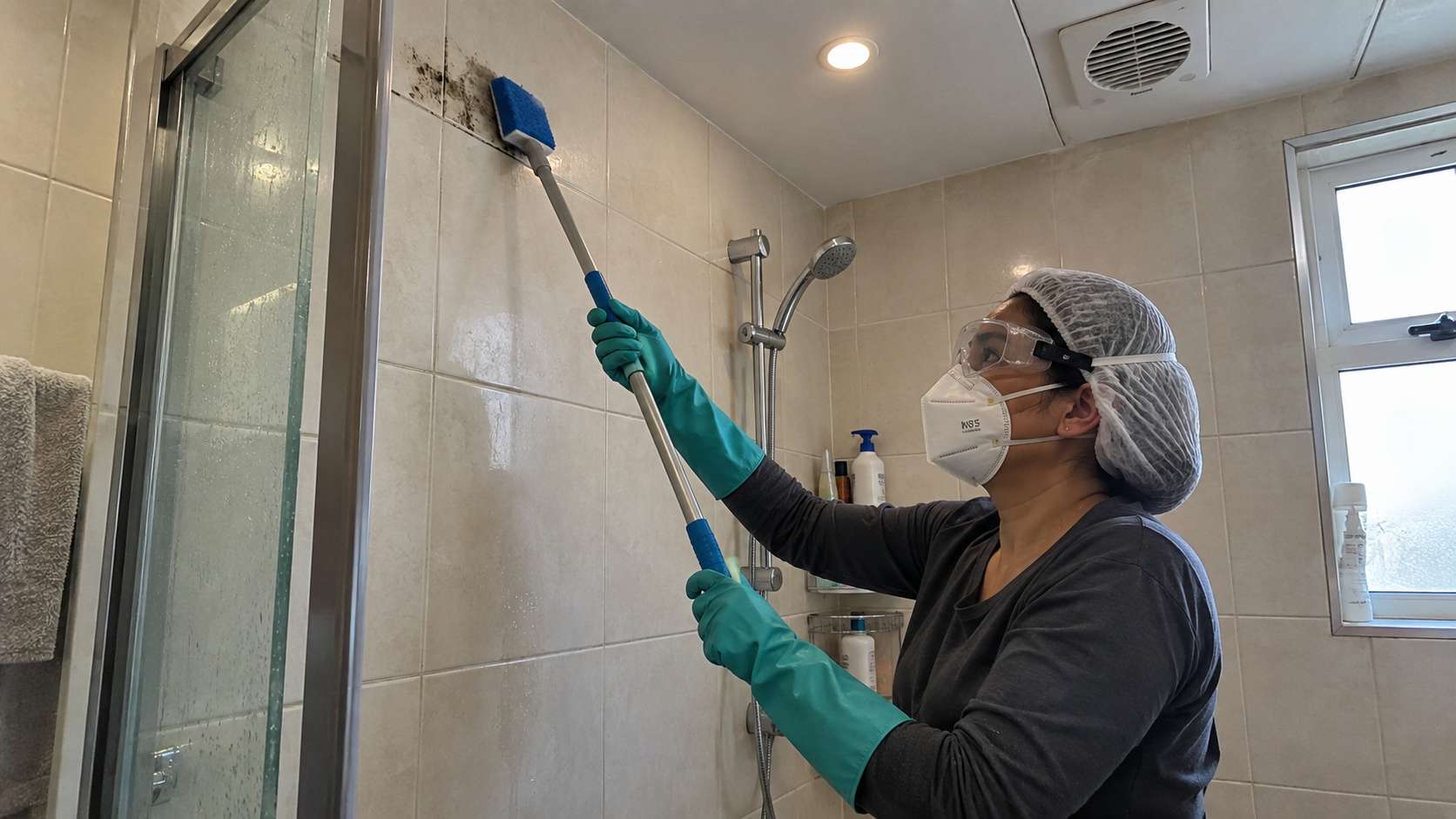
EPA guidance for mold remediation notes that safety glasses or goggles with open vent holes are not acceptable for mold cleanup because they do not protect well against particles.
3. Long Chemical-Resistant Gloves
Use long nitrile, rubber, neoprene, polyurethane, or PVC gloves depending on the cleaner label. Thin disposable gloves may tear during scrubbing.
Long gloves are better because shower cleaning often sends dirty water down your arms. If you are using a stronger cleaner, read the product label to choose gloves that match the chemical.
4. Long Sleeves and Long Pants
Cover your skin. Wear old long-sleeved clothing and long pants that can be washed after cleanup. If the mold is heavier or you may be brushing, scraping, or removing caulk, disposable coveralls are better.
Clothing protection matters because mold residue can stick to fabric. You do not want to clean the shower and then sit on your sofa wearing contaminated clothes.
5. Waterproof or Washable Footwear
Wear rubber boots, waterproof shoes, or washable non-slip footwear. Mold cleaning can involve dirty water, rinse water, and chemical residue on the shower floor.
CDC guidance for mold-damage cleanup includes protective gloves and also highlights boots and protective clothing in broader cleanup situations.
6. Shower Cap or Hair Cover
A hair cover is useful when cleaning overhead mold or ceiling mold in a shower. It prevents droplets, dust, and residue from settling in your hair.
This may sound excessive for a tiny corner spot, but it is practical when cleaning ceiling areas, high grout lines, or mold above your head.
7. Disposable Plastic Bags
Use plastic bags to dispose of contaminated cloths, removed caulk, dirty sponges, gloves, and paper towels. Seal them before carrying them through the home.
Do not shake dirty cloths or brushes indoors.
8. HEPA Vacuum Only When Appropriate
A regular vacuum is not a mold cleanup tool. It can spread small particles if it is not designed for fine contaminant capture.
For mold work, professionals may use HEPA-filtered equipment. For small shower cleaning, damp wiping is usually more practical. If mold is dry, powdery, widespread, or in porous material, do not vacuum it with a household vacuum.
9. Safe Cleaner and Label-Based Protection
Your PPE should match the cleaner. A mild detergent may require basic gloves and goggles. A stronger mold remover may require chemical-resistant gloves, better ventilation, and more caution.
Never mix cleaners. Do not mix bleach with vinegar, ammonia, descalers, toilet cleaner, or other products. The CDC warns against mixing bleach with ammonia because dangerous vapors can form; the same caution applies broadly to mixing cleaning chemicals.
Precaution: When Shower Mold Is Not a DIY Job
Shower mold is not a DIY job when it is large, recurring, hidden, inside porous materials, or connected to leaks. PPE helps reduce exposure, but it does not make every cleanup safe or effective.
Call a professional if:
- Mold keeps returning after cleaning
- The silicone or caulk is black underneath
- The grout is cracked or missing
- The wall behind tiles may be wet
- The ceiling is stained, soft, or peeling
- There is a musty smell outside the shower
- Mold covers a large area
- Water leaks from the shower area
- The bathroom has no working exhaust
- Someone in the home has asthma, allergies, lung disease, or immune concerns
- You need to remove wallboard, ceiling material, or built-in panels
EPA guidance says larger mold problems or heavy water damage may need broader remediation guidance, and porous materials may be difficult or impossible to clean completely when mold grows into them.
Also, do not paint over shower mold. Do not caulk over moldy silicone. Do not seal damp grout without drying and fixing the source. Covering mold may make the shower look cleaner for a short time, but the problem can continue behind the surface.
The Bottom Line
Mildew vs mold in shower cleanup starts with protection. Mildew is usually flatter, lighter, and more surface-level, while mold is often darker, deeper, mustier, more stubborn, and more likely to return. But both can expose you to particles and cleaning chemicals when disturbed.
For mildew cleaning, use gloves, eye protection, good ventilation, non-slip footwear, and gentle cleaning tools. For mold cleaning, upgrade to an N95 respirator, sealed goggles, long chemical-resistant gloves, long sleeves, long pants, washable or waterproof footwear, and careful disposal.
The final precaution is simple: PPE makes small cleanup safer, but it does not fix leaks, failed caulk, wet wallboard, poor ventilation, or hidden mold. If the shower mold keeps coming back, the real solution is not stronger scrubbing. It is moisture repair, safer remediation, and better prevention.