


KILZ Mold and Mildew Primer Review: What It Really Does
KILZ Mold and Mildew Primer is designed to prepare surfaces for paint in high-humidity or moisture-prone areas. The official product description calls it a water-based primer-sealer-stain blocker with excellent adhesion for interior and exterior surfaces, plus a mold-and-mildew-resistant primer film. It is made for areas such as kitchens, bathrooms, powder rooms, laundry rooms, and similar damp environments.
The phrase “primer film” is the key. This primer is designed to resist mold and mildew growth on the primer surface itself. It does not mean you can paint over live mold and forget about it. KILZ’s own blog says mold must be removed first before priming, and that the primer prevents mold and mildew growth on the primer film or primer surface.
That makes it useful in the right situation. For example, if a bathroom ceiling had mildew because the exhaust fan was weak, you clean the surface, fix the ventilation, let everything dry, and then apply KILZ Mold and Mildew Primer before repainting. In that case, the primer can help reduce future surface growth.
But if the ceiling is still damp, the fan is still broken, and mold is active above the drywall, the primer becomes cosmetic. It may hide the stain for a while, but it does not remove the cause.
So this product is best reviewed as a finishing and prevention layer after proper prep, not as a mold remediation product.
What People Usually Say About KILZ Mold and Mildew Primer
Most public reviews are positive. The strongest praise is usually about coverage, stain blocking, adhesion, low odor compared with oil-based primers, and how clean the painted surface looks afterward.
Home Depot’s product listing shows the 1-gallon version at 4.8 stars from more than 1,600 reviews, which is very strong for a paint-prep product. A review snippet on the same listing mentions using it in a bathroom with heavy shower moisture and seeing the room look “super clean” afterward.
Walmart’s listing also shows strong customer sentiment, with a 4.9-star rating from more than 680 reviews for the 1-gallon water-based primer. Lowe’s review summaries commonly mention that one coat is often enough to cover and seal existing mold and mildew stains, though those summaries are AI-generated and include incentivized reviews, so they should be read with some caution.
The common positive themes are:
- It covers stains well.
- It helps old walls look fresh again.
- It works well in bathrooms and basements.
- It dries quickly.
- It has easier cleanup than oil-based primer.
- It gives paint a better, more even surface.
- It feels like a smart extra layer in moisture-prone rooms.
The common complaints are more about application and expectations. Some painters say the water-based version can feel tricky if you overwork it with a roller or brush. One Reddit user complained that brushing or rolling back over a freshly coated area caused the primer to pull and look blotchy.
Other negative experiences come from expecting primer to solve a deeper mold or smell problem. If a basement still smells months after priming, the issue may not be the primer. It may be moisture, contaminated material, poor drying, or hidden odor sources that were never fully fixed.
Our Hands-On View as a Professional Mold Cleaning Service
From a professional mold cleaning service perspective, KILZ Mold and Mildew Primer is useful, but only after the real mold work is done. We would never treat it as the first step for active mold. We would treat it as a finishing step after inspection, moisture correction, cleaning, drying, and surface preparation.
In actual mold work, the order matters:
- Find the moisture source.
- Stop the leak, condensation, or humidity problem.
- Remove materials that cannot be safely cleaned.
- Clean salvageable hard surfaces.
- Dry the area fully.
- Confirm the surface is sound.
- Prime with a suitable primer.
- Apply the correct topcoat.
KILZ Mold and Mildew Primer belongs near the end of that sequence. It is not the tool that solves steps one through five.
This is where many DIY projects fail. Someone sees dark spots on a bathroom ceiling, paints over them, and feels relieved. Two months later, the stain comes back. The primer did not necessarily fail. The prep failed. The fan was still weak. The ceiling stayed damp. The mold or mildew had the same conditions it had before.

KILZ’s own product information supports this professional view. It says the surface should be clean, dry, free of dust, chalk, oil, grease, wax, mold, mildew, loose paint, rust, and other substances before applying.
So our field verdict starts here: good primer, wrong product if you are trying to bury an active mold problem.
How Good It Is at Preventing Mold Growth
KILZ Mold and Mildew Primer can be effective at reducing mold and mildew growth on the primer film when the surface has been properly cleaned, dried, and painted in the right environment. The product contains an EPA-registered mildewcide, and KILZ says that active ingredient creates a mold-and-mildew-resistant film that protects the primer film from mold and mildew growth.
That makes it a good choice for rooms where mild surface mildew is a recurring risk, such as:
- Bathrooms
- Laundry rooms
- Powder rooms
- Kitchens
- Basement walls that are dry and sound
- Moisture-prone ceilings
- Exterior surfaces that can be properly prepped
- Areas previously stained by humidity, after cleaning
But prevention has limits. A primer can protect its own film; it cannot control the entire room environment. If relative humidity stays high, bathroom steam has nowhere to go, or a pipe keeps leaking inside the wall, mold can still grow on dust, caulk, paint residue, drywall paper, framing, insulation, or other nearby materials.
EPA’s guidance is very direct: the key to mold control is moisture control. If mold is a problem, it should be cleaned up and the water problem fixed.
That means KILZ is strongest when the mold risk is surface-level and the environment has already been corrected. It is weakest when the moisture problem is still active.
So, how good is it? As a preventive primer film, very good for the right surface. As a full mold prevention strategy by itself, not enough.
Where KILZ Mold and Mildew Primer Works Best
KILZ Mold and Mildew Primer works best on clean, dry, properly prepared surfaces that need stain blocking and extra protection in humid environments. It is especially practical when you are repainting a bathroom ceiling, laundry room wall, basement area, or kitchen wall that has had previous staining from moisture.
It also works well when you need a primer that helps the topcoat look better. KILZ markets it as high hide, heavy-duty stain blocking, low VOC, and suitable for sealing porous surfaces. It can block many medium to heavy stains, including water stains, grease, ink, pencil, felt marker, tannin, and other common stains.
The best use cases include:
- A bathroom ceiling after mildew has been cleaned
- A laundry room wall after humidity correction
- Dry basement walls before repainting
- A kitchen wall with old stains
- A powder room with previous moisture spotting
- Exterior trim or siding after proper cleaning and drying
- Previously stained surfaces where adhesion matters
One Lowe’s review snippet gives a realistic example: a user cleaned a bathroom ceiling with a mold and mildew cleaner, replaced a broken bathroom fan, primed with KILZ, waited several hours, then painted again. The key detail is not only the primer. They also replaced the broken fan, which addressed the moisture problem.
That is exactly how this product should be used. Clean first. Fix the moisture. Prime. Then paint.
Where This Primer Cannot Help at All
KILZ Mold and Mildew Primer cannot help when the mold problem is active, hidden, wet, or structural. It is not a mold killer, not a leak repair product, and not a substitute for removing contaminated material.
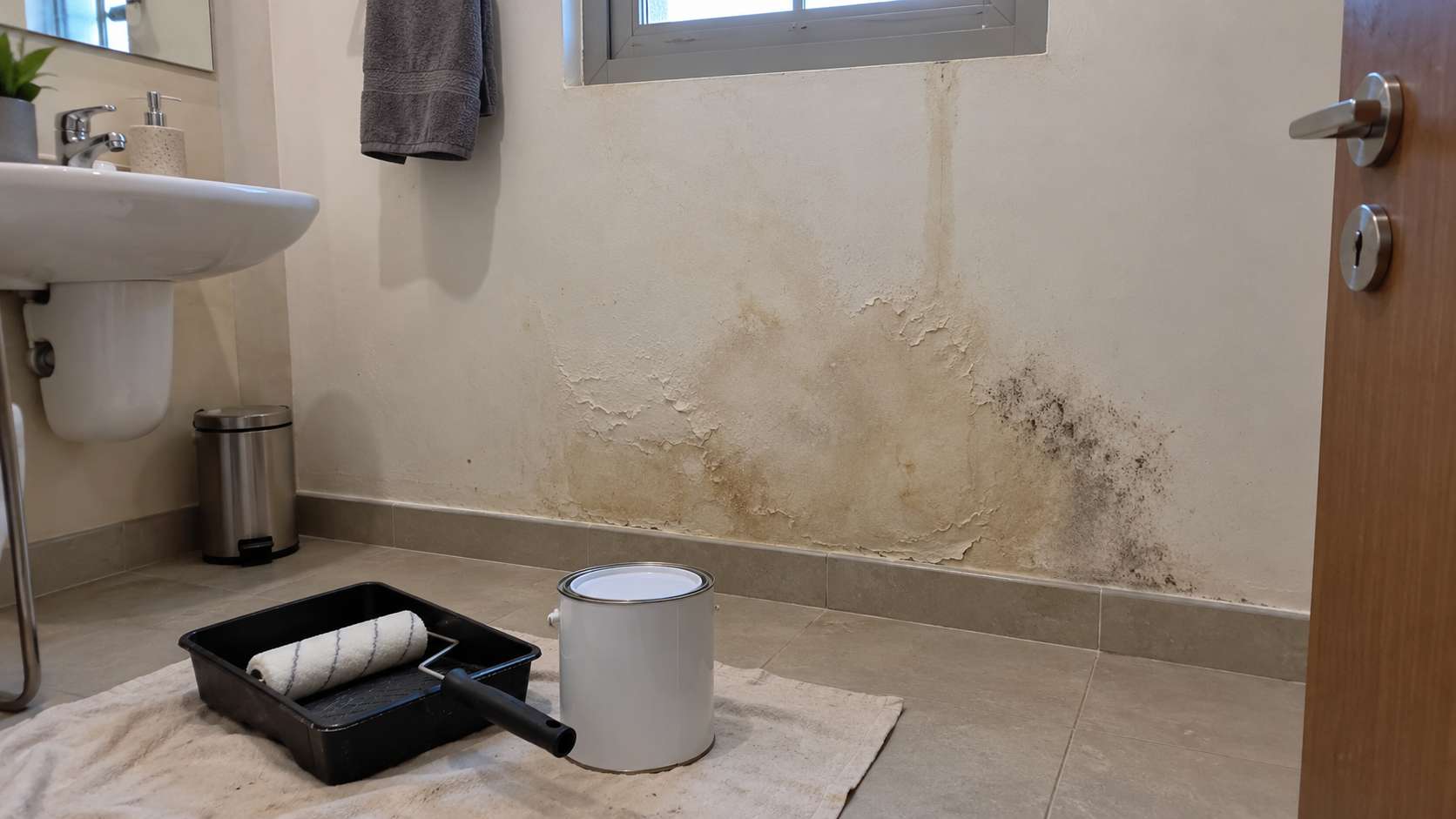
It cannot fix:
- Active mold growth
- Wet drywall
- Mold behind walls
- Mold inside insulation
- Mold under flooring
- Mold behind baseboards
- Mold in cabinets
- Moldy carpet padding
- AC condensation problems
- Roof leaks
- Plumbing leaks
- Poor bathroom ventilation
- High indoor humidity
- Musty odors from hidden contamination
It also cannot guarantee that mold will never return. No primer can do that if the environment still supports mold growth.
This is especially important for porous materials. Drywall, ceiling tile, insulation, carpet backing, MDF, and particle board can hold moisture and contamination below the surface. Painting the face of the material does not remove what is inside it. EPA notes that absorbent or porous materials such as ceiling tiles and carpet may need to be thrown away if they become moldy, because mold can grow into empty spaces and crevices and may be difficult or impossible to remove completely.
KILZ also should not be applied over dirty or moldy surfaces. Product and retailer guidance repeatedly says surfaces should be clean and free of mold before priming.
So if you have live mold, the answer is not “paint over it.” The answer is to remove the mold, fix the moisture, dry the material, and then decide whether priming is appropriate.
Application Notes From the Field
Good results with KILZ Mold and Mildew Primer depend heavily on preparation. A lot of complaints about primers come from rushing the prep, applying it to damp surfaces, overworking the product, or expecting one coat to perform miracles.
Before applying, the surface should be:
- Clean
- Dry
- Dull enough for adhesion
- Free of active mold and mildew
- Free of peeling paint
- Free of loose drywall paper
- Free of grease, dust, and soap residue
- Repaired if damaged
- Properly ventilated
KILZ says the water-based primer can be applied when surface, air, and product temperatures are between 50°F and 90°F, and that it can be topcoated after one hour or more under normal conditions.
Our practical advice is to avoid heavy rolling back and forth once the primer begins to set. Lay it down evenly, keep a wet edge, and do not keep brushing the same area until it turns tacky. That can create pulling, streaking, or uneven texture, especially on patched or porous walls.
Also, use the right topcoat. The primer helps, but the finish paint still matters. In bathrooms and laundry rooms, choose a paint suitable for moisture-prone spaces. If you use a weak flat paint in a steamy bathroom, you may still get surface problems faster than expected.
Finally, let the room dry and ventilate properly. A primer that is constantly exposed to trapped steam will not perform the way it should.
Our Final Verdict: Primer Is Helpful, But Not Always Enough
KILZ Mold and Mildew Primer is a strong product when it is used for the right reason. It is helpful after cleaning, after drying, and after correcting the moisture source. It can block stains, help new paint adhere, and create a mold-and-mildew-resistant primer film on the painted surface.
You probably do not need a professional mold remediation service if:
- The issue was small and surface-level.
- The mold or mildew has already been cleaned.
- The wall or ceiling is fully dry.
- There is no musty smell.
- There is no active leak.
- The affected material is not soft, swollen, or damaged.
- The room’s ventilation problem has been fixed.
- The area does not keep growing mold again.
But you should consider hiring a professional if:
- Mold keeps coming back after cleaning and repainting.
- There is a musty smell but no visible source.
- The drywall is soft, swollen, or stained repeatedly.
- There was flooding or long-term leakage.
- Mold is behind cabinets, baseboards, walls, or ceilings.
- The problem involves HVAC or AC condensation.
- The affected area is large.
- People in the home have asthma, allergies, or immune concerns.
- You need documentation for a rental, sale, insurance, or workplace issue.
EPA says that if you hire a contractor for mold cleanup, you should make sure the contractor has experience cleaning up mold and follows government or professional guidance, including EPA guidance and other recognized professional guidelines.
Our final verdict is simple: KILZ Mold and Mildew Primer is enough for prevention only when the surface is already clean, dry, and stable. It is not enough when the building still has a moisture problem.
The Bottom Line
KILZ Mold and Mildew Primer gets strong reviews because it does several useful things well. It covers stains, seals surfaces, helps paint adhere, dries quickly, and provides a mold-and-mildew-resistant primer film for moisture-prone areas. For bathrooms, laundry rooms, kitchens, and dry basement surfaces, it can be a very practical choice after proper cleaning and prep.
But it is not mold remediation in a can. It does not kill hidden mold, dry wet walls, repair leaks, replace damaged drywall, or solve bad ventilation. It also should not be applied directly over active mold.
So the balanced verdict is this: use KILZ Mold and Mildew Primer after the mold has been cleaned, the surface has dried, and the moisture source has been fixed. For small, surface-level mildew prevention, it can be enough. For recurring, hidden, widespread, or moisture-driven mold, you still need a professional inspection or remediation plan before primer ever touches the wall.