


Why Household Mold Can Be Risky for Your Family
Household mold becomes risky when it grows indoors and keeps releasing particles into a space where your family sleeps, eats, plays, and rests. Mold spores naturally exist indoors and outdoors, but active indoor growth means there is a moisture problem feeding it.
That moisture may come from plumbing leaks, roof leaks, AC condensation, bathroom humidity, poor ventilation, flooding, damp cabinets, or water trapped behind walls. Once mold has moisture and a food source, it can grow on drywall, wood, ceiling tiles, carpet backing, furniture, clothes, cardboard, or dust on AC components.
The risk is not only the visible mold patch. The bigger concern is repeated exposure. A small patch behind a wardrobe may seem harmless, but if the room smells musty every night, your family may be breathing contaminated air for hours.
Health effects vary. Some people may feel nothing. Others may react quickly. CDC explains that exposure to damp and moldy environments may cause a variety of health effects, or none at all, depending on the person and the situation.
That’s why household mold should not be ignored just because one person in the house feels fine. A child with allergies, a parent with asthma, or a grandparent with chronic lung disease may react differently inside the same home.
Short-Term Symptoms of Household Mold Exposure
Short-term symptoms are usually the first warning signs. They may appear after sleeping in a moldy bedroom, spending time near a musty AC vent, opening a damp wardrobe, or staying in a room with visible mold.
Common short-term symptoms may include:
- Sneezing
- Stuffy or runny nose
- Sore throat
- Coughing
- Wheezing
- Burning or watery eyes
- Itchy eyes
- Skin rash
- Headache
- Fatigue
- Throat irritation
- Musty odor sensitivity
CDC lists stuffy nose, sore throat, coughing or wheezing, burning eyes, and skin rash as possible effects in people sensitive to mold. NIOSH also notes that damp buildings are associated with respiratory symptoms, infections, developing or worsening asthma, allergic rhinitis, hypersensitivity pneumonitis, and eczema.
In many homes, the symptoms feel confusing because they look like normal flu, dust allergy, sinus problems, or AC sickness. The clue is the pattern.
For example, your child may cough more in one bedroom. Your nose may block every morning but improve when you leave the house. Your eyes may burn when the AC starts. Someone may get a rash after touching moldy clothes or sleeping near a damp wall.
These patterns don’t prove mold is the only cause. But they do mean your home environment deserves attention.
Long-Term Dangers When Household Mold Is Ignored
Long-term household mold exposure is more concerning because the body may be exposed repeatedly over weeks, months, or even years. The biggest concern is usually the respiratory system, especially for people who already have allergies, asthma, sinus problems, or chronic lung conditions.
The World Health Organization concluded that the most important health effects linked with dampness and mold are increased respiratory symptoms, allergies, asthma, and disturbance of the immune system. WHO’s review also found sufficient evidence that occupants of damp or moldy buildings have increased risk of respiratory symptoms, respiratory infections, and asthma exacerbation.
Long-term risks may include:
- Worsening asthma symptoms
- More frequent coughing or wheezing
- Recurring sinus irritation
- Chronic nasal congestion
- Ongoing throat irritation
- Repeated allergy flare-ups
- Eczema flare-ups
- Poor sleep due to breathing discomfort
- Higher sensitivity to indoor air triggers
- More serious infection risk in immune-compromised people
For most healthy people, household mold does not automatically mean a severe disease will happen. But it should still be treated as a real indoor health concern, not a cosmetic issue.
The risk is higher for vulnerable family members. CDC warns that people with immune suppression or chronic lung disease may be at greater risk, and people with asthma or other lung conditions should avoid buildings with visible or smelled mold after severe weather events.
So if your home has mold and someone in your family has asthma, allergies, chronic lung disease, cancer treatment, organ transplant history, immune suppression, or repeated respiratory symptoms, the response should be faster and more careful.
Why Children, Elderly People, and Asthma Patients Need Extra Protection
Children, elderly people, and asthma patients often need extra protection because their bodies may react more strongly to poor indoor air.
Children spend a lot of time indoors, sleep longer hours, and may not explain symptoms clearly. A child may not say, “My room smells musty and my breathing feels irritated.” They may simply cough at night, wake up tired, rub their eyes, avoid a certain room, or get recurring congestion.
Asthma patients can be sensitive to many triggers, including dampness, mold, dust, pests, and chemical odors. Mold exposure may worsen wheezing, chest tightness, coughing, and breathing discomfort. For a family member with asthma, visible mold around AC vents, bedrooms, or bathrooms should be taken seriously.
Elderly people may also be more vulnerable, especially if they have chronic respiratory disease, weaker immunity, or slower recovery from infections. A musty room may not bother a healthy adult much, but it can still become a problem for someone with fragile lungs.
People with weakened immune systems need the most caution. CDC explains that immune-compromised people and people with chronic lung disease may get infections in their lungs from mold. That does not mean every moldy home causes lung infection, but it means high-risk people should not casually clean or stay around mold contamination.
The safest mindset is simple: if a vulnerable person lives in the home, don’t wait until mold spreads. Control moisture, isolate the affected area, and get proper help sooner.
Where Household Mold Hides Inside the Home
Household mold often grows where moisture stays trapped. You may not see it at first because the visible stain can be only the final stage of a hidden moisture problem.
Common mold hiding spots include:
- Behind wardrobes placed against cold or damp walls
- Under sinks
- Behind kitchen cabinets
- Around AC vents
- Inside or near HVAC components
- Behind wallpaper
- Behind skirting boards
- Under carpets
- Inside ceiling cavities
- Around bathroom grout and silicone
- Behind washing machines
- Near window frames with condensation
- Inside storage boxes or cardboard piles
- On mattresses or furniture near damp walls
A musty smell is one of the strongest warning signs. EPA says if mold is a problem in your home, you should clean up the mold and get rid of excess water or moisture. EPA also notes that water-damaged areas and items should be dried within 24–48 hours to prevent mold growth.
AC-related mold deserves special attention in hot and humid climates. Condensation, dust, clogged drain lines, poor insulation, dirty filters, and poorly maintained ducts can create repeated moisture. If your family’s symptoms get worse when the AC runs, the AC system should be checked.
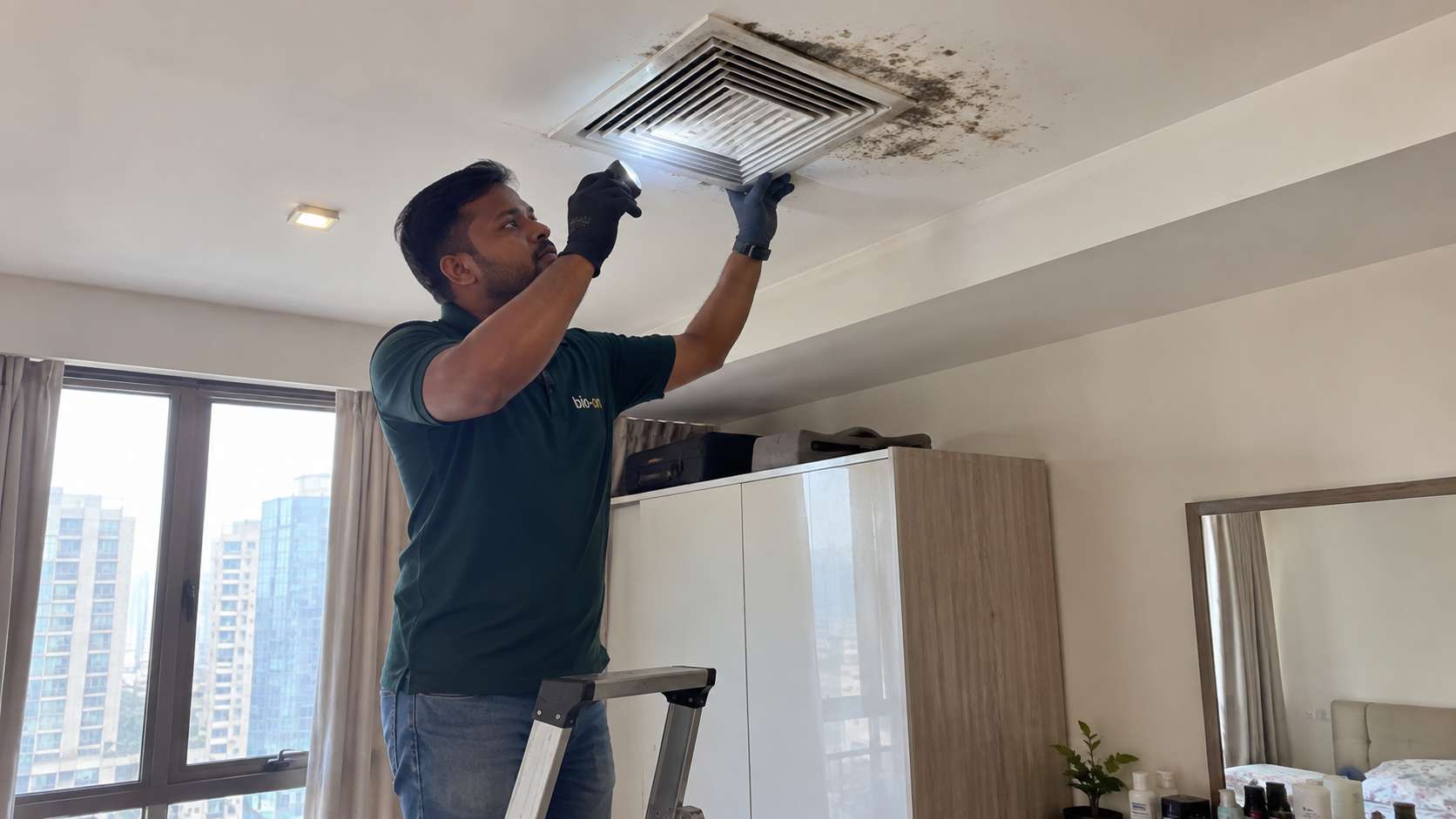
But here’s the key: cleaning the AC alone may not solve household mold if the wall, ceiling, cabinet, or insulation is also contaminated. The right solution depends on where the moisture and mold actually are.
Immediate Steps When You Find Household Mold
When you find household mold, act quickly but don’t panic-clean it in a way that spreads spores. Dry brushing, aggressive scraping, or blasting a moldy surface with strong airflow can spread particles into the room.
Start with these immediate steps:
- Keep vulnerable people away from the affected area. This includes children, elderly people, asthma patients, and immune-compromised family members.
- Stop the moisture source. Fix leaks, condensation, seepage, AC drainage issues, or humidity problems.
- Avoid disturbing large mold patches. Don’t sand, scrape, or dry-brush moldy materials.
- Remove wet soft items if safe. Damp cardboard, fabric, rugs, or cushions can hold moisture and odor.
- Ventilate carefully. Fresh air may help, but don’t point fans directly at visible mold.
- Document the issue. Take photos of the affected areas, especially if you rent the property or need professional assessment.
- Call the right specialist if the issue is large, hidden, recurring, or AC-related.
EPA says mold cleanup requires fixing the water problem and drying items completely. If you hire a contractor or professional service provider, EPA recommends making sure they have experience cleaning up mold.
For small mold on hard surfaces, careful cleaning with detergent and water may be enough if the moisture source is fixed. But if the mold is on porous materials such as drywall, carpet, insulation, MDF cabinets, or ceiling tiles, the contaminated material may need removal or specialized treatment.
AC Specialist, Deep Cleaning, or Mold Remediation Service?
Not every household mold case needs the same type of service. Choosing the wrong provider can waste money and leave the health risk inside the home.
When you need an AC or HVAC specialist
Call an AC or HVAC specialist when the mold problem seems connected to airflow, cooling, condensation, or AC performance.
This may include:
- Musty smell when the AC turns on
- Mold around supply vents
- Water dripping from indoor AC units
- Clogged drain lines
- Dirty filters
- Poor airflow
- Condensation around ducts or vents
- Mold near the AC intake
- Rooms that feel humid even with AC running
An HVAC specialist can check mechanical causes such as drainage, insulation, airflow, filters, coil condition, and condensation. That matters because mold will come back if the AC keeps creating moisture.
But an AC technician is not always a mold remediation expert. If mold has spread into walls, ceilings, cabinets, furniture, or occupied rooms, you may need mold remediation in addition to HVAC repair.
When you need a deep cleaning specialist
Deep cleaning can help when the issue is surface-level dirt, dust, mild bathroom staining, general hygiene buildup, or post-remediation cleaning.
A deep cleaning team may clean floors, furniture, bathrooms, kitchens, vents, and surfaces. This can improve overall indoor cleanliness and reduce dust that feeds mold.
But deep cleaning alone is usually not enough when there is active mold growth. If cleaners wipe visible mold without containment, moisture control, or material assessment, the mold can return. Worse, cleaning may disturb spores and spread contamination.
Deep cleaning is helpful as support. It should not replace mold remediation when the problem is hidden, recurring, or health-related.
When you need mold remediation
Mold remediation is the right choice when the goal is to remove mold safely, stop spread, and prevent recurrence.
You likely need mold remediation if:
- Mold keeps coming back
- There is a strong musty smell
- Mold is larger than a small patch
- The home had water damage
- Mold is on drywall, ceiling, wood, carpet, or cabinets
- Mold is near AC vents or inside hidden areas
- Family members have symptoms
- The affected area is a bedroom, nursery, kitchen, or living room
- You are not sure how far the contamination has spread
Professional mold remediation should involve inspection, moisture source identification, containment when needed, safe removal or treatment, cleaning of affected surfaces, and prevention guidance. It is not just spraying chemicals on a wall.
Consult Bio-on for Household Mold Protection
If you find household mold in your home and your family is already experiencing coughing, allergies, skin irritation, musty odor sensitivity, or asthma flare-ups, it’s worth consulting Bio-On before the problem becomes bigger.
Bio-On can help assess whether the issue is simple surface mold, AC-related mold, hidden contamination, or a recurring moisture problem. This matters because the wrong solution can make the mold look gone while the exposure continues behind the scenes.
A professional consultation is especially useful when:
- The mold is in a bedroom or child’s room
- Your family smells mold but can’t find the source
- Mold returns after cleaning
- AC airflow smells musty
- Someone has asthma, allergies, or chronic breathing problems
- The home recently had a leak, flood, or condensation issue
- You need safe remediation without spreading contamination
Bio-On is a practical recommendation for UAE homes that need more than ordinary cleaning. Their work can support mold inspection, mold remediation, odor control, and deeper cleaning where household mold may affect indoor health.
The goal is not to scare your family. The goal is to prevent avoidable exposure. Household mold becomes more dangerous when it is ignored, repeatedly cleaned the wrong way, or allowed to spread into hidden materials.
The Bottom Line
Household mold can threaten family health because it affects the air and surfaces inside the place where your family spends the most time. Short-term exposure may cause sneezing, coughing, itchy eyes, skin rash, sore throat, or wheezing. Long-term or repeated exposure may worsen asthma, allergies, respiratory irritation, and indoor air sensitivity, especially for children, elderly people, asthma patients, and immune-compromised family members.
The right solution depends on the source. Call an AC or HVAC specialist when the AC is creating condensation, poor airflow, or musty odor. Use deep cleaning for hygiene support and surface-level cleaning. Choose mold remediation when the mold is visible, recurring, hidden, widespread, or connected to health symptoms.
If you already found household mold at home, don’t wait for it to become a bigger family health problem. Consult Bio-On so the moisture source, contamination, odor, and recurrence risk can be handled properly. The safest home is not only clean on the surface. It is dry, well-ventilated, and free from active mold growth.