


EC3 Mold Spray Review: What This Product Really Is
EC3 mold spray is a ready-to-use surface spray from Micro Balance Health Products. The company positions it as a gentle botanical cleaner for maintaining a cleaner indoor environment, especially on hard and soft surfaces throughout the home, office, or car. Its listed ingredients are a proprietary natural botanical blend of citrus seed extracts, distilled water, and vegetable glycerin.
That makes it very different from bleach-based mold removers. Bleach products usually work by whitening stains and disinfecting suitable hard surfaces. EC3 is built more around routine environmental maintenance, low odor, and safer-feeling everyday use. The brand says the spray is fragrance-free, non-toxic, plant-based, and usable on materials like floors, walls, clothing, shoes, furnishings, rugs, upholstery, and car interiors.
This is also why the product attracts a specific type of buyer. People who are sensitive to strong cleaners, people dealing with mold anxiety after a contaminated home, and people trying to clean belongings often look for something they can use more often without the chemical smell of bleach.
The product’s own directions are simple: shake well, spray directly onto the surface, allow it to air-dry or wipe with a clean cloth, and use weekly or as needed for routine maintenance. The brand also recommends testing on an inconspicuous area if you are concerned about colorfastness.
So, in plain words, EC3 mold spray is not a heavy-duty demolition-grade remediation chemical. It is a mild, botanical mold-focused spray for surface treatment, belongings, and ongoing maintenance.
What People Usually Say About EC3 Mold Spray
Public reviews are generally positive, especially from people who use the spray as part of a broader mold-sensitive lifestyle. On the official EC3 product page, the spray showed 81 customer reviews when accessed, with many recent reviewers saying they use it on counters, shoes, bags, upholstery, bathroom tile, damp wood, car interiors, and musty items.
The biggest positive theme is peace of mind. Many reviewers do not describe the product like a normal bathroom cleaner. They describe it like something they keep nearby during travel, after construction, after mold exposure, or when they notice musty smells. Some say they use it on furniture, clothing, upholstery, shoes, and personal belongings.
The second big theme is low irritation. Compared with bleach sprays, people like that it does not smell harsh or chemical. The official product page also emphasizes that it has no added fragrance, harsh chemicals, or volatile solvents.
The third theme is musty odor improvement. A number of reviews mention using it in cars, workout rooms, upholstery, closets, bathrooms, and musty household areas. Some users say the room or object smells fresher afterward.
But not every review is glowing. At least one recent official-site reviewer gave it a 1-star rating and said they did not notice any difference. Another bundle review said they liked the idea and ease of use, but did not yet have evidence that the products were working.
That mixed feedback matters. EC3 is the kind of product where user experience can depend heavily on the situation. If the issue is light surface residue or musty odor, the result may feel obvious. If the issue is hidden mold behind drywall, contaminated HVAC, damp insulation, or active water damage, the spray may feel like it does nothing because it cannot reach or remove the real source.
Our Hands-On View as a Professional Mold Cleaning Service
From a professional mold cleaning perspective, EC3 mold spray is best treated as a support product, not a standalone remediation system. It can be useful after the main moisture and contamination problem has been controlled. It can also be useful for routine maintenance on belongings, shoes, bags, car interiors, and hard surfaces that need light treatment.
In the field, however, we judge mold products differently from normal customers. We do not only ask, “Does it smell better?” or “Did the stain fade?” We ask:
- Is the moisture source fixed?
- Is the affected material porous or non-porous?
- Is the contamination surface-level or embedded?
- Is there hidden mold behind the visible area?
- Can the product physically remove mold residue?
- Is containment needed?
- Does the surface need HEPA vacuuming, removal, drying, or replacement?
That is where EC3 has both strengths and limits. Its strength is that it is easy to use and suitable for more delicate day-to-day situations than bleach. Its weakness is that it cannot perform the actual remediation steps that large mold jobs require.
For example, spraying EC3 on a musty suitcase may be practical. Spraying it on a lightly musty car seat may help. Spraying it on shoes after visiting a moldy building may give a user some peace of mind. But spraying it onto a wall with mold caused by a pipe leak is not remediation. The wall may need moisture mapping, containment, material removal, drying, and post-cleaning verification.
EPA’s mold cleanup guidance is still a useful baseline: hard surfaces can be scrubbed with detergent and water and dried completely, while larger or more water-damaged situations require more careful remediation planning.
So our hands-on position is balanced: EC3 is a good maintenance spray, but it should not be oversold as a cure for serious indoor mold contamination.
How Good EC3 Mold Spray Is at Killing Mold
EC3 mold spray may help reduce mold spores and musty contamination on treated surfaces, especially when used directly and repeatedly. The brand says it supports cleaner surfaces, works where applied, and is intended for regular use as part of an ongoing home-maintenance routine.
However, the phrase “kill mold” needs careful handling. Many consumers use “kill mold” to mean several different things: removing visible growth, reducing spores, neutralizing odor, whitening stains, preventing regrowth, or fixing the whole mold problem. Those are not the same.
EC3 is not a bleach stain remover. If you expect it to instantly whiten black grout like a chlorine product, you may be disappointed. Even the brand notes that for visible discoloration on grout or tile, EC3 Enzyme Cleaner Concentrate should be used for best results.

Where EC3 performs better is in low-stain, maintenance-style use. Based on reviews, people like it for:
- Musty upholstery
- Shoes and bags
- Car interiors
- Bathroom tile maintenance
- Counters and household surfaces
- Post-exposure cleaning routines
- Belongings that cannot be machine-washed
- Situations where bleach smell is unacceptable
From a professional point of view, EC3 is more convincing as a surface and belongings maintenance spray than as a primary mold removal chemical. If there is visible mold growth, you still need physical cleaning. Mold residue should be removed, not merely sprayed and left behind. EPA specifically recommends scrubbing mold off hard surfaces with detergent and water, then drying completely.
So, is it good at killing mold? For light surface treatment and routine maintenance, it may be useful. For established mold colonies, hidden growth, porous material contamination, or stained grout, it is not enough by itself.
Where EC3 Mold Spray Works Best
EC3 mold spray works best in situations where the goal is light treatment, odor reduction, and maintenance rather than major remediation. It is especially useful when the surface is something you do not want to treat with bleach.
Good use cases include soft items that are not easy to wash, such as upholstery, rugs, fabric accessories, bags, and car interiors. The official product page specifically describes use on clothing, shoes, rugs, upholstery, personal belongings, furnishings, and car interiors.
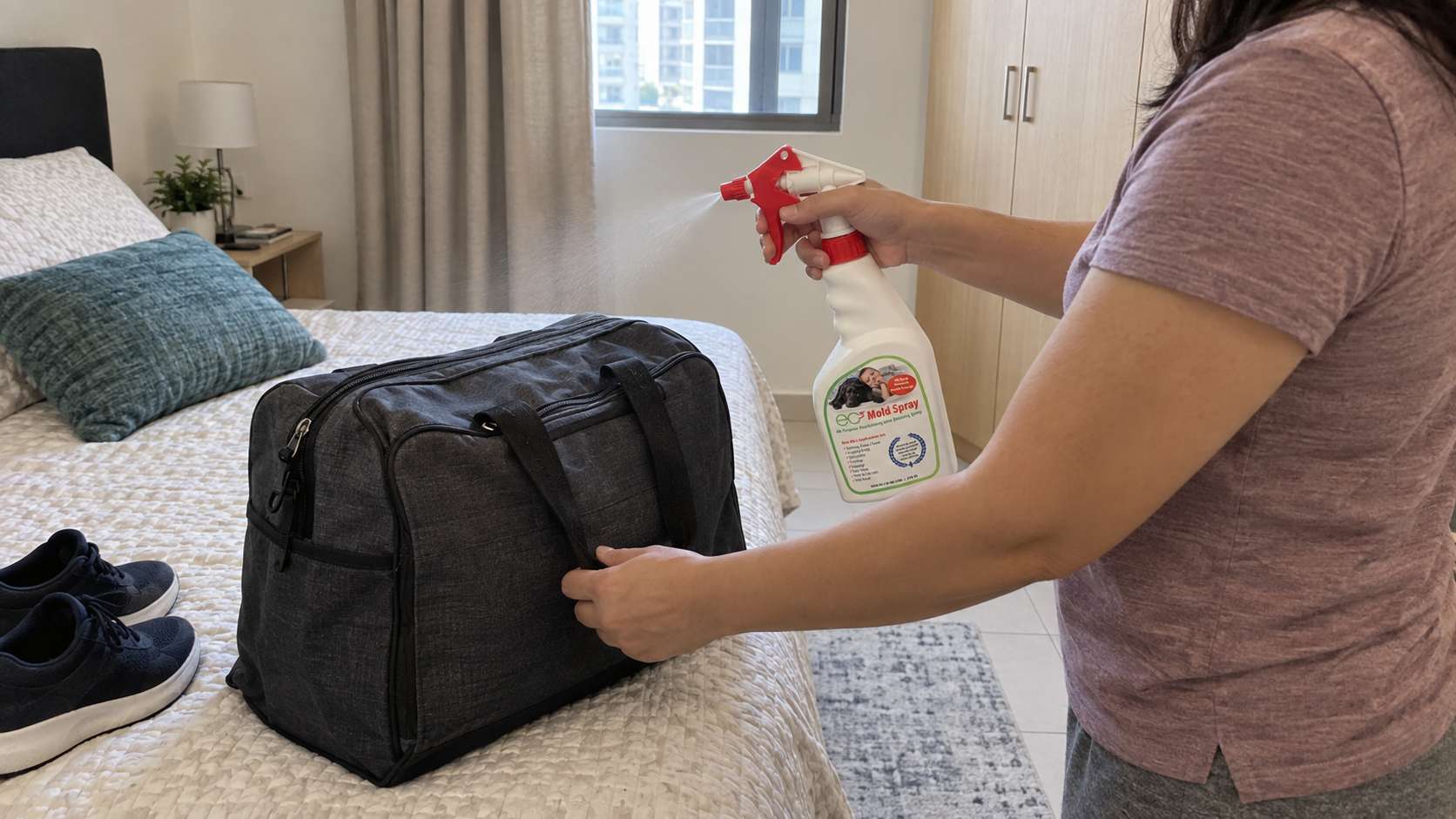
It can also make sense for routine weekly cleaning in a home that has already had mold issues corrected. For example, after remediation, a homeowner may want to maintain shoes, closets, hard surfaces, and soft furnishings more carefully. EC3 fits that role better than a harsh disinfectant because it is easier to use often.
The spray is also practical for travel. Some reviewers mention carrying it when they travel or using it on items that tend to get musty. That makes sense because travel exposes luggage, shoes, clothes, and bags to unknown indoor environments.
Best-fit situations include:
- Light musty smell on belongings
- Shoes, bags, and travel items
- Car upholstery after mild moisture exposure
- Routine surface maintenance after remediation
- Cleaning items that cannot handle bleach
- Mold-sensitive households wanting a low-odor option
- Small bathroom maintenance when staining is not severe
- Preventive cleaning after being in a damp or musty space
In these situations, EC3’s gentler profile is the point. It is not trying to act like a heavy stain-removing bathroom chemical. It is trying to be a regular-use mold-focused spray.
Where EC3 Mold Spray Cannot Help at All
EC3 mold spray cannot fix a moisture problem. This is its biggest limitation and the most common reason people may overestimate what it can do.
It cannot repair roof leaks, plumbing leaks, condensation issues, AC drain problems, wet insulation, damp drywall, or mold inside wall cavities. It also cannot remove mold from porous materials that are already contaminated deep inside. If the source continues feeding mold, the spray may only reduce surface symptoms for a short time.
It also cannot replace material removal. If drywall, particle board, carpet padding, ceiling tile, insulation, or MDF furniture has active mold growth, spraying the surface is often not enough. Porous materials can hold moisture and contamination internally. EPA notes that mold can infiltrate porous substances, making complete removal difficult or impossible in some cases.
EC3 is also not the best choice when the main problem is heavy staining. If the customer wants black grout to become white in minutes, a botanical spray may not create that “wow” effect. The brand itself points users toward its enzyme cleaner for visible discoloration on grout or tile.
It cannot fully solve:
- Mold behind drywall
- Mold under flooring
- Wet insulation
- Contaminated carpet padding
- Large mold colonies
- HVAC contamination
- Active leaks
- Flood-damaged rooms
- Sewage-related mold issues
- Heavy black grout staining
- Musty odor from hidden wall cavities
If the mold keeps coming back, do not blame the spray first. Look for the moisture source. A product can only do so much when the building is still wet.
Safety, Pets, and Surface Concerns
One reason EC3 gets attention is that people see it as a safer alternative to harsher mold sprays. The official product page describes it as non-toxic, fragrance-free, plant-based, and low-irritant when used as directed.
Even so, “botanical” does not mean “zero caution.” Plant-based ingredients can still irritate some people, and sensitive individuals may react differently. It is smart to test a small area first, especially on dyed fabrics, leather-like materials, fine wood, painted surfaces, or delicate upholstery. The brand also advises caution with fine wood furniture that may water-stain, recommending misting and wiping after one minute.
Pet concerns are also worth mentioning. Some customer discussions are positive about pet-safe use, but at least one bundle review raised concern about cats and essential-oil-type ingredients.
Because cats and some pets can be sensitive to certain botanical oils, the safest approach is simple: do not spray directly on pets unless a veterinarian approves it, avoid heavy misting around animals, allow treated surfaces to dry, and follow the product label carefully. If your pet has respiratory problems, asthma-like symptoms, liver disease, or unusual sensitivity, ask your vet before using botanical sprays around them.
For people with asthma, chemical sensitivity, or mold-related anxiety, start small. Use it in a ventilated area, test your personal tolerance, and do not over-mist your entire house on the first use. More product is not always better.
Our Final Verdict: DIY Spray or Professional Mold Help?
EC3 mold spray is a good DIY product when your goal is routine maintenance, light surface treatment, and odor control. It is especially useful if you want a non-bleach option for belongings, soft surfaces, shoes, bags, upholstery, and areas where harsh chemical smell is a problem.
You probably do not need professional mold remediation if:
- The issue is a small, light, surface-level concern
- There is no active leak
- The material is washable or non-porous
- There is no recurring musty smell
- The area dries fully after cleaning
- Mold does not keep coming back
- You are mainly treating belongings after exposure
But you should consider hiring a professional if:
- Mold covers more than a small isolated area
- The odor keeps returning
- There is visible water damage
- Mold is on drywall, carpet padding, insulation, or MDF
- The source may be hidden behind walls or cabinets
- The problem involves AC or HVAC systems
- People in the space have asthma, allergies, immune issues, or recurring symptoms
- You already tried sprays and the problem came back
EPA guidance suggests that mold growth over 10 square feet or significant water damage deserves more serious remediation guidance, and professional judgment becomes more important as contamination size and exposure risk increase.
Our verdict is this: EC3 is worth keeping as a maintenance spray, especially for mold-sensitive homes and soft-surface situations. But it should not be your main strategy for serious mold. Professional remediation is about moisture control, containment, removal, HEPA cleaning, drying, and verification. A bottle of spray cannot replace that.
The Bottom Line
EC3 mold spray has a strong audience because it solves a real need: people want a mold-focused cleaner that does not smell like bleach and can be used on more than just bathroom tile. Based on public reviews, users commonly praise it for musty odors, upholstery, shoes, bags, car interiors, routine cleaning, and peace of mind after mold exposure. Some users, however, say they did not notice a clear difference, which is fair because the result depends heavily on the type and severity of the mold problem.
As a professional mold cleaning service, we see EC3 as a helpful support product, not a full remediation solution. It is best for light surface care, soft items, and maintenance after the real moisture problem has been solved. It is not enough for hidden mold, large contamination, wet building materials, HVAC issues, or mold that keeps returning.
So the final verdict is balanced: EC3 mold spray is a solid low-odor DIY mold maintenance spray. Use it for small, manageable situations and belongings. Hire a professional when the mold is structural, recurring, hidden, widespread, or connected to health-sensitive indoor air concerns.