


Fact 1: Drywall Mold Repair Starts With the Moisture Source
Drywall mold repair is not really about the mold first. It is about the water. If the moisture source is still active, any repair you do will probably fail.
That moisture may come from a hidden pipe leak, AC condensation, roof seepage, bathroom humidity, window leakage, or dampness behind furniture. In UAE homes, AC-related condensation is also a common reason mold appears on walls, ceilings, and corners.
Before repairing drywall, ask:
- Is the wall still damp?
- Did a leak happen recently?
- Is paint bubbling or peeling?
- Is the mold near an AC vent or indoor unit?
- Does the same patch return after cleaning?
- Does the room smell musty?
- Is the other side of the wall connected to a bathroom, kitchen, or service area?
If the answer is yes, do not start with sanding, repainting, or patching. Find and fix the moisture source first.
The EPA’s basic mold cleanup guidance is clear: fix plumbing leaks and other water problems as soon as possible, and dry everything completely. That rule matters more than any cleaner, primer, or repair product.
Fact 2: Surface Mold Can Sometimes Be Repaired
Surface-level mold on drywall can sometimes be repaired when the drywall is dry, solid, and painted. This usually happens when mold grows on dust or dirt sitting on the paint layer, not deep inside the gypsum board.
This type of repair may be possible when:
- The mold patch is small
- The wall feels firm
- There is no swelling
- There is no crumbling
- There is no damp smell
- The paint is still attached
- The source of moisture is fixed
- The mold is not returning after cleaning
In this case, the process may include careful cleaning, full drying, surface treatment, stain-blocking primer, and repainting. But the wall must be stable first.
The mistake is assuming every mold stain is only surface-level. A black mark on paint can look small while the paper backing or wall cavity is affected. If the mold appears again after cleaning, it probably was not just surface mold.
So yes, repair is possible. But only after you confirm the drywall is not wet, damaged, or contaminated inside.
Fact 3: Wet, Swollen, or Soft Drywall Usually Needs Replacement
Wet, swollen, or soft drywall usually should not be repaired. It should be removed and replaced because the material may already be damaged inside.
EPA guidance says drywall or gypsum board may be dried in place if there is no obvious swelling and the seams are intact. Otherwise, removal is necessary.
That is one of the most useful rules for homeowners. If the drywall has changed shape or strength, it is no longer just a stain problem.
Replace the affected drywall if you notice:
- Soft spots
- Sagging
- Swelling
- Crumbling gypsum
- Brown or yellow water stains
- Paint bubbling from behind
- Mold smell coming from the wall
- Mold on both sides of the drywall
- Damp insulation behind the wall
- A leak that lasted more than a short time
Trying to save badly damaged drywall can trap mold and moisture inside the wall. It may look cheaper today, but it can create a repeat repair later.
Fact 4: Painting Over Mold Is Not Drywall Mold Repair
Painting over mold is not drywall mold repair. It is only hiding the evidence.

Paint may cover the stain for a while, but it does not remove mold, dry the wall, fix the leak, or clean the wall cavity. If the drywall is still damp, the mold can return through the paint. The new paint may also bubble, peel, or stain again.
CDC/NIOSH warns that inappropriate remediation, including painting over water-damaged materials or moldy surfaces, can cause further problems.
A proper repair sequence should look more like this:
- Find the moisture source.
- Stop the leak or condensation.
- Dry the area completely.
- Decide whether the drywall can be cleaned or must be removed.
- Treat and repair the surface if it can be saved.
- Replace damaged sections if it cannot be saved.
- Prime and repaint only after the wall is clean, dry, and stable.
Paint is the final step. It should never be the first fix.
Fact 5: The 10-Square-Foot Rule Helps You Decide When to Call a Professional
The size of the mold patch helps you decide whether drywall mold repair is a DIY job or a professional job. The EPA says that if the moldy area is less than about 10 square feet, roughly a 3 ft × 3 ft patch, many homeowners can handle cleanup themselves if they follow proper guidance. Larger areas or heavy water damage should be handled with professional guidance.
Use this as a practical guide:
| Mold on Drywall | What It Usually Means | Better Action |
|---|---|---|
| Small spots under 1 sq ft | Possible surface mold | Inspect moisture, clean carefully if wall is dry |
| 1–3 sq ft | More serious moisture signal | Check source before repair |
| 3–10 sq ft | Higher risk of hidden spread | Consider professional assessment |
| Over 10 sq ft | Beyond casual DIY cleanup | Hire mold remediation help |
| Any size with soft drywall | Material damage | Remove and replace affected section |
| Any size near AC or recurring leak | Hidden source likely | Professional inspection recommended |
But size is not the only factor. A small patch on soft drywall can be more serious than a larger stain on a washable hard surface. Mold near an AC vent, bedroom, nursery, or wall cavity should also be treated more carefully.
Fact 6: Safe Drywall Mold Repair Requires Containment and Dust Control
Drywall mold repair can spread mold particles if it is done carelessly. Cutting, sanding, breaking, or removing drywall creates dust. If the drywall is moldy, that dust can carry mold fragments into the room.
This is why you should not dry-sand moldy drywall. You should not aggressively scrape it. You should not cut into a moldy wall without understanding what is behind it.
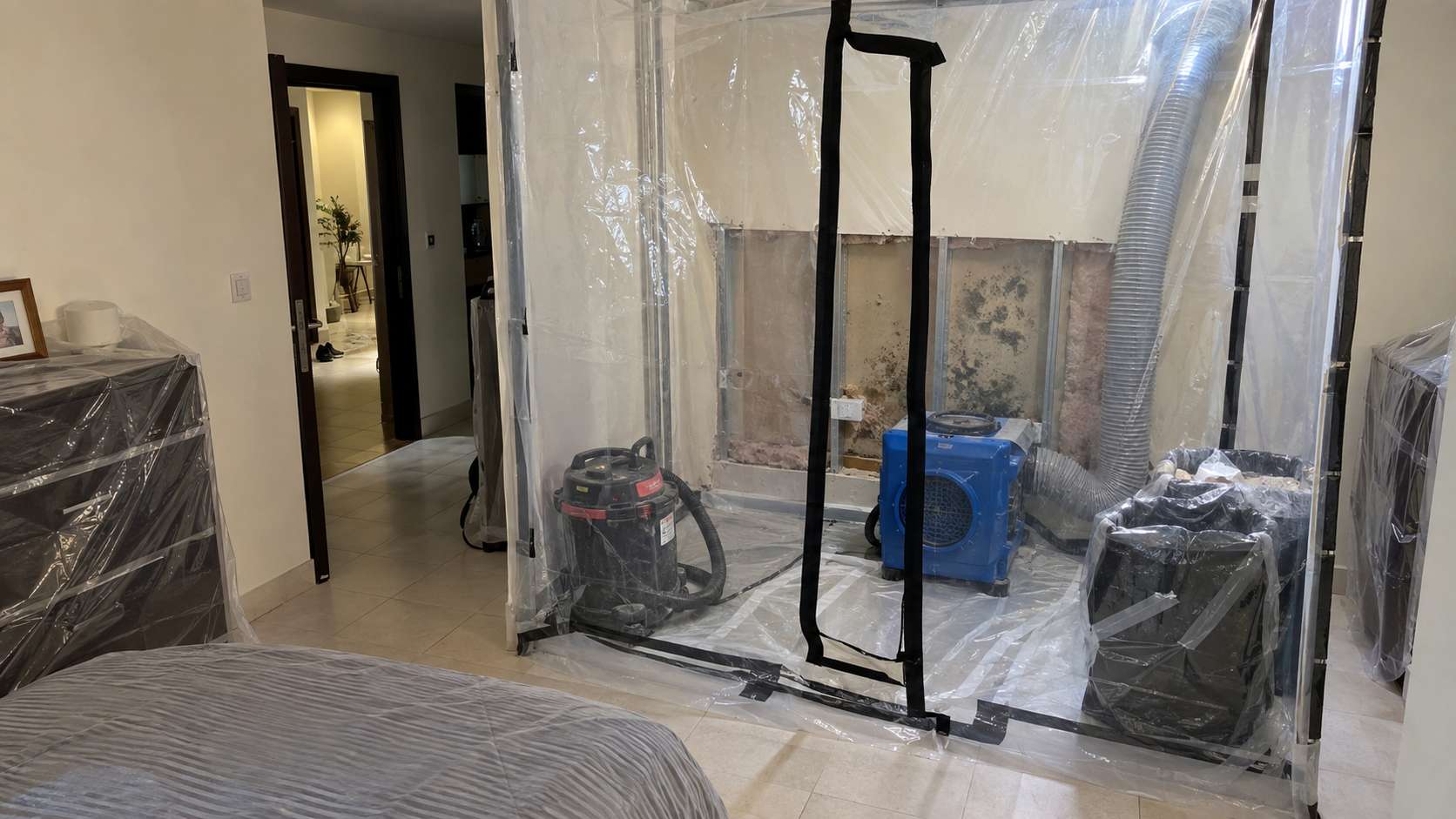
CDC guidance says that if you spend a lot of time removing moldy belongings or doing work like ripping out moldy drywall, you should wear a half-face or full-face respirator.
For serious drywall mold repair, professionals may use:
- Plastic containment
- Sealed work areas
- PPE
- Controlled removal
- Bagging of contaminated drywall
- HEPA vacuuming
- Negative air machines in larger jobs
- Proper disposal
- Post-removal cleaning
This is one reason professional repair costs more than normal patching. You are not only paying someone to cut and replace a wall section. You are paying for safer removal and less spread.
Fact 7: Long-Term Repair Means Mold Prevention, Not Just Wall Patching
Long-term drywall mold repair means preventing the same wall from becoming damp again. If you only patch the drywall but keep the same moisture condition, mold can return.
After repair, focus on prevention:
- Fix hidden pipe leaks quickly
- Service AC units and drain lines
- Check condensation around vents and ducts
- Improve bathroom ventilation
- Use exhaust fans after showers
- Keep furniture slightly away from walls
- Avoid drying laundry in closed rooms
- Use a dehumidifier in damp rooms
- Monitor humidity with a hygrometer
- Repair roof, balcony, or window seepage
- Do not repaint before the wall is fully dry
In UAE homes, this is especially important because humidity and AC use often work together. A cold wall, blocked airflow, and humid air can create condensation even without a major leak.
After drywall repair, monitor the area for at least a few weeks. Watch for new stains, musty smell, bubbling paint, damp patches, or mold returning in the same shape. Those signs mean the root cause may still be active.
The Bottom Line
Drywall mold repair is possible, but only when the mold is light, surface-level, dry, and caused by a moisture issue that has already been fixed. If the drywall is firm, painted, and not swollen, it may be cleaned, treated, primed, and repainted carefully.
But if the drywall is wet, soft, swollen, crumbling, musty, moldy from behind, or affected by a long leak, repair is usually not enough. The safer solution is to cut out the damaged section, remove contaminated material, dry the cavity, fix the source, and replace the drywall properly.
Do not treat drywall mold like a normal stain. Treat it like a moisture warning. Once you fix the water problem, you can decide whether the wall can be repaired or whether replacement is the smarter long-term move.