


Dettol Mould & Mildew Remover Review From Real User Patterns
Most public reviews are positive when people use Dettol Mould & Mildew Remover for the right job: bathroom mould, black spots on grout, orange stains in showers, mildew around taps, and dark marks on silicone sealant. A common review pattern is that users spray it, leave it for a few minutes, and see the stain fade without heavy scrubbing. Some reviewers describe black mould on grout or sealant turning much cleaner after one or two applications.
The biggest compliments usually sound like this:
- It works fast on bathroom mould stains.
- It makes grout look much whiter.
- It helps with black spots around baths and showers.
- It can reduce the need for hard scrubbing.
- It feels stronger than many ordinary bathroom cleaners.
That matches what we would expect from a bleach-based mould and mildew spray. Bleach can be very effective at lightening dark mould stains and killing surface-level microbial growth on suitable surfaces. So, when people say it “works before your eyes,” that is not surprising.
The less positive reviews usually point to three issues. First, the smell is strong. Many people mention a bleach-like smell and the need to open windows. Second, some stains need repeated treatment. Third, it may disappoint people who expect it to fix recurring mould permanently. If moisture keeps coming back, mould will usually come back too.
So, the review summary is simple: people usually love it when the mould is visible, surface-level, and bathroom-based. People get disappointed when the problem is deeper than a cleaning stain.
Our Hands-On View as a Professional Mould Cleaning Service
From a professional mould cleaning point of view, Dettol Mould & Mildew Remover is a good consumer product for small, visible, localised mould marks. It is not the same category as professional remediation, but it has a useful place.
In hands-on cleaning situations, products like this perform best when the affected area is small and the surface is smooth. Think bathroom tiles, glazed ceramics, chrome fixtures, white grout, shower trays, acrylic baths, and similar washable materials. Dettol’s own product information describes it as an active bleach mould and mildew remover, while retailer listings commonly position it for tiles, grout, chrome, stainless steel, bathrooms, and kitchens.
Where it shines is stain removal. A mould problem often has two parts: the living mould growth and the dark staining left behind. Bleach-based sprays are especially good at bleaching the stain, which is why the surface can look dramatically cleaner in a short time.
But in professional work, we don’t judge success only by appearance. We ask:

- Is the moisture source fixed?
- Is the mould only on the surface?
- Is the material porous or sealed?
- Is there hidden contamination?
- Is the smell gone after drying?
- Does the mould return after a few days or weeks?
That is where a consumer spray has limits. A bathroom corner can look clean today but still grow mould again if there is poor ventilation, wet sealant, leaking plumbing, trapped condensation, or moisture behind the surface.
So, our hands-on verdict is not “bad product” or “miracle product.” It is a strong surface cleaner. Use it for the correct problem, and it can perform very well. Use it as a replacement for investigation or remediation, and it may only hide the symptoms.
How Good Is Dettol Mould & Mildew Remover at Killing Mould?
Dettol Mould & Mildew Remover can be effective against surface mould because it contains active bleach. Public product information describes it as a powerful bleach formula, and Dettol’s own FAQ confirms that its Mould & Mildew Spray is one of the Dettol products that contains bleach.
For small bathroom mould, that can be enough. If the mould is sitting on the surface of tile, grout, or a shower area, the spray can help break down the visible growth and remove the dark staining. This is why many reviews are impressed by how quickly it improves the look of the surface.
However, “killing mould” in a practical home-cleaning sense is not always the same as “solving the mould problem.”
On non-porous surfaces, a bleach-based cleaner can contact the mould directly. That gives it a better chance of working. On porous or semi-porous surfaces, the situation is different. Mould can sit inside tiny gaps, cracks, grout pores, sealant edges, plaster, wood, drywall, and painted surfaces. In those cases, the spray may whiten the top layer without fully reaching the deeper contamination.
That is why you can see a clean-looking surface, then the same mould pattern returns later.
The product is good for:
- Fresh bathroom mould stains
- Mild black spots on white grout
- Mildew around shower corners
- Orange or pinkish bathroom residue
- Surface marks around taps
- Stained tile edges
- Small mould patches caused by normal shower humidity
It is less reliable for:
- Deep black staining inside old silicone
- Mould behind tiles
- Mould inside walls or ceilings
- Mould from leaks
- Mould on untreated wood
- Mould on fabric, carpet, or soft furnishings
- Large contaminated areas
- Persistent musty smell with no visible source
So, effectiveness depends heavily on where the mould is growing. If it is a surface stain, Dettol can be impressive. If it is a building moisture problem, Dettol is only a temporary cosmetic fix.
What People Usually Like About It
The most common positive review theme is speed. People like that they don’t need to scrub aggressively. They spray it, wait, rinse or wipe, and the surface looks cleaner. Some reviewers say it worked on grout or sealant they thought they would need to replace. Others mention shower stains fading in seconds or after a few minutes.
The second thing people like is convenience. It is a ready-to-use trigger spray, so there is no mixing, measuring, or special equipment needed. For a homeowner or tenant dealing with a small bathroom stain, that matters. You don’t always want a full cleaning setup just to treat a small mould mark near the shower.
The third positive point is confidence. Dettol is a familiar hygiene brand, so many buyers trust it more than unknown mould sprays. That trust does not automatically mean the product is suitable for every mould case, but it does explain why people reach for it.
In review patterns, it seems especially popular for:
- Shower grout
- Bath edges
- Silicone sealant
- Bathroom corners
- Tile stains
- Sink areas
- Damp bathroom patches
It also gets praise from people who compare it with ordinary bathroom sprays. That makes sense because ordinary bathroom cleaners may remove soap scum and dirt, but they may not lift black mould staining as aggressively as a bleach-based mould remover.
For light household use, the biggest benefit is visual transformation. It makes ugly mould stains look cleaner quickly. For many people, that is exactly what they want.
What People Usually Complain About
The most common complaint is the smell. Even positive reviewers often mention that the spray smells strong or bleachy. Some say you should open a window, ventilate the room, or leave the area after spraying. This is not a small detail. A strong bleach-based cleaner should be treated carefully, especially in small bathrooms with poor airflow.
The second complaint is that it can require a lot of product. For heavier mould staining, some users say they need repeated applications or a large amount of spray. That is a clue that the mould may not be only a light surface problem.
The third complaint is inconsistent results. Some people get dramatic results. Others say it barely helped. That difference usually comes down to the material and the depth of the problem. A spray can perform brilliantly on white grout but struggle on stained silicone, painted surfaces, porous grout, or mould that has been left for months.
There are also safety and surface concerns. Because it contains bleach, it may not be suitable for every material or colour. Bleach can discolor fabrics, damage some finishes, irritate skin, and create strong fumes. It should not be mixed with other cleaners, especially acidic cleaners or ammonia-based products.
So, the negative reviews do not necessarily mean the product is weak. Many complaints come from expecting too much from a consumer spray. It is designed for surface cleaning. It is not designed to inspect hidden mould, dry wet structures, replace contaminated sealant, fix leaks, or treat air quality problems.
In What Cases Dettol Mould & Mildew Remover Cannot Help at All
Dettol Mould & Mildew Remover cannot help when the mould problem is not really a surface cleaning problem. This is where many homeowners misunderstand mould.
If you have a small black mark in the shower corner, a spray may work. If you have a musty smell throughout the room, damp walls, recurring ceiling mould, swollen skirting boards, or mould after water leakage, the issue is bigger than a stain.
It cannot properly solve these cases:
Hidden mould behind walls or ceilings.
If mould is growing behind paint, drywall, wallpaper, cabinets, ceiling boards, or tiles, spraying the visible surface will not reach the real colony.
Mould caused by active leaks.
If a pipe, roof, AC drain, window frame, or waterproofing layer is leaking, the mould will keep coming back until the water source is fixed.
Porous contaminated materials.
Materials like untreated wood, gypsum board, carpet, insulation, fabric, and some old grout can hold mould deeper inside. A surface spray may clean the top but not the inside.
Large mould areas.
A small bottle spray is not a serious remediation plan for a large contaminated area. Large growth needs containment, safe removal, drying, and sometimes material replacement.
Recurring mould with poor ventilation.
If a bathroom has no exhaust fan, poor air movement, constant condensation, or high humidity, cleaning alone won’t stop regrowth.
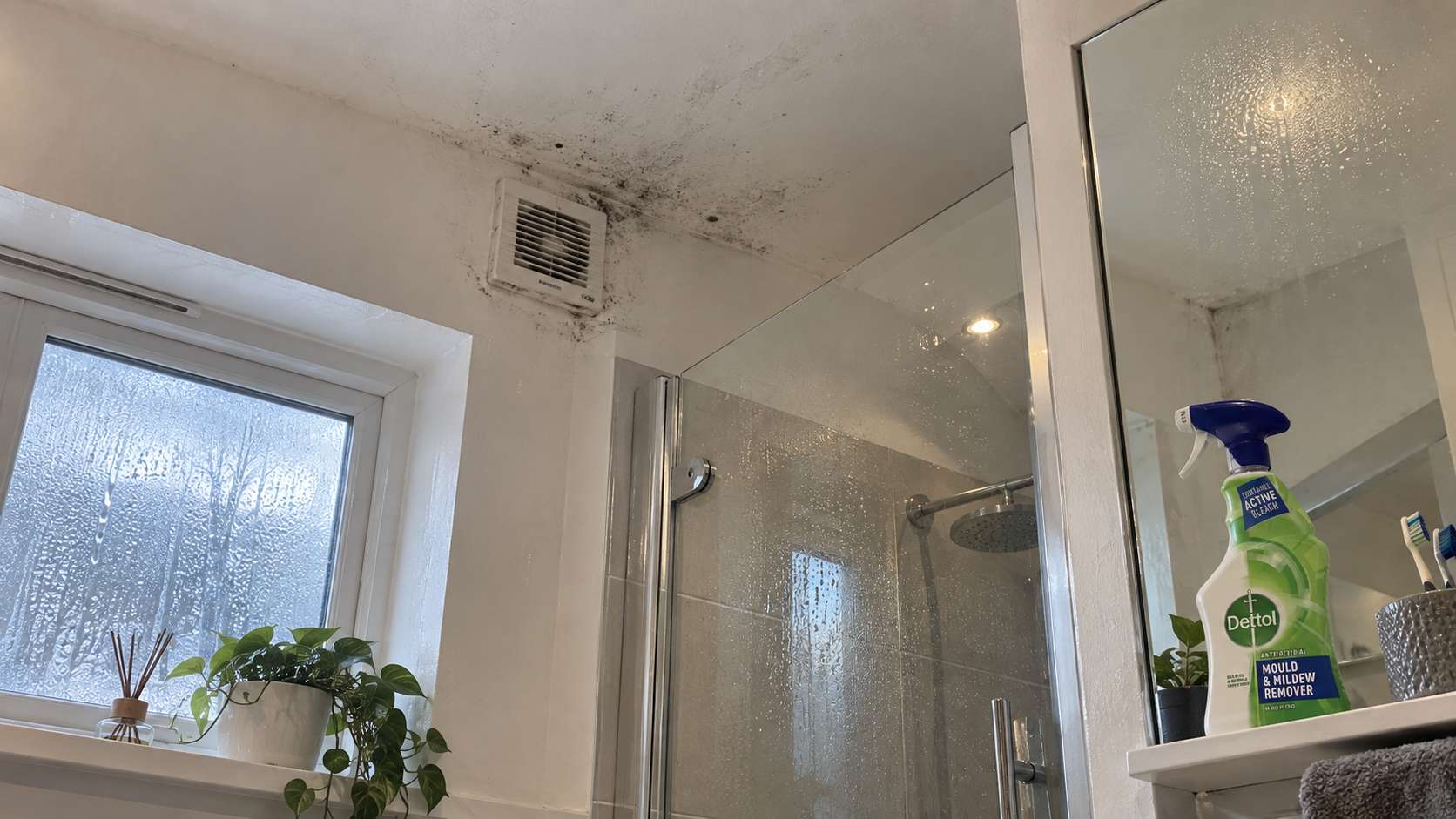
Mould-related odour.
A musty smell can come from hidden dampness or microbial growth in materials. A bleach spray may reduce a visible stain but fail to remove the source of the smell.
Sensitive health situations.
If someone in the property has asthma, allergies, immune concerns, or strong reactions around the affected area, it is safer to treat the issue more carefully instead of repeatedly spraying bleach in a closed room.
In these cases, the product may make the area look better for a while, but it cannot complete the job.
How We Would Use It Safely for Small Mould Spots
For a small bathroom stain, Dettol Mould & Mildew Remover can be part of a sensible cleaning routine. The key is to use it carefully and not overcomplicate the job.
A safe, practical approach would be:
- Ventilate the room before spraying.
- Wear gloves.
- Keep children and pets away from the area.
- Do not mix it with other cleaners.
- Spray only the affected surface.
- Leave it for the recommended contact time.
- Rinse or wipe according to the label instructions.
- Dry the area completely.
- Improve airflow so the same spot does not stay wet.
The drying part is more important than many people think. Mould loves moisture. If the area stays damp after every shower, it will eventually come back. So, after cleaning, wipe shower edges, open the window, use an extractor fan, or leave the bathroom door open when possible.
For silicone sealant, be realistic. If the black staining has penetrated deep into the sealant, the spray may only lighten it. Old mouldy silicone often needs to be removed and replaced. Spraying it again and again may make the bathroom smell harsh without truly restoring the sealant.
For grout, the product may work better visually, especially if the grout is light-coloured. But if the grout is cracked, missing, or constantly damp, cleaning is not enough. The grout may need repair or resealing.
Dettol Mould & Mildew Remover vs Professional Mould Cleaning
The difference between Dettol Mould & Mildew Remover and professional mould cleaning is not just “cheap vs expensive.” They are solving different levels of problem.
Dettol is for visible surface mould and staining. Professional mould cleaning is for identifying the cause, controlling spread, removing contamination correctly, and preventing recurrence as much as possible.
A professional service may check:
- Moisture levels
- Leak sources
- Condensation patterns
- AC or HVAC contribution
- Hidden mould areas
- Porous material damage
- Airflow issues
- Surface type and contamination depth
- Whether removal, treatment, or replacement is needed
That is why professional cleaning matters when mould keeps coming back. If the source is behind the wall, under flooring, inside cabinetry, or connected to AC moisture, no supermarket spray can properly diagnose that.
But that does not mean everyone needs to hire a mould service immediately. For a few small spots around a shower, Dettol may be a reasonable first step. Use it, dry the area, improve ventilation, and watch what happens. If the mould does not return, the issue was probably light surface growth.
You should consider professional help if:
- The mould keeps returning in the same place.
- The affected area is larger than a small patch.
- There is a musty smell but no obvious source.
- The mould appeared after a leak or flood.
- The wall, ceiling, cabinet, or flooring feels damp.
- The mould is on porous material.
- You see mould near AC vents or ducts.
- Someone in the property has health sensitivities.
- You already cleaned it several times and it keeps coming back.
Professional remediation is not always needed for a small bathroom stain. But it becomes important when the mould is a symptom of a bigger moisture problem.
The Bottom Line: Dettol Mould & Mildew Remover Final Verdict
Dettol Mould & Mildew Remover is a strong and useful surface cleaner for small mould and mildew stains, especially in bathrooms. Based on public review patterns, people usually like it because it works quickly, brightens grout, improves shower areas, and reduces the need for heavy scrubbing. Its active bleach formula explains why the visible results can look dramatic.
Our professional verdict is this: buy it for minor surface mould, but don’t rely on it for serious mould problems.
You probably don’t need a professional if the mould is small, visible, on a washable surface, and does not return after cleaning and drying. In that case, Dettol can be enough.
You do need professional help if the mould keeps coming back, spreads, smells musty, follows a leak, affects porous materials, appears near AC systems, or may be hidden behind walls, ceilings, cabinets, or flooring. In those cases, Dettol may clean the appearance, but it won’t solve the reason the mould exists.
So, the fair final verdict is: Dettol Mould & Mildew Remover is good for surface cleaning, not full mould remediation. Use it for the right case, and it can be genuinely impressive. Use it for the wrong case, and it may only bleach the warning sign while the real mould problem continues underneath.