


Can You Test Air Quality for Mold?
Yes, you can test air quality for mold by collecting indoor air samples and sending them to a laboratory. The lab can identify and estimate mold spores or mold-like particles present in the sampled air. This can help show whether the air contains signs of mold contamination, even when the mold source is not visible.
This is especially useful when a room smells musty, people feel worse in a certain area, or there has been water damage but no obvious mold patch. EPA notes that hidden mold may be suspected when a building smells moldy but the source cannot be seen, or when there is known water damage and occupants report health concerns.
However, air testing should not be treated like a simple pass-or-fail exam. Mold spores naturally exist indoors and outdoors. Finding mold spores in the air does not automatically mean you have a serious hidden mold problem. The key is the pattern: what types were found, how indoor samples compare with outdoor samples, and whether the results match the building’s moisture condition.
CDC and EPA both point out that there are no federal health-based standards for acceptable mold levels in indoor air. That means a lab report cannot simply say, “This number is safe” or “This number is unsafe” in the way people often expect.
So, yes, testing air quality can help reveal mold clues. But it works best as part of a proper mold investigation, not as the only evidence.
Can Air Quality Testing Reveal Hidden Mold?
Air quality testing can reveal hidden mold when the air contains an unusual amount or type of mold spores compared with normal indoor and outdoor conditions. For example, if outdoor air shows low mold activity but one indoor room shows higher mold spore counts, that may suggest an indoor source.
It can also help when certain mold types appear indoors in a way that does not match outdoor air. Outdoor mold normally enters buildings through doors, windows, clothing, shoes, and ventilation. Because of that, indoor and outdoor air will never be completely mold-free. But if an indoor sample is dominated by mold types that are not dominant outdoors, that difference can be meaningful.
Air testing may be useful in situations such as:
- A room has a musty smell, but no visible mold.
- Someone recently had a leak, flood, AC condensation issue, or roof seepage.
- Mold is suspected behind drywall, under flooring, above ceiling panels, or inside cabinets.
- Occupants report irritation, coughing, sneezing, or asthma flare-ups in one area.
- A building owner needs documentation before or after remediation.
- There is concern that mold particles may have spread through dust or airflow.
Still, a clean air test does not always mean there is no mold. Some hidden mold colonies do not release many spores into the room at the exact time of sampling. Spores may be trapped behind walls, sealed inside cavities, stuck to damp surfaces, or released only when airflow changes. EPA explains that air sampling gives information only for the moment when sampling took place, like a snapshot.
That is why air testing can suggest hidden mold, but it cannot always rule it out.
How Mold Air Quality Testing Works
Mold air quality testing usually works by pulling a measured amount of air through a sampling device. The particles in that air are captured on a cassette, slide, plate, or other collection media. A laboratory then examines the sample and reports the mold spores or fungal structures found.
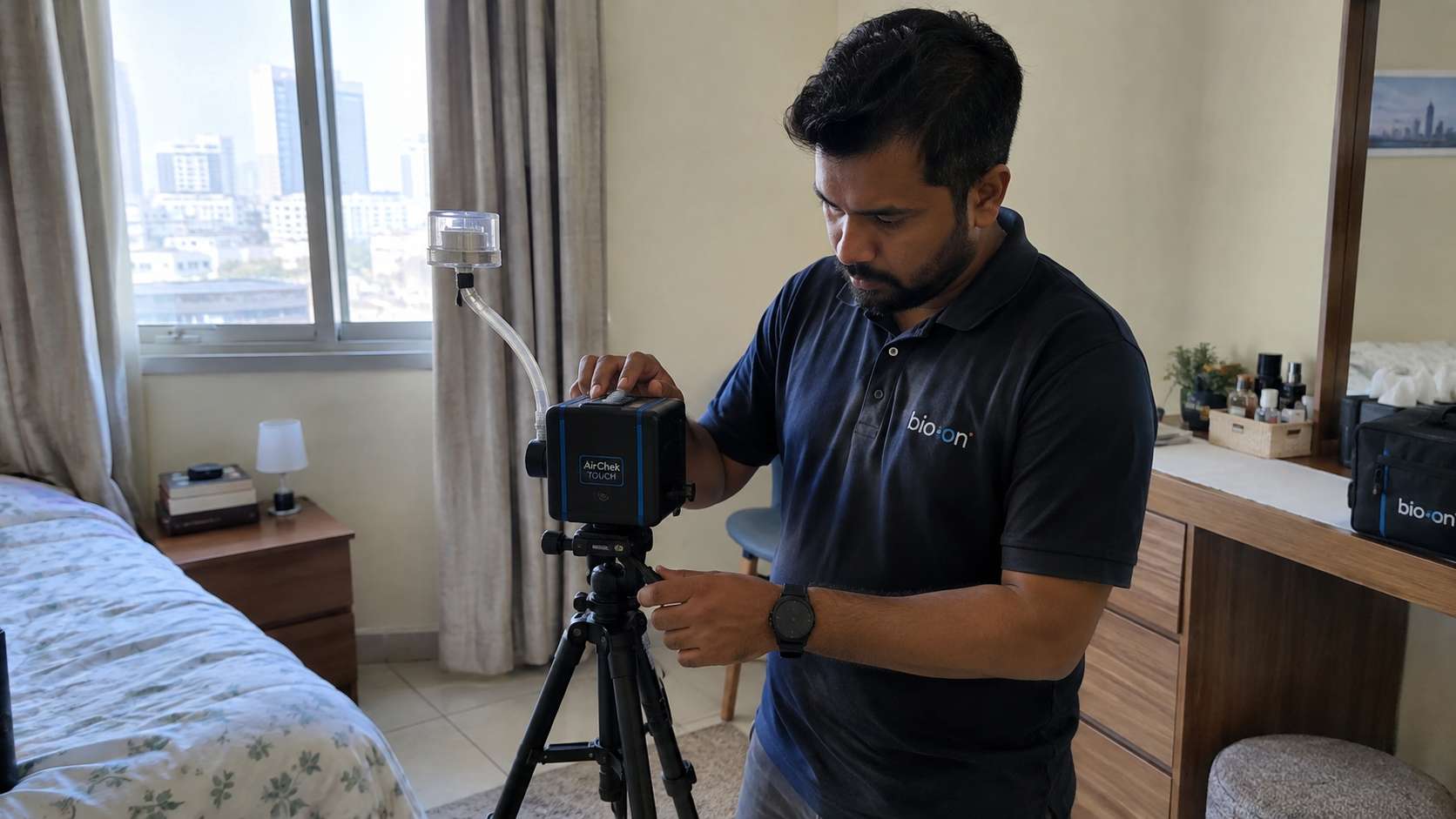
There are several common approaches.
Spore Trap Air Sampling
Spore trap sampling is one of the most common methods. A pump pulls air through a cassette, and airborne particles stick to a collection surface. The lab examines the sample under a microscope.
This method can detect many airborne spores, including spores that are alive or dead. That is useful because dead spores can still contribute to irritation or allergy-like reactions in some people. The limitation is that some spores are hard to identify down to exact species. The report may identify groups such as Aspergillus/Penicillium-like spores rather than one exact species.
Culture Sampling
Culture sampling attempts to grow viable mold spores on a medium. This can help identify living mold colonies more specifically. The weakness is that not all spores grow well in culture, and some dead or damaged spores will not appear even if they were present in the air.
Because of that, culture results can underrepresent the real amount of mold material in a space.
Surface and Dust Sampling
Although not air testing, surface and dust samples are often used together with air testing. A tape lift, swab, or dust sample can help identify mold on a material, inside settled dust, or on surfaces near suspected contamination.
This matters because mold exposure is not only about what is floating in the air at one second. Spores and fragments also settle into dust. When people walk, clean, open cabinets, run AC, or move furniture, that dust can become airborne again.
Moisture and Building Inspection
A good mold investigation should also include moisture meters, humidity readings, thermal imaging when appropriate, inspection of AC systems, and checks around plumbing, roofs, windows, wall cavities, and damp materials.
EPA notes that specialized tools such as moisture meters, borescopes, and special sampling techniques may help locate hidden mold areas.
This is often where the real answer comes from. Air testing may say, “There is a mold signal.” Moisture inspection helps answer, “Where is it coming from?”

What Air Testing Can and Can’t Tell You
Air testing can tell you what was present in the air sample at the time it was collected. It may show mold spore types, relative concentrations, and whether one room looks more contaminated than another. It may also support a bigger investigation when paired with outdoor baseline samples and non-complaint area samples.
But air testing cannot tell you everything.
It usually cannot prove:
- The exact location of hidden mold.
- Whether mold is inside a wall cavity unless particles are escaping.
- Whether a person’s symptoms are definitely caused by mold.
- Whether the building is “safe” based on one number.
- Whether mold will return after cleanup if the moisture source remains.
- Whether all mold has been removed from every hidden space.
This is where many homeowners, tenants, office managers, and property owners misunderstand mold testing. They expect the lab report to give a clear legal or medical answer. But mold air testing is more like forensic evidence. It needs interpretation.
For example, a bedroom sample may show elevated Aspergillus/Penicillium-like spores. That result may support a suspicion of indoor mold growth, but it does not automatically identify the source. It could be from damp drywall, AC dust, a moldy wardrobe, stored cardboard, carpet dust, or a nearby water-damaged area.
On the other hand, a normal-looking air test does not guarantee that hidden mold is absent. If the mold is behind sealed material or the room was not disturbed before testing, spores may not enter the air sample.
CDC says it does not recommend routine mold testing because results can be difficult to interpret, testing can be expensive, and there are no set standards for acceptable mold quantities in homes.
So the right question is not only, “What did the mold air test find?” It is, “Do the test results match the moisture evidence and the building symptoms?”
Signs You May Need Mold Air Quality Testing
You may consider mold air quality testing when you suspect mold but cannot find the source through normal inspection. It is most useful when there is a clear reason to investigate, not when you are simply curious.
Some common reasons include a persistent musty odor, unexplained staining, previous water damage, recurring allergy-like symptoms indoors, or moisture problems in areas that are hard to inspect. For example, if one room smells earthy every time the AC runs, but the walls look clean, air testing may help show whether the air contains unusual mold particles.
Testing can also help in larger properties, offices, clinics, gyms, restaurants, hotels, schools, and apartments where documentation matters. In these situations, you may need a clearer record of indoor air conditions, affected zones, and whether remediation changed the situation.
However, if you can already see mold, testing may not be necessary before taking action. Visible mold growth is already evidence of a moisture and mold problem. EPA says if visible mold is present, sampling is usually unnecessary; the mold should be removed and the moisture problem fixed.
Air testing becomes more useful when the situation is unclear, hidden, disputed, or complex.
You may also need testing after remediation, but only if it is part of a proper clearance process. Post-remediation verification should include visual inspection, moisture confirmation, cleaning quality, and sometimes air or surface sampling. Air testing alone should not be the only clearance method.
Can Air Testing Prove Mold Exposure?
Air testing can support evidence of possible mold exposure, but it usually cannot prove personal mold exposure by itself. A mold air test measures the air in a place at a specific time. It does not measure exactly what entered your body, how long you were exposed, or whether mold caused your symptoms.
This distinction is important. Building testing and medical diagnosis are different things.
A building test can show that the indoor environment has mold indicators. A doctor evaluates the person. That may include health history, symptom patterns, allergy testing when appropriate, lung function testing for asthma concerns, and other medical assessments. CDC notes that mold can cause irritation of the eyes, nose, throat, skin, or lungs, and can affect people with asthma or mold allergies, but diagnosis depends on medical and exposure history, examination, and appropriate medical tests.
In practical terms, air testing may help answer:
“Is there evidence that this room has abnormal airborne mold?”
But it cannot fully answer:
“Is mold definitely the reason I feel sick?”
That does not make air testing useless. It just means it should be used correctly. If test results show a strong indoor mold signal and the building has a history of leaks or dampness, that information can help guide investigation and remediation. If someone’s symptoms are serious or persistent, they should also speak with a healthcare professional.
How to Read Mold Air Quality Test Results
A mold air quality report usually includes mold types, estimated spore counts, sample locations, and sometimes comparison with outdoor air. The most useful interpretation comes from comparing patterns rather than staring at one number.
A proper report may compare:
- Indoor sample vs outdoor sample
- Complaint room vs non-complaint room
- Before remediation vs after remediation
- Normal background mold types vs unusual indoor dominance
- Air results vs moisture findings
- Air results vs visible damage or odor
For example, if the outdoor sample has mixed common outdoor spores and the indoor sample has a much higher concentration of one indoor-associated group, that may suggest an indoor reservoir. If a room has a musty odor and elevated spores compared with the rest of the building, that strengthens the suspicion.
However, you should be careful with reports that use fear-based language. A mold report should not panic you with dramatic labels. It should explain what was found, what the limitations are, and what further inspection or correction may be needed.
Also, be careful with companies that test first, interpret loosely, and then sell unnecessary remediation based only on scary numbers. Mold testing should answer a clear question. EPA advises that sampling should be conducted by professionals with specific experience in designing mold sampling protocols, methods, and result interpretation.
A good inspector should explain why each sample was taken. Random testing without a clear plan can create confusion instead of clarity.
What to Do If Air Quality Testing Suggests Mold
If air quality testing suggests mold, the next step is not to panic. The next step is to locate the moisture source and affected materials. Mold problems are solved by fixing moisture and removing contaminated materials or cleaning affected surfaces properly.
Start with the source. Look for leaks, condensation, AC drain issues, roof seepage, damp insulation, plumbing defects, poor ventilation, or high indoor humidity. If the source is not fixed, mold can return even after cleaning.
Then determine what is affected. Non-porous surfaces may sometimes be cleaned properly, depending on the extent of contamination. Porous materials like drywall, ceiling tiles, insulation, cardboard, and some wood-based products may need removal if mold has grown into them.
Containment is also important. Disturbing moldy materials can release spores and fragments into the air. This is why scraping, dry brushing, sanding, or demolishing moldy material without containment can worsen the spread. For small, simple surface issues, careful cleaning may be enough. For larger hidden mold problems, professional assessment and remediation are safer.
In offices, villas, apartments, restaurants, clinics, warehouses, and commercial spaces, professional help is often more appropriate because the mold source may involve HVAC, ceiling voids, wall cavities, or moisture movement across multiple rooms.
The goal is not only to make the air test look better. The real goal is to remove the source of contamination and prevent the building from becoming damp again.
The Bottom Line
You can test air quality for mold, and the results can reveal signs of hidden mold even when you cannot see mold spots. Air testing can detect airborne spores, compare indoor and outdoor patterns, and support a wider investigation when there is musty odor, water damage, occupant symptoms, or suspected hidden growth.
But air quality testing is not a complete answer by itself. It cannot always locate the mold source, prove personal illness, or guarantee that a building is safe based on one sample. Mold spores are natural in air, and there are no federal health-based standards that define one universal “safe” indoor mold number.
The best approach is to use air testing as one piece of evidence. Combine it with moisture inspection, visual checks, building history, surface or dust sampling when needed, and a clear plan to fix the moisture source. If the air test points to mold, the solution is not just more testing. The solution is finding why the building is damp, removing contaminated material correctly, and making sure the conditions that allowed mold to grow do not continue.