


How Serious Is Mold in a Wall AC?
Black mold in wall AC unit can range from a small maintenance problem to a reason to stop using the unit. Its seriousness depends more on location, extent, moisture, recurrence, and occupant health than on the growth being black, green, white, or another colour.
A mark limited to a removable filter or outer grille is easier to address than growth on the coil, blower wheel, drain pan, insulation, or wall cavity. In my professional experience, those deeper areas are harder to reach and sit in the path of moving air.
The concern rises when you notice any of the following:
- A musty smell appears or becomes stronger when the AC starts.
- Dark, fuzzy, spotted, or slimy material is visible behind the front cover.
- Growth returns shortly after the visible area is wiped.
- Water is pooling, dripping indoors, or staining the wall below the unit.
- The filter, coil area, fan, or internal insulation appears contaminated.
- People in the room develop coughing, wheezing, irritated eyes, or worsening asthma.
An air conditioner can move particles from contaminated components into the room. This does not make every dark spot a medical emergency, but contamination in the airflow path is more than ordinary surface dirt.
Does Black Colour Mean Toxic Black Mold?
No. Mold colour cannot reliably identify the species, show whether it produces mycotoxins, or predict how a person will react. Many indoor molds can appear dark, while the mold commonly called Stachybotrys chartarum is only one possible greenish-black species.
People often use “black mold” as a visual label rather than a laboratory identification. Dark material inside an AC may be:
- Mold or mildew growth
- Dust stuck to damp surfaces
- A mixture of dust and microbial film
- Soot or outdoor pollution deposits
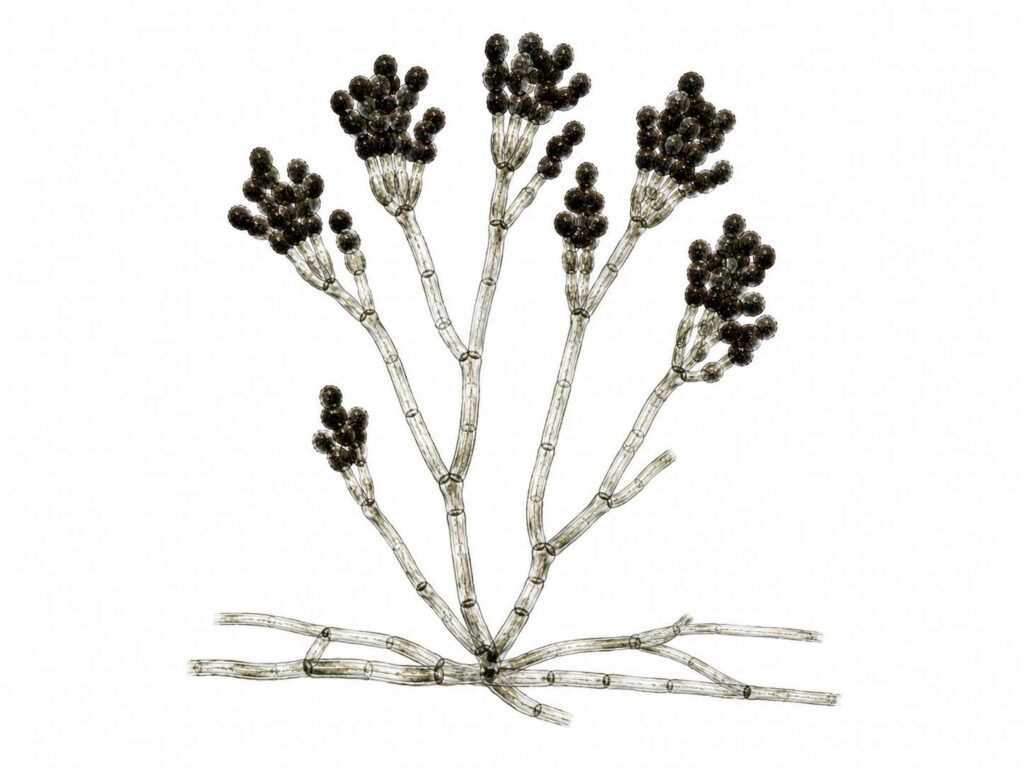
Appearance can bring questions and suspicions. But texture, smell, recurrence, and moisture give you more useful ideas than color alone.
True Stachybotrys usually grows on wet, cellulose-rich materials such as gypsum board, paper backing, or fiberboard and needs persistent moisture. The response is the same for confirmed Stachybotrys and other indoor mold: remove it safely and correct the moisture source. Public-health guidance does not recommend treating one colour as harmless and another as automatically toxic.
What Causes Mold Inside Wall AC Units?
Wall AC units naturally create condensation while cooling humid air. Mold becomes possible when that water does not drain or dry properly and combines with dust, skin particles, pollen, or other debris that has collected on filters and internal components.
This applies to wall-mounted split systems and through-wall or window-style units. Common causes include:
- A blocked or poorly draining condensate line
- A dirty filter or restricted airflow
- A contaminated evaporator coil or blower wheel
- Wet internal insulation
- Condensation around the wall opening
- Incorrect installation or drainage angle
Cleaning the visible mark without solving these conditions often leads to recurrence. Moisture control is the main fix; surface cleaning is only one part of it.
What Health Problems Can It Cause?
Common reactions include a blocked or runny nose, sore throat, coughing, wheezing, irritated eyes, or skin irritation. But often, indoor mold exposure can cause no noticeable effect in one person and allergy-like or respiratory symptoms in another.

That said, you need to pay closer attention when:
- Symptoms become worse in the room where the AC operates.
- Irritation starts soon after the unit is switched on.
- A child, older adult, asthmatic person, or immunocompromised person uses the room.
- Wheezing, breathing difficulty, fever, or persistent symptoms occur.
Severe breathing difficulty needs prompt medical care. Persistent symptoms should be discussed with a healthcare professional rather than explained through a home mold test. Public-health guidance notes that routine mold testing cannot determine how a specific person will respond.
How Can You Tell If It Is Mold?
You can judge it by whether the mark behaves like active growth. The strongest clues are a damp location, musty odour, irregular or fuzzy patches, repeated return, and visible moisture inside or around the unit.
Signs that make mold more likely include:
- Speckled colonies rather than an even layer of grey dust
- Fuzzy, powdery, or slimy texture
- Musty odour that appears when airflow begins
- Damp insulation, standing water, or a dirty drain pan
- Growth appearing on several internal surfaces
- Reappearance after the faceplate or grille was cleaned
Laboratory identification is rarely needed to decide that visible growth and moisture require attention. Testing may help distinguish mold from another material, but it should not delay correction of an obvious drainage or water problem.
What Should You Do After Finding It?
After finding it, stop using the AC until it is assessed. Cleaning only the front grille may leave the coil, blower, drain system, insulation, or wall cavity untreated.
Then, what you’re going to do next depends on where the material is found:
- Removable filter only: Replace a disposable filter or clean a washable one exactly as the manufacturer directs. Inspect the area behind it before restarting the unit.
- Outer plastic grille only: Cleanable hard surfaces may be addressed carefully after power is disconnected, but investigate why the area became damp.
- Coil, blower, fan housing, or drain pan: These parts need deeper AC servicing because incomplete cleaning can leave contamination in the system.
- Wet foam, fiber lining, or porous insulation: Replacement is often more reliable than surface treatment because moldy porous duct or HVAC insulation may not be effectively cleaned.
After cleaning or repair, the drainage and moisture fault must be corrected. Otherwise, the same dark growth is likely to return.
When Professional Inspection Makes Sense
Professional help is appropriate when the suspected contamination is inaccessible, repeatedly returns, involves porous material, or appears to extend into the wall. It is also sensible when the unit serves a vulnerable occupant or causes a strong odour whenever it operates.
For a better understanding of your issue and the solution, give our mold remediation professionals in the UAE a call.
A proper assessment should look beyond the visible mark. The technician may need to inspect the filter, evaporator coil, blower wheel, condensate pan, drain line, insulation, wall penetration, and nearby building materials.
Ask to see the affected components rather than accepting a claim that “the ducts are moldy” without evidence.
The goal is to remove contamination, restore drainage and airflow, and leave the area dry enough to prevent quick recurrence.
What Should You Focus on More?
Dark growth inside a wall AC deserves investigation, but black colour does not confirm “toxic black mold.” Focus instead on its location, moisture source, recurrence, extent, and who is being exposed in the room.
When contamination sits in the airflow path, or the unit repeatedly smells musty, stop relying on surface wiping and have the underlying drainage, condensation, or hidden moisture problem properly addressed.