


Mold Formation Starts When Moisture Stays Too Long
Mold formation starts when spores find a surface that stays damp long enough. Mold spores are naturally present in indoor and outdoor air, so the real trigger is not the arrival of spores. The trigger is moisture.
A dry wall with normal dust may hold spores without visible growth. But if that same wall stays damp from humidity, condensation, leakage, or trapped water, spores can begin colonizing the surface. Mold then feeds on organic material such as drywall paper, wood, dust, paint film, cardboard, fabric, insulation facing, or grime.
This is why mold commonly appears on:
- Bathroom ceilings
- AC vents
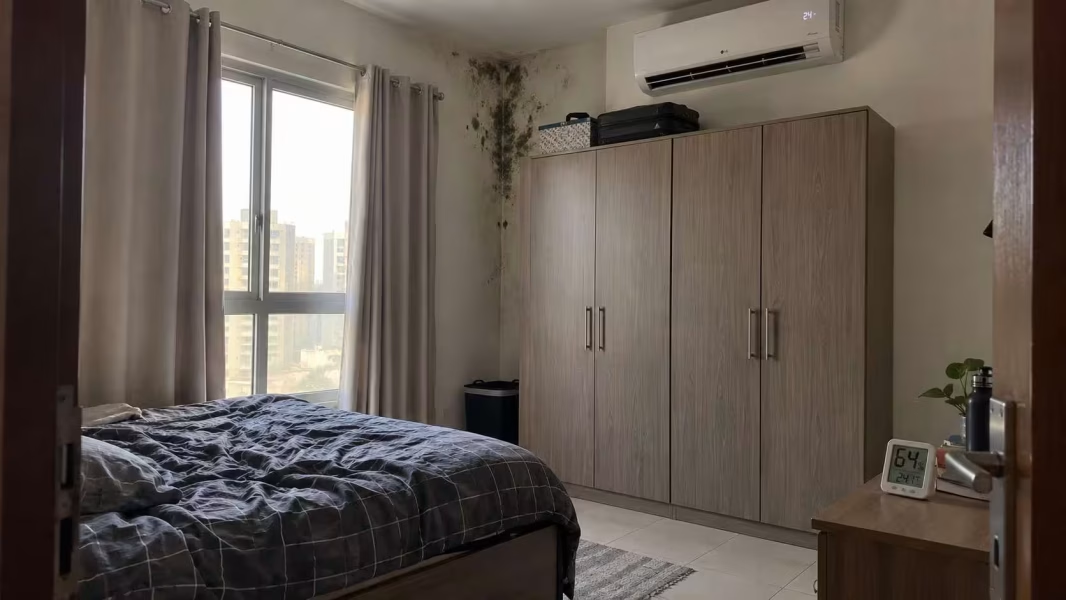
- Wardrobes against exterior walls
- Gypsum walls near leaks
- Window frames
- Kitchen cabinets
- Laundry areas
- Storage rooms
- Ceiling voids
- Duct insulation
- Behind furniture
- Under sinks
In the UAE, mold formation is often less about “dirty homes” and more about moisture imbalance. A villa, apartment, office, hotel room, clinic, or retail space can look clean but still have hidden mold if moisture is trapped behind surfaces.
EPA’s mold guidance explains that indoor mold growth should be prevented or controlled by controlling moisture indoors. It also recommends drying wet materials and preventing condensation by reducing moisture or increasing surface temperature.
So the scientific explanation is simple: mold formation is a biological response to a moisture condition. If you remove visible mold but leave the moisture, the biology has permission to restart.
Why Indoor Humidity Above 60% Is a Major Mold Trigger
Indoor relative humidity above 60% is one of the most common mold formation triggers because air itself can carry enough moisture to support damp surfaces. This does not always mean water is dripping. Sometimes the room simply stays humid long enough for mold to grow on cooler walls, dusty vents, furniture backs, and stored items.
Relative humidity measures how much water vapor is in the air compared with how much the air can hold at that temperature. Warm air can hold more moisture. Cool air holds less. When humid air cools near a cold AC vent, chilled wall, or poorly insulated ceiling, the air may reach its dew point and release water as condensation.
That is why a room can feel air-conditioned but still moldy. Cooling and dehumidifying are related, but they are not the same. An AC can cool the room quickly while failing to remove enough moisture, especially if the system is oversized, poorly maintained, short-cycling, leaking, or pulling humid outdoor air into the space.
EPA recommends keeping indoor RH below 60%, ideally 30% to 50%. CDC is even more conservative for homes, advising humidity no higher than 50% all day long.
In Dubai, this matters because many buildings run AC for comfort, not always for moisture control. If the thermostat is set very low but the air remains humid, cold surfaces can sweat. Once that condensation hits dust, gypsum board, wood, fabric, or duct lining, mold formation becomes much more likely.
A practical warning sign is repeated humidity readings above 60%, especially in bedrooms, wardrobes, storage rooms, bathrooms, and AC-cooled spaces with poor airflow.
AC Condensation and Mold Formation in Dubai
AC condensation is one of the biggest mold formation mechanisms in Dubai and the wider UAE. Air conditioning creates cold surfaces. When warm, moisture-heavy air touches those surfaces, water condenses. This can happen on evaporator coils, ductwork, vent grilles, chilled walls, drain pans, pipes, or ceiling spaces near AC lines.
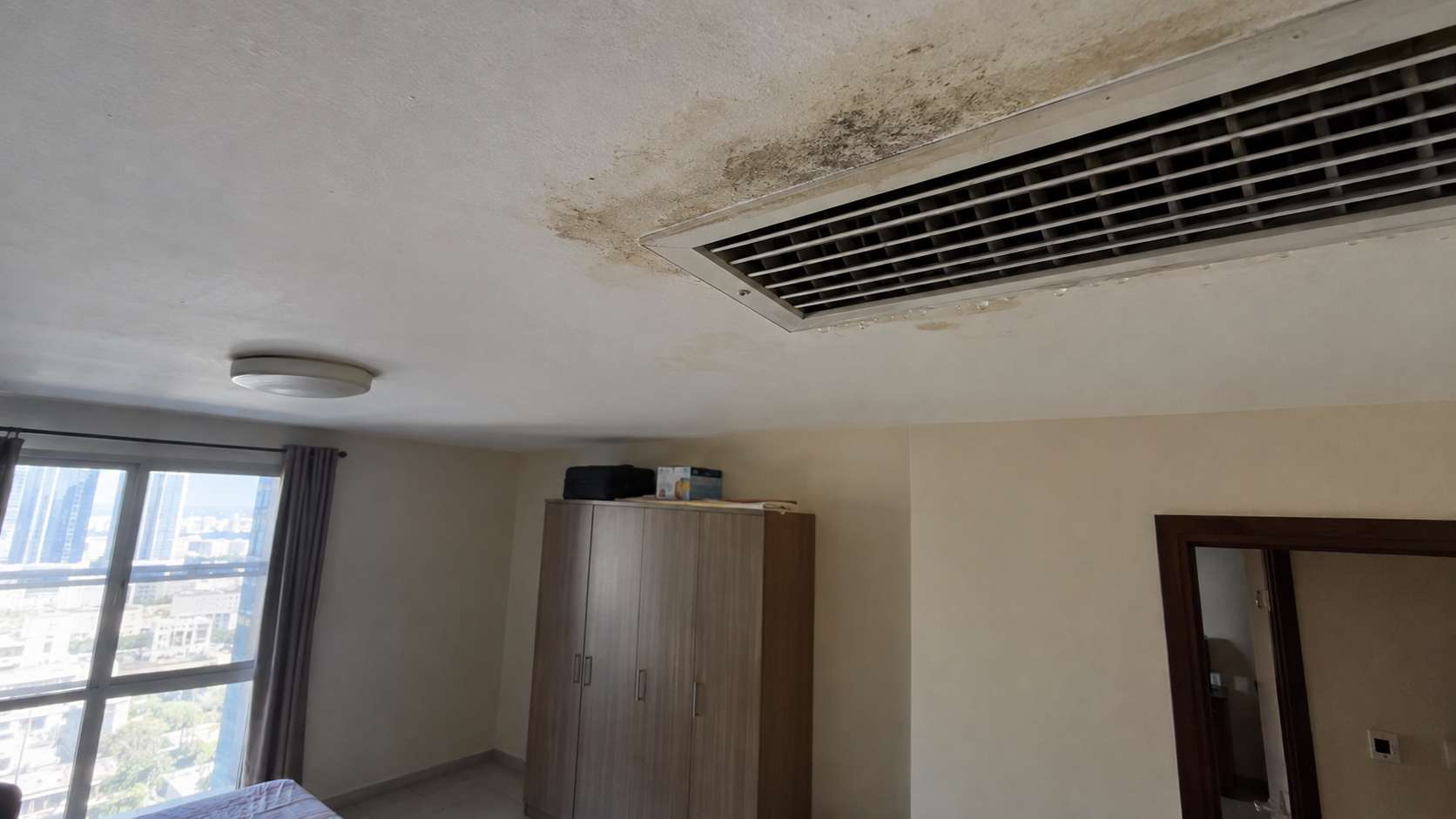
In a well-maintained AC system, condensation should collect and drain properly. But when the drain line clogs, the pan gets dirty, insulation fails, or humid air leaks into the duct system, moisture stays where it should not. Dust and organic debris inside the AC then become food for microbial growth.
That is why mold often appears around:
- Supply vents
- Return air grilles
- AC coils
- Drain pans
- Duct insulation
- Ceiling voids around AC pipes
- Closets near chilled walls
- Bedrooms with cold AC and poor airflow
Dubai’s climate makes this more likely because indoor spaces are cooled heavily while outdoor air can be hot and humid. UAE-focused indoor air quality sources describe condensation risk as a result of strong temperature differences between hot outdoor air and aggressively cooled interiors, especially where moisture-sensitive building materials are used.
The mistake many people make is thinking the AC prevents mold automatically. It can, but only when it removes moisture properly. If the AC cools without dehumidifying, leaks condensation, or spreads damp air through dirty ducts, it can become part of the mold formation cycle.

The fix is not just cleaning the vent. The system needs proper maintenance: clean coils, clear drain lines, insulated cold surfaces, sealed ducts, balanced airflow, and humidity monitoring.
Hidden Plumbing Leaks Feed Mold Behind Surfaces
Hidden plumbing leaks cause mold formation because they provide direct, continuous moisture. Unlike humidity, which may fluctuate, a pipe leak can keep one area damp for weeks or months. Mold can then grow behind walls, under cabinets, above ceilings, inside gypsum board, and under flooring before anyone sees it.
In UAE homes, hidden leaks often appear around:
- Bathroom walls
- Kitchen sink cabinets
- Laundry lines
- Water heater areas
- Ceiling spaces below bathrooms
- Pipe shafts
- AC condensate drains
- Balcony or terrace drainage points
The visible sign may be small: peeling paint, bubbling wall finish, brown stains, swollen skirting, a musty smell, or black spotting near a corner. But behind the surface, the material may already be wet.
CDC says mold grows where there is moisture, including around leaks in roofs, windows, or pipes, and advises fixing leaks so mold does not have moisture to grow.
This is why surface cleaning fails when the source is a hidden leak. You can wipe the wall today, but if the pipe keeps leaking inside the cavity, mold formation continues behind the paint. In some cases, the outside surface only shows a faint stain while the backside of the drywall or cabinet is heavily contaminated.
The correct sequence is investigation first, cleaning second. Use moisture meters, thermal imaging when appropriate, plumbing inspection, and controlled opening of suspicious areas if needed. Then fix the leak, dry the cavity, remove damaged porous materials, and only rebuild once the moisture is gone.
Poor Insulation Creates Cold Surfaces and Condensation
Poor insulation contributes to mold formation by creating cold surfaces where humid air can condense. This is common in AC-cooled UAE buildings because the temperature gap between inside and outside can be large.
Imagine an exterior wall facing hot humid air outside while the room inside is cooled strongly by AC. If insulation is weak, missing, compressed, poorly installed, or interrupted by thermal bridges, parts of the wall or ceiling can become cooler than surrounding surfaces. When humid indoor air touches those cold spots, microscopic condensation can form. Mold then grows on dust, paint, drywall paper, or nearby furniture.
Common places include:
- Exterior bedroom walls
- Corners near columns
- Ceiling edges
- Wardrobe backs
- Behind beds and headboards
- Around AC vents
- Pipe penetrations
- Concrete beams
- Poorly insulated duct routes
This is why mold often appears in neat patterns: along ceiling lines, wall corners, behind furniture, or near structural elements. Those patterns often reveal temperature differences, not random contamination.
EPA recommends preventing condensation by increasing surface temperature or reducing moisture levels. That is the exact science behind insulation-related mold control.
The fix may include improving insulation, sealing air gaps, moving furniture away from exterior walls, increasing airflow, reducing indoor humidity, and avoiding extreme AC temperature settings. If a wall keeps sweating because of thermal bridging, cleaning alone will not solve the root cause.
Why Mold Formation Is Common in Dubai and Other Emirates
Mold formation is common in Dubai and other UAE emirates because buildings face a unique moisture challenge: extreme outdoor heat, coastal humidity in many areas, sealed interiors, continuous AC use, and moisture-sensitive finishing materials.
The UAE also has many high-rise apartments, villas, offices, and commercial spaces with concealed AC systems, false ceilings, gypsum partitions, fitted wardrobes, and enclosed service areas. These designs can look clean and modern while hiding dampness in cavities. Once moisture enters a ceiling void or wall system, it may stay hidden until odor or staining appears.
Coastal emirates such as Dubai, Abu Dhabi, Sharjah, Ajman, and Umm Al Quwain can experience high humidity conditions, especially during summer and transitional periods. UAE-focused indoor air quality discussions often connect mold growth with temperature differentials, coastal humidity, high-rise construction, and extensive water infrastructure inside modern buildings.
The most common UAE mold formation scenarios are:
- AC condensation above ceilings
- Mold behind fitted wardrobes on exterior walls
- Bathroom exhaust problems
- Leaking AC drain lines
- Balcony waterproofing failure
- Plumbing leaks in pipe shafts
- Kitchen cabinet water damage
- High indoor RH despite cooling
- Moldy duct insulation
- Poorly dried water damage after leaks
Another UAE-specific issue is lifestyle. People may keep windows closed, run AC continuously, store items in wardrobes with low airflow, dry laundry indoors, or overcool rooms. These habits can increase local humidity or create condensation points.
So mold formation in the UAE is not surprising. It is the predictable result of moisture, cooling, building materials, and hidden cavities interacting.
The Science of Condensation, Dew Point, and Surface Mold
To understand mold formation properly, you need to understand condensation. Mold does not always need a visible leak. It can grow when moisture condenses repeatedly on a cool surface.
The key idea is dew point. Dew point is the temperature at which air becomes saturated and water vapor begins turning into liquid water. If humid indoor air touches a surface colder than the dew point, condensation can form. That surface may be an AC grille, chilled pipe, ceiling panel, exterior wall, duct, window frame, or concrete beam.
This is why two homes with the same room temperature can have different mold risks. A room at 22°C with low humidity may be fine. A room at 22°C with high humidity and cold wall corners may develop condensation and mold.
Mold formation often starts microscopically. You may not see water drops. A thin moisture film can be enough, especially on dusty or porous surfaces. Over time, the area darkens, smells musty, or develops visible colonies.
This is also why cleaning products alone cannot solve condensation mold. The mold is not forming because the surface forgot to be disinfected. It is forming because the surface repeatedly becomes damp.
To reduce condensation risk:
- Keep RH below 60%, ideally closer to 30%–50%.
- Avoid overcooling rooms.
- Improve airflow behind furniture.
- Insulate cold surfaces and pipes.
- Maintain AC drain systems.
- Use exhaust fans in bathrooms and kitchens.
- Fix air leaks that pull humid air into cooled spaces.
- Use dehumidifiers when AC does not control RH well.
How Mold Formation Progresses From Moisture to Damage
Mold formation often follows a predictable timeline. First, a surface gets damp. Then dust and organic residue hold moisture. Spores settle and begin growing. A musty odor may appear before visible mold. Finally, staining, surface damage, and material breakdown can happen.
On drywall, mold can feed on the paper facing. On wood, it may grow on the surface and in dust or cellulose. On AC components, it may grow on dust, biofilm, and wet surfaces. On concrete, it may feed on surface dirt, paint, or organic contamination rather than the mineral concrete itself.
Once mold is established, it can release spores, fragments, and microbial odors. CDC notes that people sensitive to molds can experience symptoms such as stuffy nose, wheezing, red or itchy eyes, or skin irritation. Mold exposure has also been linked with respiratory symptoms and asthma symptoms in people with asthma.
That does not mean every mold stain is a medical emergency. But it does mean visible indoor mold should not be ignored, especially in bedrooms, offices, clinics, nurseries, schools, or spaces used by people with asthma, allergies, or immune concerns.
If the moldy material is porous and wet, cleaning the surface may not be enough. CDC advises cleaning up mold and fixing the moisture problem, while EPA notes that absorbent materials may need removal when mold grows into spaces and crevices.
How to Stop Mold Formation Before It Returns
Stopping mold formation requires moisture control first, cleaning second, and prevention third. If you reverse that order, mold usually comes back.
Start with measurement. Use a hygrometer to monitor indoor RH in bedrooms, wardrobes, storage areas, bathrooms, and rooms with musty odors. If readings stay above 60%, investigate why. If the room feels cold but humid, the AC may not be dehumidifying properly.
Then inspect moisture sources:
- Roof and balcony leaks
- Plumbing lines
- AC drain pans and pipes
- Window condensation
- Bathroom exhaust fans
- Kitchen ventilation
- Exterior wall dampness
- Wardrobe backs
- Ceiling access panels
- Duct insulation
For small hard-surface mold, scrub with detergent and water, then dry completely. For wet porous materials, consider removal. CDC advises drying the home and wet items quickly after water events, and EPA emphasizes that mold cleanup is incomplete until the water or moisture problem is fixed.
For UAE properties, prevention often means regular AC maintenance, better condensate drainage, insulation checks, humidity control, and not blocking airflow with wardrobes or stored items. In villas and apartments, fitted furniture should not sit tightly against cold exterior walls without ventilation gaps.
If mold keeps returning, do not keep spraying it. Recurrence is evidence of an unresolved moisture source.
The Bottom Line
Mold formation is not random. It is the result of spores meeting moisture, suitable temperature, oxygen, and organic material. In Dubai and other UAE emirates, the most common drivers are indoor relative humidity above 60%, AC condensation, hidden plumbing leaks, roof or balcony leaks, and poor insulation that creates cold surfaces.
The science is straightforward: when humid air meets cool surfaces, condensation can form. When that moisture stays on dust, drywall paper, wood, insulation, or AC components, mold can grow. That is why UAE buildings can have mold even when they feel cold and air-conditioned.
The solution is not only cleaning. It is moisture control. Keep RH below 60%, ideally around 30%–50%. Maintain AC systems. Clear drain lines. Fix leaks. Improve insulation. Increase ventilation. Dry wet materials quickly. Remove moldy porous materials when they cannot be cleaned.
Once the moisture source is fixed, mold cleanup has a real chance of lasting. Without that, mold formation simply restarts in the same place.