


What Is 303 Mold & Mildew Cleaner Blocker?
303 Mold & Mildew Cleaner Blocker is a ready-to-use cleaning product made for mold and mildew stains. The brand’s own product page describes it as a cleaner that removes stains caused by mold and mildew, helps remove odors, does not contain bleach, and works on water-safe surfaces including vinyl and fabrics. It is sold in sizes such as 16 oz, 32 oz, and 1 gallon under the 303 product range.
That tells us a lot about what the product is meant to do. It is not marketed as a demolition-grade mold treatment for damaged walls. It is not a moisture repair solution. It is not a professional containment system. It is a cleaner for surfaces that can safely handle water-based cleaning.
This is why the product is popular in marine, outdoor, and recreational cleaning. Boat seats, covers, bimini tops, vinyl cushions, patio materials, RV surfaces, and other damp-prone items often develop mildew stains. People want something that can remove the dark marks without the strong smell or bleaching risk of traditional chlorine-based cleaners.
West Marine’s product listing gives a similar description: it says the cleaner removes mold and mildew stains from water-safe surfaces, helps remove odors, does not contain bleach, and is safe for surfaces such as vinyl, plastic, painted surfaces, and fabric.
So the product’s lane is pretty specific: surface cleaning and odor reduction on washable materials.
That is a useful lane. But it is not the same as solving a serious mold problem in a home, apartment, villa, office, or AC system.
What People Usually Say About It
The general review pattern is positive when people use 303 Mold & Mildew Cleaner Blocker for the right job. The brand’s review section shows a 4.0 out of 5 rating from 51 reviews. Several positive reviewers mention that it works well, is easy to use, performs well on boat materials, and does not smell as harsh as other products.
One common theme is easy stain removal. People using it on boat seats, bimini tops, vinyl, or mildew-prone outdoor materials often say the stains wipe off with less effort than expected. One reviewer said it took “very little elbow grease” to wipe mildew stains off boat seats, while another said it worked well on a bimini top.
Another common theme is lower odor compared with harsher cleaners. Some users like that it does not have the aggressive chlorine smell they associate with bleach products. The product itself is also promoted as bleach-free and fresh-scented, which lines up with those user comments.
People also seem to like the idea that it includes a “blocker” benefit. However, this is harder to judge from short-term reviews. One user said they were impressed with the cleaning performance but had not had enough time to properly test the blocker capability yet. That is an important point because prevention claims need time. You cannot fully judge a blocker after one afternoon of cleaning.
So, the review summary is pretty fair:
- People usually like it for vinyl, marine surfaces, outdoor fabric, and washable surfaces.
- They often appreciate that it is bleach-free.
- They like that it helps with odor.
- They tend to judge the cleaning effect faster than the blocking effect.
- Long-term prevention depends heavily on whether the surface stays dry afterward.
The only caution is that many reviews are from boat, RV, and outdoor-surface users. That does not automatically translate to serious indoor mold problems behind walls or inside AC systems.
Our Professional Hands-On View: How Effective Is It?
From a professional mold cleaning point of view, 303 Mold & Mildew Cleaner Blocker is a useful surface cleaner, not a complete mold solution.
Its effectiveness is strongest when the mildew is sitting on top of a water-safe surface. For example, if you have mildew staining on vinyl cushions, plastic outdoor furniture, washable boat covers, painted trim, or certain fabric surfaces, this kind of cleaner can make sense. It is designed for those jobs, and the reviews support that use case.
Where it works best:
- Vinyl boat seats
- Outdoor cushions
- Patio furniture
- RV surfaces
- Bimini tops
- Plastic surfaces
- Painted water-safe surfaces
- Washable fabrics
- Light surface mildew
- Musty surface odor
In these cases, the cleaner can reduce visible staining and freshen the surface. The bleach-free formula is also a practical advantage when the surface is more delicate or when the user does not want the strong fumes and discoloration risk of bleach.
But as professionals, we would not call this a deep mold treatment. Mold is not always sitting neatly on the surface. In buildings, mold often grows inside porous materials or behind visible finishes. If the moisture source is still active, the visible stain is only the symptom.
For example, if you spray 303 on a moldy drywall patch, the surface may look cleaner for a while. But if the back side of the drywall is wet, the paper facing may still be colonized. If the leak continues, the mold returns. The product did not fail. It was simply used for the wrong problem.
So our hands-on verdict on effectiveness is this: good for water-safe surface mildew, limited for true indoor mold contamination.
Our Professional Hands-On View: Does It Kill Mold?
This is where we need to be careful with wording. Many people search for a product like this because they want to “kill mold.” But in real mold cleaning, “killing” is not the only goal. Often, it is not even the most important goal.

For indoor mold, the goal is to remove the mold growth and the contaminated dust, then fix the moisture source so it does not return. Dead mold particles can still irritate sensitive people. A stain that has been chemically treated may still contain residue, fragments, or contamination if it was not physically removed.
303 Mold & Mildew Cleaner Blocker is marketed around cleaning stains, helping remove odors, and working on water-safe surfaces. It is also identified in the safety data sheet as a liquid mixture, with handling guidance such as good ventilation, gloves, safety glasses, and respiratory protection if ventilation is insufficient.
That tells us it should still be treated as a cleaning chemical, not a casual room spray.
For surface mildew, it may do a good job reducing the visible problem. But if someone asks, “Can this kill mold inside my wall?” the answer is no. It cannot reach hidden growth behind tile, inside drywall paper, under carpet backing, inside insulation, or inside HVAC components.
This matters because many people over-focus on the word “kill.” They think if a cleaner kills the organism, the job is done. But professional mold work is more about:
- Finding moisture
- Stopping water intrusion
- Removing contaminated material
- Cleaning settled spores and fragments
- Drying the area
- Preventing recurrence
A surface cleaner can be part of that process for the right surface. It cannot replace the process.
Where 303 Mold & Mildew Cleaner Blocker Makes Sense
303 Mold & Mildew Cleaner Blocker makes sense when the affected item is water-safe, structurally sound, and only has surface mildew or odor. This is why it is so commonly associated with marine and outdoor surfaces. Boats, RVs, and patio materials often get mildew from moisture exposure, but the materials are often washable.
Good use cases include:
- Boat seats with surface mildew stains
- Bimini tops with mildew marks
- Outdoor fabric that can safely be wet-cleaned
- Vinyl cushions
- Plastic chairs
- Patio storage covers
- RV upholstery
- Painted surfaces that tolerate water-based cleaning
- Light mildew smell on washable materials
- Maintenance cleaning before applying protective products
It is also useful when you want to avoid bleach. Bleach can lighten stains quickly, but it can also damage colors, weaken some fabrics, irritate breathing, and leave a harsh smell. A bleach-free product can be a better fit for delicate surfaces, especially where appearance matters.
Another good use case is after cleaning and drying an item that tends to get mildew repeatedly. The “blocker” concept is more valuable when the item is stored properly afterward. For example, if you clean a boat cushion, dry it fully, improve storage ventilation, and reduce moisture, the blocking effect has a much better chance of helping.
But if you clean the cushion and put it back into a damp closed compartment, the mildew may come back. No cleaner can overcome bad storage conditions forever.
In What Cases It Cannot Help at All
303 Mold & Mildew Cleaner Blocker cannot help when the actual problem is hidden, structural, porous, or moisture-driven. This is the most important part of the review for homeowners.
It cannot solve:
- Active water leaks
- Roof seepage
- AC condensation problems
- Wet drywall
- Mold behind walls
- Mold behind wallpaper
- Mold under carpets
- Mold inside insulation
- Moldy ceiling tiles
- Mold inside AC ducts
- Mold around wet HVAC components
- Musty odor from hidden cavities
- Flood-damaged materials
- Recurring mold caused by high humidity
- Soft, swollen, or crumbling building materials
EPA guidance says mold cleanup should include fixing the water problem, and absorbent or porous materials such as ceiling tiles and carpet may have to be thrown away if they become moldy. EPA also advises professional guidance when there has been a lot of water damage or the moldy area is more than about 10 square feet.
That is exactly where a product like 303 reaches its limit. It can clean surfaces, but it cannot determine moisture content behind a wall. It cannot remove mold embedded in drywall. It cannot set up containment. It cannot HEPA-clean an affected room. It cannot stop condensation from an AC duct.
It also cannot make a medically sensitive home safe by itself. If someone in the home has asthma, chronic respiratory disease, strong mold allergy, or weakened immunity, cleanup decisions should be more cautious. CDC notes that some people are at higher risk of significant or severe health effects from mold exposure, including people with asthma, COPD, or weakened immune systems.
So, if the issue is a mildew stain on a boat seat, this product may be helpful. If the issue is a damp apartment wall with recurring mold, it is not enough.
Our Professional Hands-On View: Application Mistakes
The biggest mistake is using 303 Mold & Mildew Cleaner Blocker as a shortcut for proper cleaning and drying.
People often spray a moldy area, wipe the surface quickly, and assume the problem is gone. But mildew and mold usually return when moisture, dirt, and poor airflow remain. The product can help with the visible surface, but it cannot change the environment.
Common mistakes include:
- Using it on non-water-safe materials
The product is described for water-safe surfaces. If the material should not be wet-cleaned, test first or avoid using it. - Cleaning without drying
Any mildew cleaner works better when the surface is dried fully afterward. Moisture left behind invites the same problem back. - Treating porous building materials like vinyl
Vinyl is different from drywall, carpet backing, ceiling tile, and insulation. Porous materials can hold growth deeper inside. - Ignoring odor source
If the smell is coming from AC vents, damp walls, or hidden mold, cleaning one visible item will not solve the room odor. - Using it without ventilation
The safety data sheet recommends good ventilation during handling and PPE such as gloves and eye protection. If ventilation is poor, respiratory protection may be needed. - Expecting the blocker to fix damp storage
If cushions, covers, shoes, or fabrics are stored in a humid closed area, mildew can return.
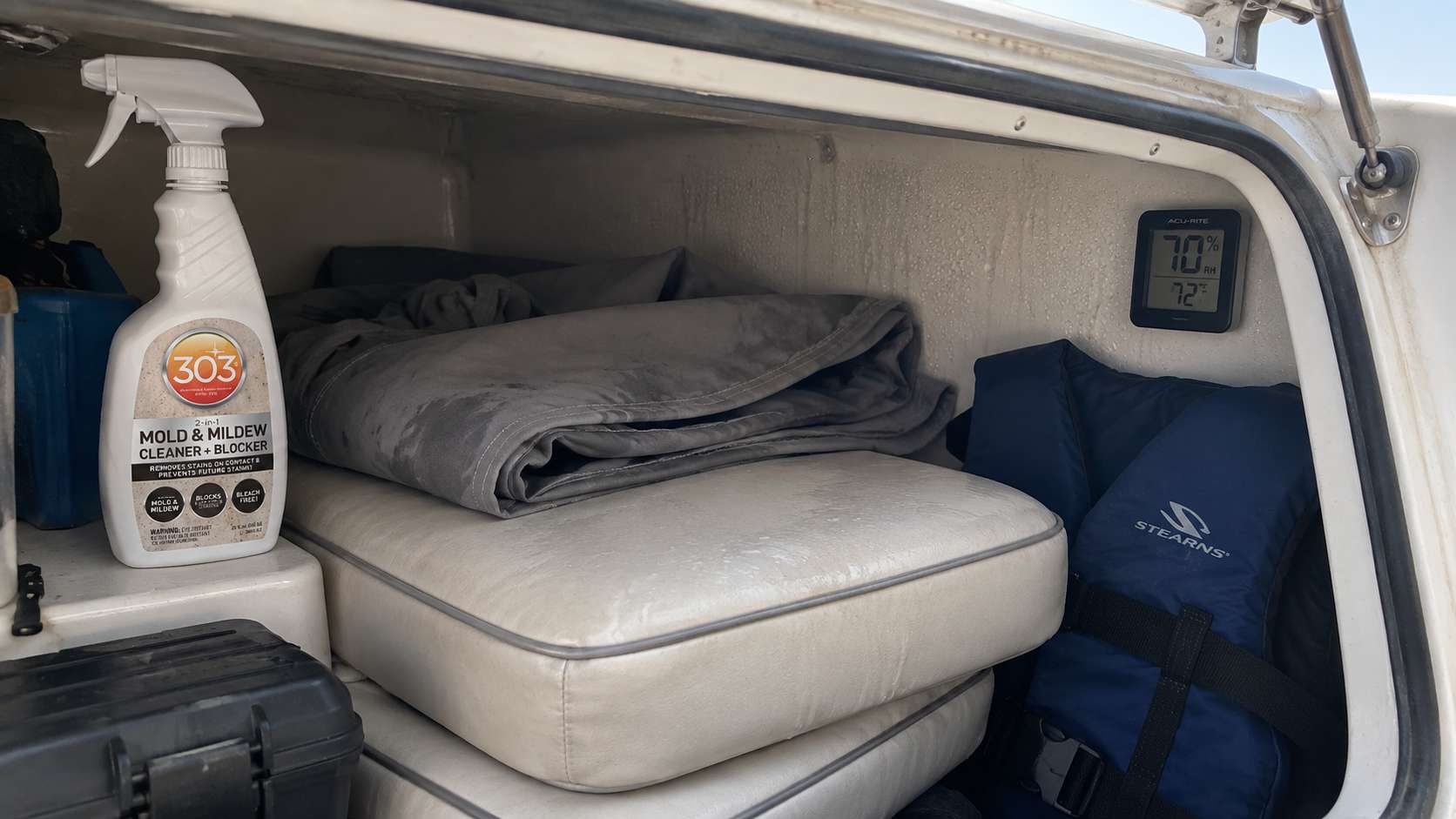
Our practical advice is simple: use it like a cleaner, not like a building repair system.
Is It Safe to Use Indoors?
303 Mold & Mildew Cleaner Blocker may be used on appropriate water-safe surfaces, but it should still be handled carefully. “Bleach-free” does not mean “no precautions.” It is still a cleaning chemical.
The safety data sheet identifies the product as a mixture and says to use it per label directions. It also lists first-aid measures such as moving a person to fresh air after inhalation exposure, washing skin with water after skin contact, and rinsing eyes with water after eye contact.
For ordinary users, that means:
- Read the label before use.
- Test a hidden area first.
- Wear gloves.
- Avoid spraying near your face.
- Ventilate the room.
- Do not use it on surfaces that are not water-safe.
- Keep it away from children and pets during cleaning.
- Rinse cleaned areas when needed.
- Do not mix it with other cleaning chemicals.
This is especially important in bathrooms, boats, storage rooms, and small indoor spaces where air movement is limited.
If someone has asthma, strong chemical sensitivity, or breathing issues, they should be extra careful with any cleaning spray. Sometimes the cleaning chemical itself can irritate breathing, even when the product is doing its job.
Final Verdict: Do You Need a Professional or Not?
You probably do not need a professional if the issue is small, surface-level mildew on a water-safe material. For example, 303 Mold & Mildew Cleaner Blocker makes sense for vinyl seats, outdoor cushions, boat covers, plastic surfaces, washable fabrics, and light musty stains where the material is still solid and dryable.
You should consider a professional if the mold or mildew:
- Keeps coming back
- Covers a large area
- Smells strong or hidden
- Appears on drywall, ceiling tiles, carpet, or insulation
- Follows a leak or flood
- Shows up around AC vents
- Affects multiple rooms
- Comes with bubbling paint, soft walls, or water stains
- Is affecting someone with asthma, allergies, or immune concerns
- Needs documentation for a landlord, insurer, or property manager
The final verdict is this: 303 Mold & Mildew Cleaner Blocker is a good specialty cleaner for mildew stains on water-safe surfaces, especially marine, RV, outdoor, vinyl, and fabric uses. But it is not a complete solution for serious indoor mold problems.
If the problem is on the surface, clean it, dry it, and improve storage or ventilation. If the problem is inside the building, behind materials, or caused by ongoing moisture, hire a professional before the damage spreads.